Launch offer

30 days free, then $15/mo flat

unlimited ASINs · all marketplaces · all 20+ alerts

Start free — claim $15/mo flat →

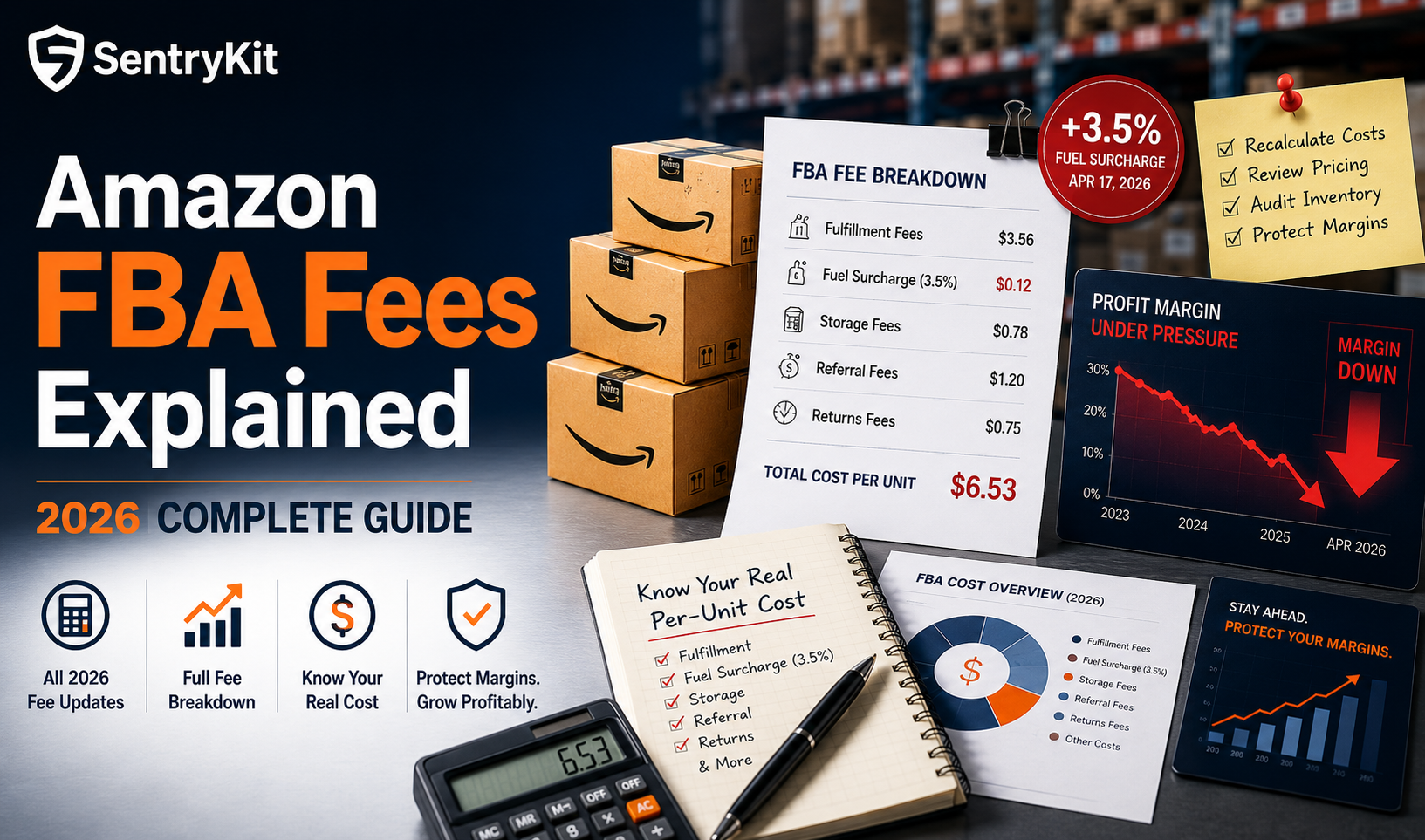
Amazon’s 2026 FBA fee changes are reshaping seller margins faster than most realize. This guide breaks down the latest fulfillment, storage, and low-inventory fees, the hidden costs sellers often overlook, and practical ways to reduce unnecessary charges while protecting profitability on Amazon.

Amazon Seller Central Passkeys: What They Protect
Blog

Amazon Seller Central Passkeys: What They Protect

Amazon is rolling out passkeys to every Seller Central account this July — a real fix for credential phishing. But passkeys only guard the login screen. They won’t catch a Buy Box hijack, a fraudulent brand claim, or a listing Amazon changes on its own. Here’s the gap sellers still need to watch.

Read More
Google's UCP Hits AI Mode: Should Sellers Care?
Blog

Google’s UCP Hits AI Mode: Should Sellers Care?

Google’s Universal Commerce Protocol just went live inside AI Mode search, letting shoppers buy directly from results with no storefront involved. It’s limited to a couple of retailers, and Amazon isn’t one of them yet. Here’s why sellers should watch this closely, not react to it.

Read More
Amazon Brand Registry Trademark Fraud, Explained How to Monitor Amazon Competitor Prices in Real Time Nisha Shetty July 26, 2026 10:49 am Amazon Brand Registry Trademark Fraud, Explained Table of Content How the Fraud Actually Works Why This Is a Different Layer Than Attribute-Level Hijacking What You Can Do Before It Happens What You Can Do If It Happens to You Where SentryKit Fits — and Where It Doesn’t Subscribe for Offers & Amazon Selling Insights Email Email Most Amazon sellers picture a hijack as something loud. A competitor undercuts your price. An unauthorized seller shows up on your listing. You lose the Buy Box and you notice within minutes because your dashboard tells you so. This fraud pattern doesn’t look like that at all. It looks like paperwork. A trademark filing here, a Brand Registry enrollment there, a routine-looking Report a Violation notice weeks later. Nothing about it resembles a hijacker undercutting your price, which is exactly why sellers don’t watch for it — and by the time a suspension notice lands in your inbox, the fraudulent registration behind it may already be months old. Legal and industry sources, including analysis published by Kohrman Jackson & Krantz and JD Supra in June 2026, report a growing pattern where bad actors file trademark applications for brand names that are already in active commercial use by someone else — a legitimate seller who built the brand but hadn’t registered the mark yet, or registered it more slowly. This isn’t a fringe theory: Amazon itself has filed federal lawsuits against participants in schemes that use fraudulently obtained trademark registrations to gain Brand Registry access and then weaponize it against legitimate sellers. When the platform is suing over the pattern, it’s past the point of being a rumor. Here’s how it turns into a real threat to your listings. How the Fraud Actually Works The mechanism has three steps, and each one is legal-looking on its own. That’s what makes the pattern hard to catch. A bad actor files first. Trademark registration in some jurisdictions goes to whoever files first, not necessarily whoever used the mark first in commerce. If you’ve been selling under a brand name for a year but never filed the trademark application, a bad actor can file for that same name and — if nobody contests it in time — walk away with a technically valid registration. The registration doesn’t ask “who built this brand.” It asks “who filed the paperwork.” Picture a private-label seller who spent two years building real sales history under a brand name before finally getting around to registering the trademark. That’s not an edge case — it’s the exact profile this fraud pattern is built to exploit. That registration buys Brand Registry access. Amazon Brand Registry enrollment, per Amazon’s own Seller Central program guidance, is built around a registered trademark as the qualifying credential. A fraudster holding a newly issued registration — even one obtained on a brand name they didn’t build — can enroll in Brand Registry and come out the other side looking like a verified, legitimate rights holder. Amazon’s systems have no way to know the registration was filed opportunistically against an existing seller’s brand. The fraudster reports you. With enrollment in hand, the bad actor files a Report a Violation or infringement claim against your listings — the real, original seller’s listings. From Amazon’s side, this looks like a straightforward brand-protection dispute: a verified Brand Registry claimant asserting rights against a seller who doesn’t hold the matching registered trademark. Amazon can suspend or remove your listings while the dispute gets sorted out, even though you’re the one who actually built the brand. Here’s what that looks like in practice: you get a policy notice citing intellectual property infringement, your listing goes dark, and you’re left proving a negative — that you’re the real owner — against someone holding a registration certificate that says otherwise. Where, in any of that, did you do something wrong? Why This Is a Different Layer Than Attribute-Level Hijacking If you’ve read Unauthorized Brand-Name and ASIN Changes: The 2026 Hijack Vector Nobody’s Watching, you already know Amazon listings can be quietly hijacked by editing the brand-name attribute field on an existing ASIN — no new trademark, no Brand Registry involved, just a backend field getting changed out from under you. This is a different problem sitting one level above that. Attribute manipulation touches a single listing’s metadata. Trademark and Brand Registry fraud touches your legal standing across your entire catalog — every ASIN tied to that brand name is exposed once someone else holds the registration and the enrollment. Same broader pattern of a silent, administrative-looking hijack. Different mechanism, different scope, different fix. What You Can Do Before It Happens The fix here starts months before any dispute, not during one. Register your trademark as early as possible. If you’re selling under a brand name, the gap between “using the name” and “having it registered” is the exact window this fraud pattern exploits. Don’t treat trademark registration as something to get to eventually. Watch for filings that resemble your brand name. USPTO and WIPO trademark watch services flag new applications that are identical or confusingly similar to a mark you specify, which gives you a window to oppose a bad-faith filing before it’s granted. This falls outside SentryKit’s data — SentryKit doesn’t monitor trademark filings, USPTO applications, or Brand Registry enrollment status — so a dedicated trademark watch service is the right tool for this specific step, not a Buy Box intelligence platform. Keep your own enrollment current. If you’re already Brand Registry-enrolled with your own registered trademark, you’ve closed most of this door. The exposure is highest for sellers who built a recognizable brand before formally registering it. That covers prevention. Here’s the part that matters once prevention has already failed. What You Can Do If It Happens to You If a listing goes down over an infringement claim you believe is fraudulent, speed and documentation both matter. Don’t wait to respond. Amazon’s dispute process has a clock. Gather proof of your own prior use — invoices, packaging dates, advertising history, anything that predates the fraudulent filing. Consider consulting a trademark or Amazon-focused attorney. The specific counter-filing and dispute strategy depends on your jurisdiction and the exact claim, and that’s a legal-strategy call worth getting professional input on rather than guessing at. Know the moment your listing actually goes dark. This is where the injustice compounds if you’re not paying attention. A bad-faith claim succeeding is one problem. Not finding out about the resulting suspension for days is a second, entirely avoidable problem stacked on top of it. Where SentryKit Fits — and Where It Doesn't To be direct about scope: SentryKit does not monitor trademark filings, USPTO or WIPO applications, or Brand Registry enrollment status, and it can’t warn you that a fraudulent registration is being filed or that a claim is coming. None of that is in SentryKit’s data. What SentryKit does track is what happens to your listing once a claim like this succeeds. If your listing gets suppressed as a result — Amazon pulls the Buy Box entirely and no Buy Box exists on the listing anymore — SentryKit’s Listing Suppressed alert fires the moment it happens, whatever the underlying cause. If the outcome instead leaves your listing live but with a competitor holding the Buy Box, the Buy Box Lost alert covers that case. Either way, you’re not finding out from a customer complaint or a sales dashboard three days later. That gap between when a bad-faith claim takes effect and when you find out is pure lost revenue on top of an already unfair situation, and closing it is squarely SentryKit’s job. For the broader toolkit around brand protection — trademark watch services, Brand Registry setup, listing monitoring, and where each tool’s responsibility starts and ends — Best Amazon Brand Protection Software 2026 — Ranked and Compared walks through the full stack. And if you want the fuller picture of what Brand Registry does and doesn’t cover on its own, What Amazon Brand Registry Protects — and the 5 Things It Doesn’t is worth reading — this fraud pattern is arguably a sixth gap in that list. Takeaway: Registering your trademark early and watching for copycat filings is the prevention layer. Getting alerted the second a bad-faith claim actually costs you your listing is the detection layer. You need both — neither one covers the other’s job.
Blog

Amazon Brand Registry Trademark Fraud, Explained

A bad actor can file a trademark on your brand name, enroll in Amazon Brand Registry, and get your real listings suspended — and it looks nothing like a typical hijack. Here’s how the fraud pattern actually works, what you can do to prevent it, and why SentryKit’s role starts only after a claim already succeeds.

Read More
Amazon Bid+ Multiplier: What It Does, What It Misses
Blog

Amazon Bid+ Multiplier: What It Does, What It Misses

Amazon’s new Bid+ Multiplier auto-raises ad bids during Lightning Deals and Prime Exclusive Discounts, then dials them back after. It has no visibility into who’s holding your Buy Box while it does. Here’s what to check before and during a deal window so higher ad spend doesn’t end up funding a competitor’s sale.

Read More
Amazon Reviews Login Required? Here's Why
Blog

Amazon Reviews Login Required? Here’s Why

Amazon is quietly testing a login wall on reviews while keeping its AI “Customers say” summary open to everyone. I don’t think this is about reviews — it’s an early signal of a much bigger bet on who controls access to Amazon’s data as it pours billions into AI infrastructure.

Read More
Amazon Virtual Multipacks: Review Before July 27
Blog

Amazon Virtual Multipacks: Review Before July 27

Amazon is auto-creating Virtual Multipack listings on eligible single-pack ASINs — no request needed. You have until July 27 to see what’s been created and until August 10 to edit or delete it before it goes live. Here’s exactly where to check and what to do next.

Read More