
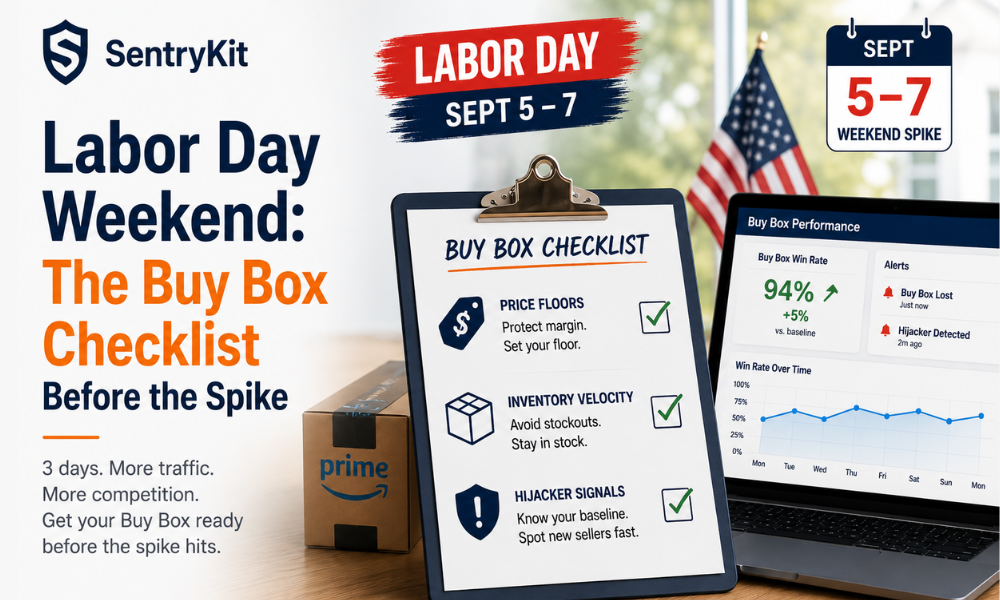
Labor Day weekend (September 5–7) is Amazon’s next promotional spike after back-to-school, and it behaves differently. Back-to-school demand builds gradually across categories over two weeks. Labor Day is compressed — a three-day window where price-driven categories (home, outdoor, appliances, apparel) see a sharp, short spike in both shopper traffic and competitor activity. That compression is exactly what makes it a Buy Box risk window: more competitors adjusting prices in a shorter timeframe means more opportunities for something to change on your listing before you notice.
Here’s what to check before Friday, not during the weekend.
If you’re running a repricer, confirm your price floor is actually set to protect margin, not just to win the Buy Box at any cost. Compressed promotional windows are when repricers race each other down fastest — a floor that felt safe in July can get tested hard in a three-day spike. Check it now, not after a weekend of sales at a price you didn’t mean to hit.
Pull your current sell-through rate against your Labor Day promotional volume estimate. A stockout mid-spike doesn’t just cost the missed sales — it hands your Buy Box to whoever’s still in stock, and getting it back after the weekend takes longer than winning it did. If any SKU is tight, this is the window to decide whether to pause a promotion rather than run out on day two.
Check the “Other Sellers on Amazon” section on your highest-volume listings now, so you have a clean baseline before the weekend. A compressed high-traffic window is exactly when an unauthorized seller is most likely to appear — they’re counting on you being too busy watching sales numbers to notice a new offer on your listing. If someone new shows up mid-weekend, you want to already know it wasn’t there Thursday.
Our back-to-school checklist covered a two-week demand build across school-related categories. Labor Day is shorter and more price-sensitive — treat it less like “watch for a competitor entering your category” and more like “watch for aggressive price moves and inventory gaps in a compressed window.” The checklist items are similar; the timing tolerance is not. You have less runway to react if something goes wrong Saturday afternoon than you would across a slower two-week spike.
If you’re unfamiliar with how Buy Box status is determined in the first place, our full breakdown covers the mechanics — worth a read before the weekend if pricing and fulfillment signals aren’t second nature yet.
The post-spike check matters as much as the pre-spike one. Compare your Buy Box win rate for the weekend against your normal baseline. A dip that doesn’t recover once the promotional pricing ends is worth investigating — it can mean a competitor held position after undercutting you, or that your own price floor stayed lower than intended past the weekend.
That’s the exact gap SentryKit’s alerts are built to close — a Buy Box Lost or Hijacker Detected alert fires the moment it happens, not when you check your dashboard Monday morning after the spike has already passed.
Labor Day falls on September 7, 2026, with the associated shopping spike typically running the Friday through Monday of that weekend — September 5–7.
That depends on your margin structure, but the checklist point stands regardless: know what your floor is set to before the weekend starts, rather than discovering it under pressure mid-spike.
Prime Day is Amazon-driven and announced well in advance with a fixed, marketplace-wide discount structure. Labor Day is seller-driven — individual sellers and brands set their own promotions, which means competitor pricing behavior is less predictable and worth watching more closely.
Nisha Shetty · Marketing Manager, SentryKit
Nisha is a marketing manager and former Amazon seller who writes about e-commerce growth, consumer behavior, and digital retail trends.