
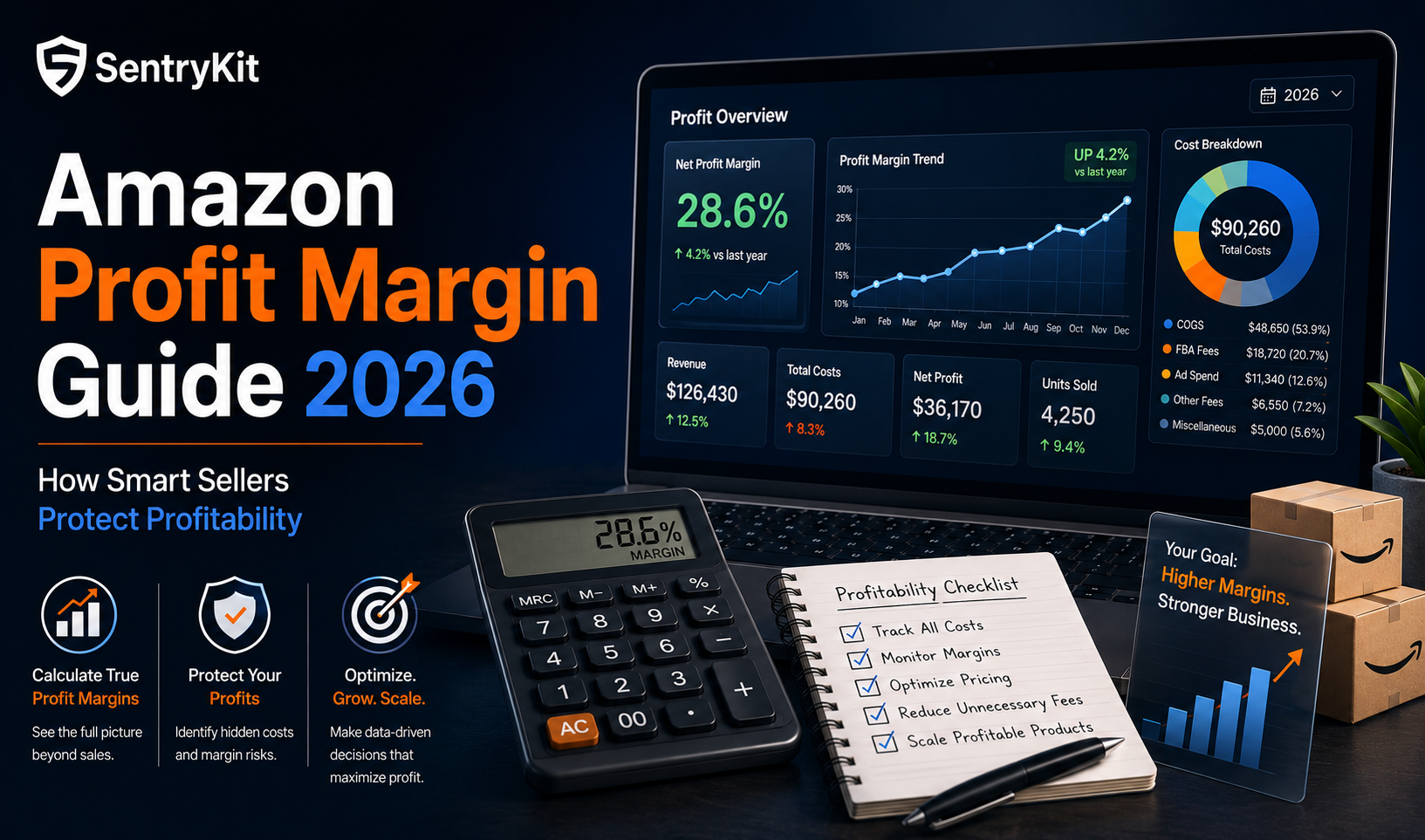
Profit margin is the number that determines whether your Amazon business is actually working. Revenue looks good until you account for FBA fees, referral fees, advertising, returns, and supplier costs — and what’s left is often far less than sellers expect.
In 2026, margins are under more pressure than ever. Amazon fees — referral plus FBA fulfillment — typically consume 25–35% of your selling price. The most recent fee update added an average of $0.08 per unit above 2025 rates. And from January 2026, Amazon eliminated FBA prep and item labelling services entirely, shifting that cost burden to sellers or their 3PL partners.
This guide covers what drives margin on Amazon, how to benchmark against realistic 2026 targets, and the strategies that actually move the number.
Your profit margin is the percentage of revenue left after covering all costs. On Amazon in 2026, realistic benchmarks look like this: most FBA sellers operate at 15–25% net margin, consistent with Jungle Scout’s FBA profit margin benchmarks. Above 25% is considered strong. Dipping below 8% consistently puts the business at risk. Private label sellers with optimised sourcing often achieve 25–30%, while wholesale and arbitrage sellers typically land between 10–20%.
A strong Amazon profit margin comes from managing the full cost stack — not just the product price. Tools like SentryKit protect margins by flagging the changes that erode them before they show up in your P&L. See SentryKit pricing.
Profit Margin = (Net Profit / Revenue) x 100
For example, if your revenue is $10,000 and your total expenses are $7,500, your net profit is $2,500 — giving you a 25% margin. Use Amazon’s official FBA Revenue Calculator to model fees before listing a new product.
Several cost categories affect your margin, and several changed or were introduced in 2026:
Rising storage fees, ad spend, and the low-inventory penalty are the three most common silent margin killers in 2026.
Use competitive research to identify niches with higher margin potential and lower return rates. In 2026, categories like health & personal care and home & kitchen continue to outperform electronics and apparel on net margin.
Bundles increase average order value and often reduce fulfillment fees per unit. They also make listings harder to hijack and reduce direct price comparison pressure.
With FBA prep and labelling eliminated and per-unit fees up $0.08 from 2025, it’s worth auditing your packaging dimensions again. Moving a product into a cheaper fulfillment tier — even by reducing box size slightly — can meaningfully improve your per-unit margin.
Higher conversion rates mean you earn more from the same ad spend and organic traffic. Optimise titles, images, bullet points, A+ content, and review quality. A listing converting at 15% vs 10% is a 50% revenue increase from the same traffic — with no additional cost.
Review campaigns weekly. Remove wasteful keywords, pause underperforming ad groups, and scale only campaigns with proven ROAS. PPC spend that isn’t yielding profitable conversions is a direct margin drain — not a growth investment.
Recurring orders reduce acquisition cost and increase lifetime margin per customer. Subscribe & Save works best in consumable categories — health, grocery, pet, beauty — where repurchase is natural.
Lower COGS has the highest long-term impact on margin. Renegotiate with existing suppliers, consolidate shipments to reduce per-unit freight costs, or source from alternative manufacturers. Running a quarterly margin audit — across all SKUs — is how top sellers catch drift before it becomes permanent.
That audit is only as good as the cost data behind it. Nova Analytics is built for this part of the job:
An automatic P&L across 200+ cost lines, per ASIN, on an hourly refresh — so a quarterly audit starts from actual fees, ad spend and returns rather than estimates.
One consolidated view across the 21+ Amazon marketplaces it supports, which is where per-SKU tracking in a spreadsheet usually breaks down.
A reporting builder and an MCP connector, so those numbers can feed your own reporting or AI tools instead of living only in a dashboard.
One of the most consistent margin killers is keeping the same price while Amazon fees and supplier costs quietly rise. By the time it shows in your P&L, the damage spans months.
SentryKit monitors the listing and marketplace changes that hit your margin before they show up in your reporting:
With SentryKit’s real-time monitoring, you catch issues before they compound into weeks of margin loss. Plans start at $19/month with a free 30-day trial. For a full breakdown of 2026 fee changes, see our Amazon Seller Fees 2026 guide. You can also use Amazon’s official FBA Revenue Calculator to model fees and margins accurately before launching a product.
Improving your Amazon profit margin in 2026 requires staying ahead of fee changes, controlling your cost stack, and catching listing and marketplace issues before they erode your earnings. The sellers who protect margin consistently aren’t the ones reacting fastest — they’re the ones with the best visibility into what’s changing.
Want to protect your profits and sell smarter?
Start your free 30-day trial with SentryKit and get real-time alerts across your full catalogue from day one.
Most FBA sellers operate at 10–25% net margin in 2026. Well-optimised operations typically achieve 15–25%. Private label sellers with tight sourcing often hit 25–30%. Sellers competing heavily on advertising in saturated categories frequently see true net margins of 8–12% after PPC costs. Below 8% consistently is a structural problem — scaling makes it worse.
The average is $0.08 per unit — but this masks variation. Standard-size products priced above $50 are seeing +$0.31 per unit on average, with large standard products facing a 6% year-on-year increase. Run the FBA Revenue Calculator on your top SKUs individually rather than applying the headline average.
Growing sales often mask margin erosion because costs scale with volume. The most common causes: rising FBA fees compounding per-unit at higher volumes, increasing PPC spend (competitive Page 1 sellers average ~15% of revenue on ads), higher return rates, and aged inventory storage fees accumulating quietly.
Amazon introduced low-inventory-level fees in 2024 and maintained them in 2026. If your sell-through rate outpaces your stock levels, a per-unit fulfillment surcharge applies. For sellers who frequently run lean, this adds 5–10% to effective fulfillment costs on affected products. Maintaining at least 28 days of coverage for fast movers avoids the fee entirely.
True margin = (Revenue – COGS – Referral fee – FBA fulfillment fee – Storage fee – Low-inventory penalty – PPC spend – Returns cost – Software subscriptions) ÷ Revenue × 100. The most commonly missed costs are aged inventory storage fees, return processing fees, and tool subscriptions adding $300–600/month.