
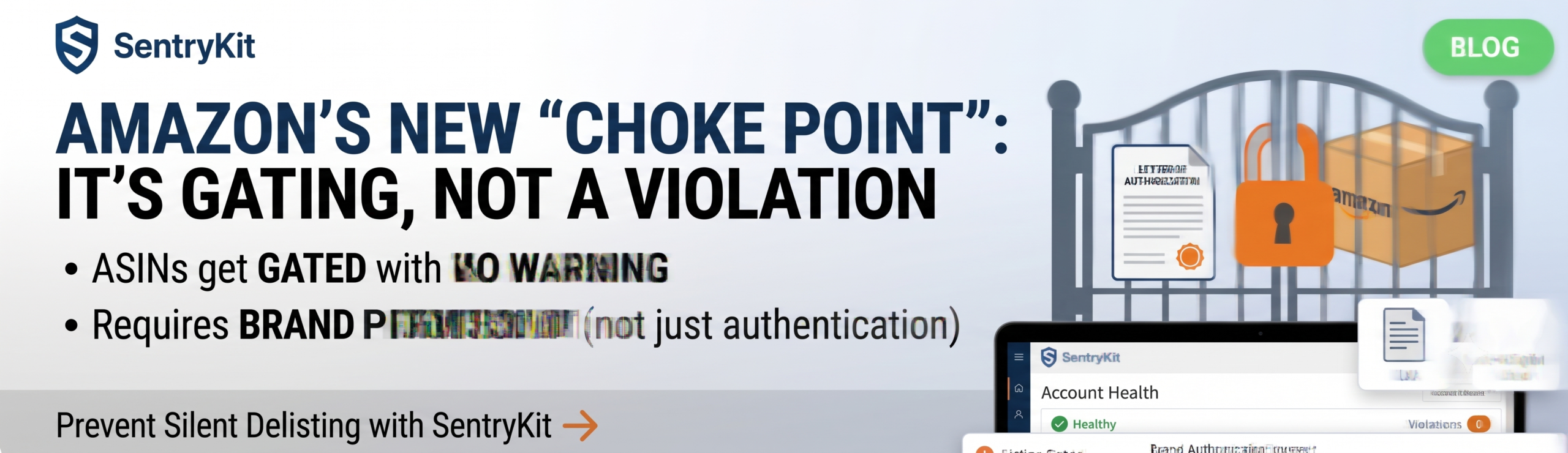
An ASIN you have sold for two years stops working. No performance notification, no violation on your Account Health page, no email. You go to relist and Amazon tells you approval is required to sell this brand.
Sellers have started calling this an unauthorized distribution violation. That category does not exist. What is actually happening is both narrower and harder to fight, and the difference matters because it changes what you can do about it.
Here is what Amazon actually recognizes, what genuinely changed in 2026, and why this one arrives with no warning at all. If you resell other people’s brands, treat this as the quietest enforcement risk on your account — it leaves no record to appeal.
Amazon recognizes three kinds of intellectual property complaint: copyright, trademark, and patent. That is the complete list, and Amazon says so directly in its own guidance on reporting violations from March 2025. There is no fourth category for selling a brand you are not authorized to sell.
There is a reason for that. A distribution agreement is a contract between a brand and its distributors. If a reseller buys genuine stock and lists it, they have not infringed anyone’s IP — they have potentially upset a commercial arrangement they were never party to. Amazon has consistently declined to treat that as an IP matter, and Brand Registry cannot remove a seller of authentic goods on that basis alone.
So when a brand wants a reseller gone and has no IP claim, the pressure moves somewhere else. It moves upstream, to whether you are allowed to list at all.
That is the shift. Not a new violation type — a new choke point.
Three things landed close together in 2026, and together they reshaped what a reseller has to prove.
Sourcing evidence got stricter. In April 2026 Amazon set out that sellers should hold a Letter of Authorization and source from the manufacturer or an authorized distributor. PPC Land covered the Seller Central post and the reaction to it in May 2026. The important detail is what the standard asks. It does not ask whether your goods are genuine. It does not ask whether you bought them lawfully. It asks whether the brand owner gave you permission. An invoice from an authorized retailer, a liquidator, or a clearance buy can be completely legitimate and still fail that test.
Barcode eligibility narrowed. From March 31, 2026, listing with manufacturer barcodes became restricted to Brand Registry sellers.
Commingling ended. The same date, Amazon stopped commingling FBA inventory, which removed a lot of the ambiguity about whose unit a customer actually received.
None of those three is a violation. They are eligibility rules. And eligibility rules produce a different kind of problem than violations do.
A violation leaves a record. It shows up on your Account Health page, it generates a performance notification, and there is a defined appeal path — you submit a plan of action or you get the complainant to retract.
Gating leaves nothing. There is no entry to appeal, because nothing was decided against you. A permission you used to have simply is not there any more. Adam Engel of The Engel Law Group described picking up clients who had received notices for lack of brand authorization on products they had been selling for years, in the same PPC Land piece.
The recourse gap is the real story. Amazon introduced Seller Challenge in October 2025, and it is a genuine improvement for contesting enforcement — but it does not reach upstream gating decisions. There is no published standard for what evidence clears an approval block, and no committed timeline for a decision. A seller with a violation on their record has more process available to them than a seller who has quietly lost the ability to list.
I have watched wholesale sellers spend a week assuming a sales dip was seasonal, then discover the ASIN had been ungettable since the previous Tuesday.
This is a wholesale, online arbitrage, and retail arbitrage problem. If you own your brand, you are the authorization — there is nobody upstream to grant or withhold it, and none of this reaches you.
If you resell other people’s brands, all of it reaches you. And the exposure scales with how many ASINs you carry and how far your sourcing sits from the manufacturer. A seller buying direct from the brand has a clean answer. A seller buying from an authorized distributor has a good answer. A seller buying from a retailer’s clearance shelf has genuine product and no answer at all.
Worth separating this from a related thing sellers often conflate: a brand telling Amazon you are unauthorized is not the same as a brand enforcing a minimum price. Those are different mechanisms with different outcomes, and we have covered what Amazon does and does not enforce between sellers separately.
The sellers who clear these fastest are the ones who prepared before anything broke.
Keep supplier invoices that are dated, unaltered, and name the buyer, the supplier, and the product. Redacting pricing is fine; redacting anything else usually is not. Get a Letter of Authorization on the brand’s letterhead for any line that represents real revenue for you — the time to ask is while the relationship is comfortable, not after you have been gated. And know, for each of your top ASINs, whether your supplier would survive Amazon verifying them.
That last one is the question most sellers cannot answer, and it is the one that decides the outcome.
You cannot control whether a brand decides to tighten its distribution. You can control how long it takes you to find out.
When Amazon restricts a listing, it attaches a reason to it. Not a generic status — an actual issue message in Amazon’s own words, an enforcement action, and a restriction reason that distinguishes approval required from not eligible. That information exists the moment the restriction lands. Most sellers never see it, because they are looking at a sales chart rather than the listing record behind it.
That is the gap worth closing. SentryKit records the restriction reason and the enforcement action Amazon attached, so a gated ASIN reads as an event with a timestamp and a cause instead of a dip you start investigating a week later. It does not fight the gate for you. It tells you the gate exists, on the day it appears, with Amazon’s own explanation attached — which is the difference between appealing with current information and appealing with a guess. That is what sits behind our Suspended Listings alert.
Let me be straight about the limits, because it matters. This is listing-level restriction data, not an Account Health feed. SentryKit does not monitor IP complaints or policy violations, and it will not tell you a brand has filed something against your account. A restriction reason tells you what Amazon enforced, not who asked for it.
If you want the wider picture of how restrictions, suppressions, and Buy Box loss interact, our guide to listing health issues covers the full set. And if your listing is live but has lost its Buy Box, that is a suppressed listing, a different problem with a different fix — do not treat them as the same thing. For wholesale sellers, where a single gated brand can be a meaningful slice of revenue, telling those three apart quickly is most of the job.
Amazon consolidated brand violation reporting into a single guided experience in July 2026. Easier reporting for brands tends to mean more reports. The direction of travel is clear enough: proving you are allowed to sell something is becoming as routine as proving it is genuine.
Your sourcing paperwork is now part of your inventory. Treat it that way before a brand makes you.
No. Amazon recognizes three intellectual property complaint types: copyright, trademark, and patent. There is no unauthorized distribution category. What sellers experience under that name is usually an approval or gating restriction, which works differently and leaves no violation record.
Not through an IP complaint alone, if your goods are genuine. Brand Registry is built to remove counterfeits and IP infringement, not lawful resellers. What a brand can do is restrict who gets approved to list, which achieves a similar result through a different route.
A document from the brand owner confirming you are permitted to sell their products. Amazon guidance from April 2026 points sellers toward holding one and sourcing from the manufacturer or an authorized distributor. It should be on the brand letterhead and name your selling entity.
Approval requirements can change after you have been listing, and Amazon does not always notify you when they do. It is an eligibility change rather than a penalty, which is why nothing appears on your Account Health page.
Largely no. If you own the brand, there is no upstream authorization to lose. This is a wholesale, online arbitrage, and retail arbitrage exposure.
No, and the fixes are different. A gated brand means you are not approved to list the item at all. A suppressed listing means the listing exists but Amazon has removed the Buy Box or hidden it from search, usually over a listing condition issue.

Raghav Tiwari · Founder, SentryKit
Raghav is the founder of SentryKit. He spent years running his own Amazon storefronts before building it, and writes about Buy Box strategy, competitive intelligence, and the platform shifts sellers can’t afford to miss.