
- Raghav Tiwari
Amazon Enforcement Loophole: Why Bad Actors Keep Relisting After Takedowns
Table of Content
Subscribe for Offers & Amazon Selling Insights
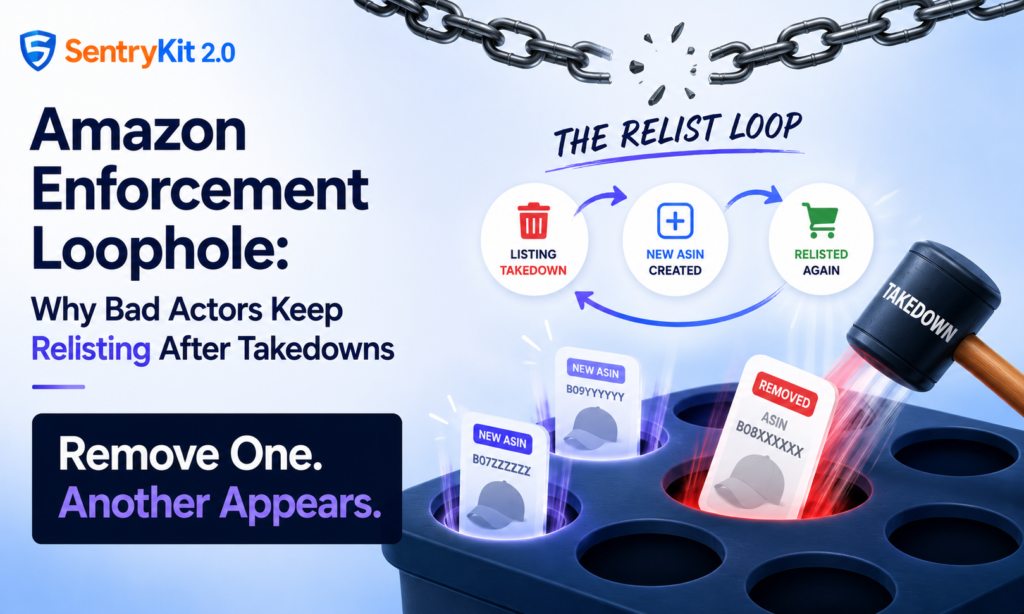
A few weeks ago, Ephraim Rosenberg — a veteran IP attorney who works with Amazon brands — posted something on LinkedIn that has been circulating in seller communities ever since. The brand is called Knickses. A China-based seller was selling counterfeit hats on Amazon. The brand filed a complaint. Amazon removed the listing. The seller created a new ASIN and relisted within days. The brand filed again. Amazon removed it again. The seller relisted again.
This cycle repeated multiple times.
Rosenberg’s point was blunt: compliant sellers are doing everything right — spending time filing complaints, paying legal fees, losing sales during each removal window — while the bad actor restarts the cycle at zero cost. There’s no account-level penalty that sticks. There’s no cost to relisting.
He’s right. And this isn’t a Knickses-specific problem.
The enforcement loop is structurally asymmetric
When you file an IP complaint against an infringing seller, here’s what it costs you: time to document the infringement, time to submit the complaint, time to follow up, and — most importantly — sales lost while Amazon processes the removal. Removal windows run anywhere from 72 hours to several weeks for complex cases.
Here’s what it costs the bad actor when their listing gets taken down: nothing. They create a new ASIN under a slightly different title, the same product, the same seller account (or a fresh one), and relist. Amazon’s complaint system targets individual ASINs, not seller behavior patterns. A deactivated ASIN doesn’t prevent the same entity from creating another one.
That’s the asymmetry. Filing a complaint is expensive for the victim. Relisting is free for the bad actor.
Until Amazon introduces genuine entity-level penalties — consequences that follow the seller, not just the ASIN — the loop continues.
This isn't just Knickses
The pattern Rosenberg described isn’t unique to hat brands or China-based sellers. It’s the same mechanism behind brand name attribute manipulation — where a seller changes the brand field on your ASIN without even listing a competing product. It’s the same mechanism behind variation abuse, where a bad actor stuffs unrelated products onto a popular parent ASIN, gets removed, and does it again on a fresh ASIN.
Amazon’s 30-day ASIN deactivation notices that started going out in 2026 are a step toward addressing catalog abuse at scale — but they target violations in your own catalog, not bad actors operating against you.
The common thread: Amazon’s enforcement architecture is complaint-driven, ASIN-level, and reactive. It doesn’t model the entity behind the listing. It doesn’t ask “has this seller entity done this before?” It asks “is this specific ASIN violating a policy right now?” That’s a system that can be gamed. And it is, systematically.
The detection gap is where the real damage happens. For a product with any meaningful velocity — even 10 units a day — a 48-hour relist window means 20 counterfeit units in customers’ hands before a second complaint gets filed. Each one is a potential negative review, a return, or a chargeback that lands against your listing’s history, not the bad actor’s.
Most sellers discover a relist the same way they found out the first time: a customer complaint, a dip in conversion rate, or a manual check. There’s no alert in Seller Central that says “a new seller appeared on this ASIN since your last complaint.” That absence is the detection problem — and it compounds the structural problem in ways the complaint statistics don’t capture.
What Amazon offers — and what it actually does
Amazon has three main tools for brand protection: Brand Registry, Project Zero, and Transparency. Here’s an honest account of each.
Brand Registry gives you access to the complaint tools and the Report a Violation portal. It does not prevent a bad actor from creating a new ASIN after their listing is removed. Brand Registry is the prerequisite for the other tools — not a protection layer itself. What Brand Registry doesn’t cover is worth understanding before you assume enrollment equals protection.
Project Zero adds a self-service removal tool and automated protections that scan for infringement patterns. It’s faster than manual complaint filing. But it doesn’t stop the relist loop — it shortens individual removal cycles. A determined bad actor can still relist, and Project Zero’s automated protections only act on patterns it already recognizes.
Transparency is the strongest structural answer — it requires each physical unit of your product to carry a serialized authenticity code. A counterfeit unit without a valid code gets rejected at FBA. This breaks the loop at the fulfillment level. But it requires serialization at manufacturing, carries per-unit costs, and only protects physical units, not the listing itself.
All three are worth using. None of them fully closes the ASIN recreation gap.
The honest answer
Amazon won’t fix the structural asymmetry until the cost-benefit math changes. Complaint-driven enforcement offloads most of the cost to the brand making the complaint. Until Amazon introduces meaningful entity-level penalties — suspensions that follow the seller across ASINs — bad actors will continue to treat listing removal as a minor inconvenience.
What you can control: detection speed. The black hat playbook has expanded significantly in 2026 — the tactics are faster and cheaper to execute than ever. The sellers who absorb the least damage are the ones who know the moment a new unauthorized seller appears on their listing, not the ones who find out days later when conversion rate has already dropped.
Filing faster doesn’t fix the structural problem. But knowing faster reduces what you lose while you wait.
Building a detection layer means monitoring seller activity on your listings continuously, not periodically. When a new unauthorised seller appears on an ASIN where you’ve already filed a complaint, knowing within minutes — not days — is the variable you can actually control, even when the enforcement architecture stays fixed.
SentryKit fires a Hijacker Detected alert the moment an unauthorised seller appears on one of your ASINs. If that entity has appeared before, the alert history gives you a documentation trail for the next complaint. A repeat violation filed quickly, with references to the previous enforcement cycle, carries more weight than an isolated complaint filed weeks later.
You can’t close the structural loophole. But you can compress the detection window to minutes instead of days — and that’s the difference between a brief disruption and a sustained sales hit that runs for days before you realise it’s happening.
Frequently Asked Questions
What is ASIN recreation abuse on Amazon?
ASIN recreation abuse is when a seller whose listing was removed — due to an IP complaint, policy violation, or enforcement action — creates a new ASIN for the same product and relists it. Because Amazon’s enforcement system operates at the ASIN level rather than the seller entity level, there is no automatic barrier preventing a new listing from going live after an old one is deactivated.
Does Amazon stop sellers from relisting after a takedown?
Not automatically. Amazon deactivates the specific ASIN flagged in a complaint. The seller can create a new ASIN and relist. Project Zero’s automated protections can flag recognized patterns, and Transparency codes can reject inauthentic units at fulfillment, but neither tool prevents a new ASIN from being created and listed.
What’s the difference between Project Zero and Brand Registry for enforcement?
Brand Registry gives you access to Amazon’s brand protection tools including the Report a Violation portal. Project Zero adds a self-service removal tool and automated protections that scan for infringement patterns. Project Zero is faster than manual filing, but bad actors can still relist under a new ASIN — the underlying enforcement architecture hasn’t changed.
How long does a typical relist take after an Amazon enforcement action?
For a determined bad actor, creating a new ASIN takes minutes. Getting it live and indexed takes 24–48 hours depending on category. The detection gap — time between relist and brand discovery — is typically 2–5 days for sellers not monitoring in real time. That window is long enough for meaningful sales volume to occur under the unauthorised listing.
Does filing multiple complaints against the same seller entity make a difference?
It can. Repeat complaints against the same entity build a record in Amazon’s systems, and complaints that reference previous violations with strong supporting documentation tend to be reviewed more thoroughly. The challenge is that Amazon doesn’t surface this history back to the filing brand — so maintaining your own documentation of each enforcement cycle is what makes subsequent complaints stronger.

Raghav Tiwari · Co-founder, SentryKit
Raghav is the co-founder of SentryKit. He writes about Amazon seller strategy, Buy Box intelligence, and the systems that protect brands on the marketplace.