
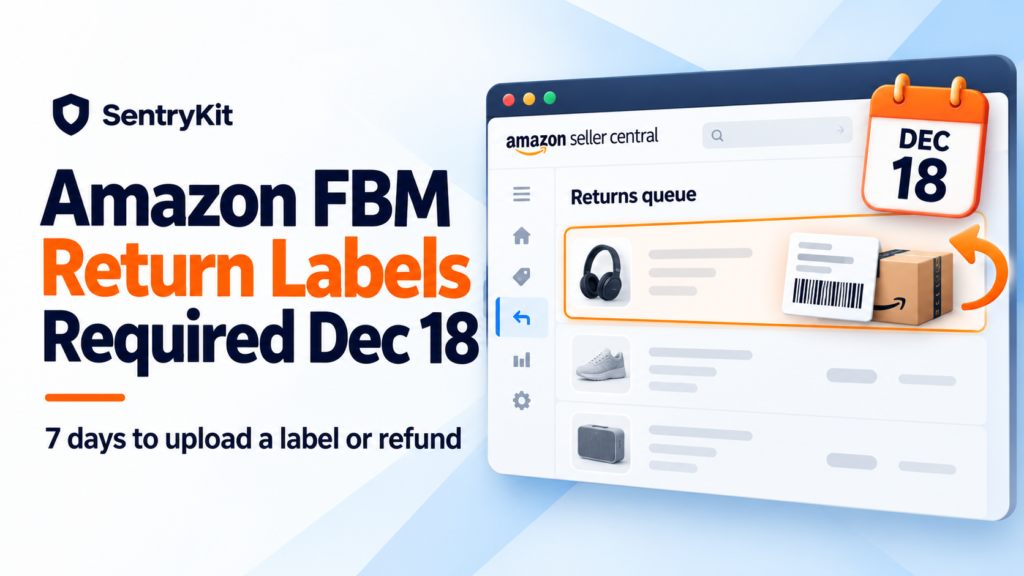
From December 18, Amazon requires a prepaid return label on every US return for a seller-fulfilled order. The email to sellers puts it plainly: “Address-only labels that require customers to pay for return shipping will no longer meet the requirement” (PPC Land).
You get seven calendar days from the return request to upload a prepaid label in Manage seller-fulfilled returns, or to refund in full without the item back. Miss it and Amazon may issue a returnless refund and deduct it from your account. FBA orders aren’t affected, and heavy and bulky items are excluded for now. The real decision is per SKU: send a label, or refund and let the item go.
| What changes on December 18 | What you do |
|---|---|
| Address-only labels stop counting | Use Amazon’s prepaid label, or upload your own prepaid label |
| Seven calendar days from the return request | Check the returns queue every day, weekends included |
| The label has to go through Manage seller-fulfilled returns | Don’t send labels by Buyer-Seller Messaging; they won’t count |
| Miss the window and Amazon may refund the buyer and deduct it | Decide in advance which SKUs get a label and which get a returnless refund |
| Heavy and bulky items are excluded, for now | Confirm how Amazon classifies your large items before you rely on it |
Amazon’s stated reason is “a consistent process for your US and international returns.” The current rules sit in Amazon’s prepaid returns help page, which didn’t yet mention the December date on October 19.
“Prepaid” describes how the label is arranged, not who ends up paying for it. Amazon still assigns return shipping by return reason, including whether the return is your fault: damaged, defective or the wrong item (Seller Essentials).
What changes is narrower than the headlines suggest. Amazon’s own prepaid return labels are unchanged, an Amazon moderator confirmed on the Seller Forums. The option that goes is handing the buyer your address and letting them pay the postage. For returns Amazon’s labels don’t cover, you now provide your own prepaid label. In practice, more of the postage lands on you.
The most common advice in the forum thread is to raise prices to cover postage. Sometimes that’s right. Do the arithmetic first.
Say you sell an item for $24.99 FBM, 6% of orders come back, and an average return label costs you $8. Spread across every order, returns postage is about $0.48 a sale. A $0.50 increase covers it. A $3 increase covers it six times over, and that’s where the risk sits.
The risk isn’t the shopper. It’s Amazon’s competitive price. Amazon compares your offer with recent prices on and off Amazon, and an offer that drifts above that line can lose the Featured Offer, even when you’re the only seller (here’s how that happens). FBM offers already give up ground on delivery speed and seller metrics, so there’s less room to absorb a price jump. Raise too far too fast and you can also trip a potential high pricing error.
Raising FBM prices before December 18? SentryKit emails you when your price goes above Amazon’s competitive price, when you’re back within it, and when Amazon moves the line while your price stays put.
The refund happens either way. The only question is whether the label buys back more than it costs.
Take a $14.99 item that cost you $5 landed, with an $8 return label. You pay $8 to recover at most $5 of stock, and only if it comes back sellable. Refund it and let the item go. Now take an $89 item with a $40 landed cost. The label pays for itself as long as most returns come back in sellable condition.
I’d set the rule once rather than decide it return by return. In Seller Central, Settings, Return Settings, Returnless Resolutions lets you refund without the item back by item price, category and return reason. Cheap, low-resale items go there. Everything else gets a label. The hidden costs of Amazon returns make the case for being strict about which is which.
Step 5 is the one that slips. You raise a price on a Friday, Amazon’s competitive price moves on Sunday, and the Featured Offer is gone before you look. SentryKit watches every ASIN and emails you when your price goes above Amazon’s competitive price, when you’re back within it, and when Amazon raises the line. It also alerts you to Buy Box changes and to FBM stock running low. Plans start at $19/month with a 14-day free trial. See pricing.
December 18 doesn’t make returns more frequent. It makes a slow returns queue expensive.
Know when a price change costs you the Featured Offer
SentryKit watches 50+ signals on your ASINs, from Amazon’s competitive price and Buy Box changes to stock and listing edits, and emails you when one changes. Plans from $19/mo.
Start 14-day free trialRelated alerts
No. It covers returns on US seller-fulfilled (FBM) orders. Amazon handles returns on FBA orders.
Amazon may issue a returnless refund to the buyer and deduct the amount from your selling account. The buyer keeps the item.
No. Labels sent by message or any channel outside Manage seller-fulfilled returns don’t count. Upload the label in that workflow, or refund in full without asking for the item back.
For now. Amazon has excluded heavy and bulky items temporarily, but hasn’t published a definition or an end date. Confirm how Amazon classifies your items.
Prepaid describes how the label is arranged, not who pays. Amazon assigns return shipping by return reason, and returns that are your fault are on you. What ends on December 18 is the address-only option where the buyer paid the postage.

Raghav Tiwari · Founder, SentryKit
Raghav is the founder of SentryKit. He spent years running his own Amazon storefronts before building it, and writes about Buy Box strategy, competitive intelligence, and the platform shifts sellers can’t afford to miss.