Most FBM sellers find out they’ve lost Buy Box eligibility the wrong way — a drop in sales they can’t explain, a look at the Account Health dashboard, and a metric that’s been slipping for weeks. By then, a competitor is winning Buy Box placements they shouldn’t have, and getting the score back takes longer than the problem did to develop.
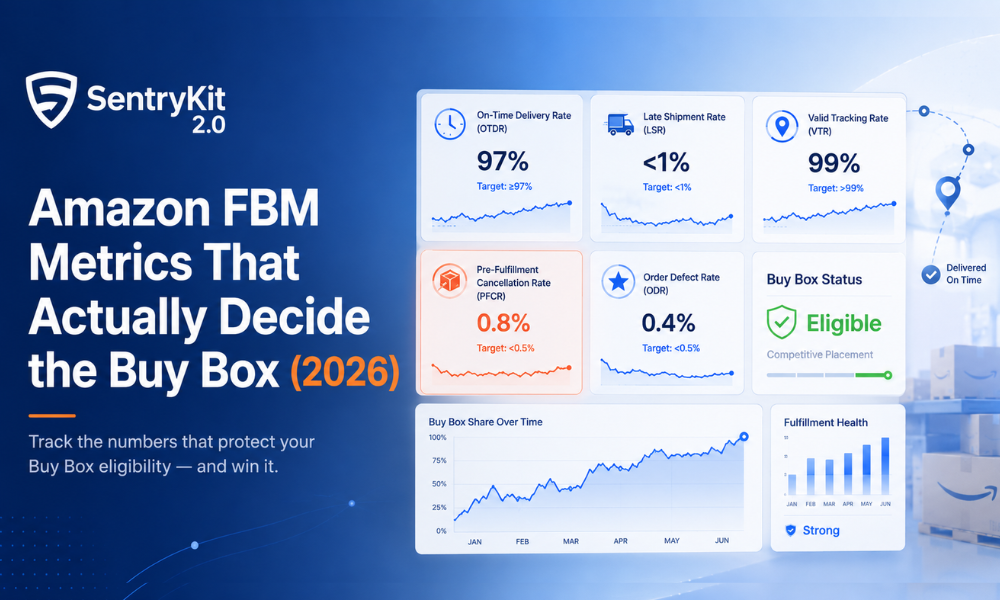
Amazon tracks five performance metrics for seller-fulfilled orders. Each one has a published threshold — the floor below which your listings face deactivation — and a higher, quieter target that determines whether you actually win Buy Box share competitively. Most FBM guides stop at the published floor. That’s not enough.
Here’s what both numbers look like for each metric, and why the February 2026 OTDR enforcement change matters more than most FBM sellers have realised.
FBA offloads fulfillment risk to Amazon. Your listings don’t get penalised for carrier delays, missed scans, or late deliveries — that’s Amazon’s problem to manage.
FBM sellers carry that risk themselves. Every order you ship is a data point Amazon uses to evaluate whether you deserve Buy Box placement. A single carrier without proper tracking integration, a stretch of high order volume that strained your handling capacity, or a run of low-stock cancellations — all of it registers in your metrics before you see a warning.
That’s not a reason to avoid FBM. Seller-fulfilled orders can and do win the Buy Box, including against FBA competitors, when metrics are strong and regional delivery speed is an advantage. The FBM sellers who struggle are usually the ones who treat account health as a compliance concern rather than a competitive lever.
Each metric has two numbers worth knowing: the published minimum (below this, Amazon deactivates listings or restricts selling privileges) and the Buy Box target (where you’re actually competitive for placement). Most guides only give you the first number.
| Metric | Published Floor | Buy Box Target | Where to Check |
|---|---|---|---|
| On-Time Delivery Rate (OTDR) | ≥90% | ≥97% | Account Health → Delivery Performance |
| Late Shipment Rate (LSR) | <4% | <1% | Account Health → Shipping Performance |
| Valid Tracking Rate (VTR) | >95% | >99% | Account Health → Shipping Performance |
| Pre-Fulfillment Cancellation Rate (PFCR) | <2.5% | <0.5% (SFP) | Account Health → Order Performance |
| Order Defect Rate (ODR) | <1% | <0.5% | Account Health → Order Performance |
The floor is 90%. The Buy Box target is 97% or higher — sellers at 98%+ see noticeably better placement in competitive categories. Amazon changed how it enforces OTDR on February 28, 2026, and most FBM sellers haven’t set up the protection the new policy offers.
Previously, falling below 90% OTDR could trigger deactivation across your entire FBM catalog. Starting February 28, Amazon now evaluates at the item level — deactivating only the specific listings that are contributing most to your low OTDR, rather than shutting down everything. That’s a meaningful difference in operational impact.
The catch: you only get item-level enforcement if you’ve configured three things in advance:
Sellers who haven’t done this setup remain exposed to full catalog deactivation when OTDR dips below 90%. As GeekSeller reported when the change went live, the protection is real — but it requires advance configuration. Amazon’s OTDR help page has the setup steps.
One detail worth knowing: Amazon uses an “OTDR without promise extensions” calculation for enforcement — it excludes extra days added for weather or carrier disruptions. This version is stricter than the delivery window your customer sees.
LSR tracks the percentage of orders where you confirmed shipment after the “ship by” date — not the delivery date. A lot of FBM sellers conflate LSR and OTDR. They’re measuring different things. LSR is about when you confirmed the label was created. OTDR is about when the customer received the package.
The published floor is below 4%. The Buy Box target is well under 1%. Feedvisor’s Late Shipment Rate data shows that Amazon adjusts Buy Box visibility algorithmically before a formal account warning is issued — you can be losing Buy Box share to a faster competitor without any notification.
If LSR is creeping up, the most common cause isn’t slow shipping — it’s delayed shipment confirmation. Confirming orders as soon as the label is created, rather than waiting until pickup, keeps this number clean.
VTR measures the percentage of orders shipped with a tracking number that produced a real carrier scan. The floor is 95%. The Buy Box target is above 99%.
In January 2025, Amazon expanded VTR requirements to cover all shipping carriers — not just Amazon-integrated ones. If you use a regional carrier that doesn’t provide consistent scan events, every shipment through that carrier counts against your VTR. The package can arrive safely, the customer can be happy, and your VTR still takes the hit because the carrier didn’t produce a valid scan record.
The straightforward fix: purchase labels through Amazon Buy Shipping, which automatically validates tracking and applies OTDR protection at the same time.
PFCR is the percentage of orders you cancel before shipment because you don’t have inventory. Floor is below 2.5%. For Seller Fulfilled Prime eligibility, it’s below 0.5%.
Take a wholesale seller managing 150 active FBM SKUs, running stock low on a handful of fast-moving items. They don’t catch the low-stock signal in time — three orders come in on the same day for a SKU with two units left, one customer gets cancelled. That’s one PFCR hit. At 200 orders a month, five cancellations puts them at 2.5% — right at the edge of the floor, before Buy Box erosion even starts.
This is the metric most directly tied to FBM inventory management, and the one most sellers don’t connect to their stock visibility. Running low on stock and cancelling orders is an inventory problem on Monday that becomes a performance metrics problem by Friday. You can see how this creates Buy Box losses that don’t look like pricing problems until you pull the account health data.
ODR combines three negative buyer signals: 1–2 star feedback, A-to-Z Guarantee claims, and credit card chargebacks. The floor is below 1%. Exceed it and Amazon can lock you out of the Buy Box for up to 60 days — that window is longer than most sellers expect.
The Buy Box target is below 0.5%. Negative feedback counts here even if it’s resolved — Amazon records the original event, not the outcome. Proactive order management (confirming shipment promptly, contacting buyers before issues escalate to A-to-Z claims) prevents ODR accumulation in a way that responding after the fact can’t.
If ODR is approaching 1%, check your Account Health Rating — the composite 0–1,000 score that reflects all five metrics together. Healthy is 200+. Below 100 is Critical. Act well before either threshold.
The February 2026 item-level protection is worth having configured — here’s the short version of what to check:
Step 1: Seller Central → Settings → Shipping Settings → enable Shipping Settings Automation.
Step 2: Same section → enable Automated Handling Time. This lets Amazon set your handling window based on your actual fulfillment data rather than a number you manually entered and may not have updated since you launched.
Step 3: Buy labels through Amazon Buy Shipping (Orders → Manage Orders → Buy Shipping) or Veeqo. These labels are marked OTDR-protected. Labels from third-party carrier integrations are not.
With all three configured: a dip below 90% OTDR triggers per-listing deactivation. Without them: it can still take down your full FBM catalog. Accounts with consistently low performance can still face broader restrictions regardless — but for most sellers, this setup is the difference between a targeted problem and a business disruption.
PFCR is where FBM inventory management and Buy Box eligibility intersect most directly. When stock runs low and an order comes in you can’t fulfill, the choices are cancel (PFCR hit) or ship late (LSR and OTDR hit). There’s no clean option after stock is gone.
The problem is that this chain is invisible in Buy Box reporting. When Buy Box share starts eroding from accumulated PFCR hits, the data shows a performance metrics issue — not a stock issue. Sellers diagnose the symptom without finding the cause. The alert that breaks this chain is the one that fires before the cancellations start, not after.
SentryKit’s FBM Stock Alert fires when your FBM inventory drops to a configurable threshold, giving you the window to restock before you’re making cancellation decisions. It’s the same underlying principle as the FBA Stock-Out alert, applied to seller-fulfilled inventory where the downstream metrics consequence is more direct and faster-moving.
Prime Day 2026 is in June. The performance window Amazon evaluates is rolling — metrics you accumulate now are the ones that determine your Buy Box eligibility when traffic is highest. Sellers who let OTDR, PFCR, or LSR drift through May don’t recover in time for the event.
If you’re seller-fulfilled and Prime Day matters, check all five scores now — against the Buy Box targets above, not just the published floors. There’s a difference between staying listed and actually winning placement when it counts.
FBM stock running low is the earliest signal that your PFCR is about to move. SentryKit’s FBM Stock Alert catches it before you’re choosing between a cancellation and a late shipment.
Yes — and it happens regularly in categories where regional delivery matters. Amazon now weights regional delivery speed more heavily than overall average delivery time. An FBM seller who can ship next-day to New York, Los Angeles, Chicago, and Dallas may outperform an FBA seller whose nearest fulfillment center is three days away from those markets. Strong metrics and competitive total price (item + shipping combined) are the starting requirements.
After February 28, 2026: if you’ve enabled Shipping Settings Automation, Automated Handling Time, and use OTDR-protected labels, Amazon deactivates only the specific listings contributing most to your low OTDR. Without this setup, full catalog deactivation is still possible. Accounts with consistently low performance can face broader restrictions regardless. If a listing is deactivated, appeal through Account Health → Product Policy Compliance → Order Performance – On Time Delivery Rate.
LSR and OTDR typically reflect a rolling 7– to 30-day window depending on the metric. Improvements you make now won’t show up immediately — expect a one to two week lag. This is worth knowing before Prime Day: metrics you let slip in May don’t recover before June traffic peaks.
Yes. Amazon can suppress the Buy Box entirely on a listing when ODR exceeds its threshold, regardless of competition. That’s a different problem from a lost Buy Box — the fix for a Suppressed listing is different from recovering a Buy Box you lost to a competitor. Check which situation you’re in before acting.
LSR measures when you confirmed shipment — it’s about your actions. OTDR measures when the customer received the package — it’s about real-world delivery. You can confirm every order on time (clean LSR) and still have poor OTDR if your carrier’s scan data is unreliable or deliveries are consistently late. Since 2024, OTDR has become the more actively weighted of the two for Buy Box eligibility.