
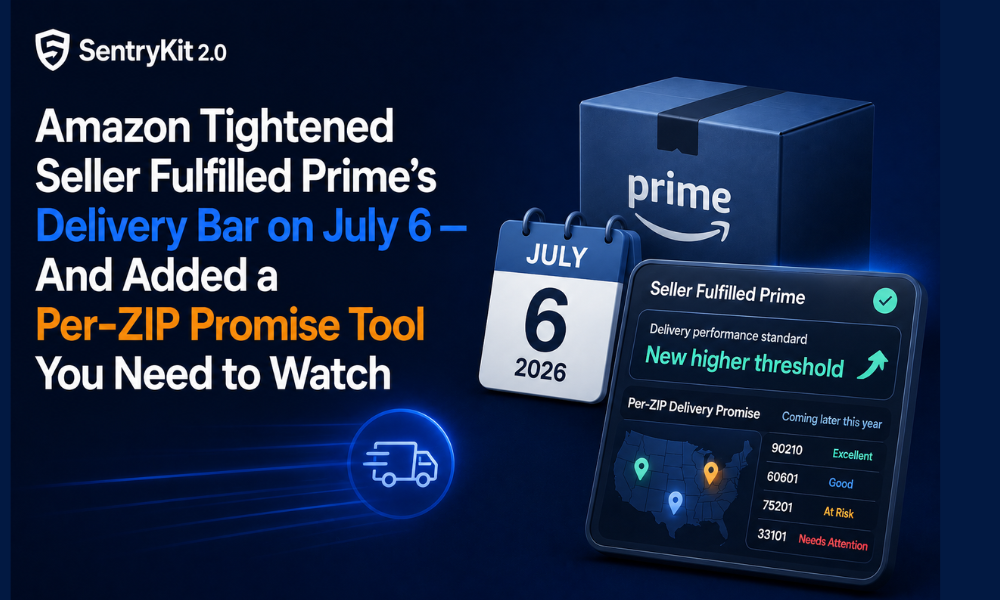
Amazon tightened the delivery performance bar for Seller Fulfilled Prime on July 6, 2026, raising the threshold sellers need to hit to keep the Prime badge on self-fulfilled listings. If you’re running SFP on even a portion of your catalog, this is worth checking against your current numbers, not just filing away.
A second, related change is on the way later this year: a per-ZIP delivery estimation tool that gives sellers more granular visibility into delivery promise accuracy by region, rather than a single blended average.
Seller Fulfilled Prime requires sellers to maintain a delivery performance standard to keep the Prime badge on self-fulfilled listings — on-time delivery rate, valid tracking rate, and cancellation rate all factor in, as laid out in our SFP requirements guide. As of July 6, 2026, Amazon raised the minimum threshold: for standard-size items, the one-day delivery benchmark moved from 30% to 40% of Prime page views and the two-day benchmark moved from 70% to 75%, according to Amazon’s own Seller Central documentation — PPC Land called it the largest upward revision to SFP speed benchmarks since the program reopened to new enrollees in 2023. A performance level that was previously acceptable may now put your SFP status at risk.
The mechanics of how performance is measured haven’t changed — it’s the bar itself that moved. Amazon is running a grace period on the new thresholds through October 17, 2026, with weekend orders temporarily excluded from the speed calculation, but sellers sitting close to the previous minimum should check their numbers against the new threshold now rather than waiting for the grace period to end.
SFP exists to let sellers offer Prime-eligible delivery without moving inventory into FBA — but that only works for shoppers if the delivery promise is reliable. Amazon has periodically tightened SFP requirements as Prime delivery-speed expectations across the marketplace have risen, since a self-fulfilled Prime badge that doesn’t consistently deliver undermines trust in the badge itself, not just the individual seller — Marketplace Pulse has described the program’s history as a repeated cycle of tightening and loosening, and this is the latest tightening swing.
This tightening lines up with the removal of the Featured Offer eligibility gate earlier this month — both changes push delivery-promise accuracy further into the center of how Amazon evaluates seller performance, whether that’s for Prime eligibility or Featured Offer ranking.
Amazon has signaled a per-ZIP delivery estimation tool for SFP sellers is coming later this year, giving visibility into delivery promise accuracy by specific delivery region rather than one blended account-level average. Amazon’s own communications on timing have been inconsistent — some references point to a rollout later this summer, others to September — so treat the exact date as unconfirmed until Amazon posts it directly in Seller Central.
What matters more than the exact date is the direction: Amazon is moving toward more granular delivery accountability, not less. A seller whose blended average looks fine today could still have specific ZIP codes or regions quietly underperforming — and that’s exactly the kind of gap a more granular tool is built to expose.
Sellers using regional or third-party fulfillment partners with inconsistent performance across delivery zones are the most exposed — a blended average can mask a specific carrier or region that’s dragging performance down. Multi-account agencies managing SFP across several seller accounts face a compounded version of this, since a single underperforming account can be harder to spot without deliberately checking each one against the new threshold — the same blended-average trap covered in our FBM seller metrics breakdown.
Sellers who fulfill orders in-house with tighter operational control are generally in a better position, but “generally fine” isn’t the same as confirmed — the new threshold is worth checking against actual numbers either way.
Pull your current on-time delivery rate, valid tracking rate, and cancellation rate from Seller Central and compare them directly against the new SFP threshold — not your recollection of where you stood before July 6. If you’re within a few points of the minimum, that’s the signal to address it now rather than after a badge removal notice.
Delivery performance issues often show up alongside other listing problems — a Listing Suppressed alert or a drop in Featured Offer percentage can be an early symptom of the same underlying fulfillment issue, and knowing how to diagnose a suppression fast saves time if one shows up. Check what SentryKit’s pricing looks like if you want that visibility across your SFP listings in one place.
Amazon raised the minimum delivery performance threshold sellers must maintain to keep the Prime badge on self-fulfilled listings, covering on-time delivery rate, valid tracking rate, and cancellation rate.
An upcoming tool that shows delivery promise accuracy by specific ZIP or region rather than a single blended account-level average, expected later this year, though Amazon’s exact rollout timing hasn’t been confirmed.
Prime delivery-speed expectations across the marketplace have continued rising, and a self-fulfilled Prime badge that doesn’t consistently deliver undermines trust in the badge for all sellers, not just the individual account.
Sellers using regional or third-party fulfillment partners with inconsistent performance across zones, and multi-account agencies managing several SFP sellers, since a blended average can hide an underperforming region or account.
Pull your current on-time delivery rate, valid tracking rate, and cancellation rate from Seller Central and compare them directly against the new minimum rather than relying on where you stood before July 6.
Both changes push delivery-promise accuracy further into how Amazon evaluates seller performance, whether that’s for Prime eligibility or Featured Offer ranking, though they’re separate mechanics.

Nisha Shetty · Marketing Manager, SentryKit
Nisha is a marketing manager and former Amazon seller who writes about e-commerce growth, consumer behavior, and digital retail trends.