
Seller Fulfilled Prime gives your listings the Prime badge without moving your inventory into an FBA warehouse. For sellers who want Prime visibility but need to stay in control of their own fulfillment — or who carry products that don’t work well in FBA warehouses — it’s one of the most valuable programs Amazon offers.
The challenge isn’t getting into SFP. It’s staying in.
Amazon publishes the minimum performance thresholds you need to keep your Prime badge. What most guides don’t cover is that the metrics required to actually win the Buy Box as an SFP seller are meaningfully higher than the published floor — and that Amazon tightened On-Time Delivery Rate enforcement in February 2026, catching a significant number of sellers off guard.
This guide covers both: how to qualify for Seller Fulfilled Prime and how to maintain the performance levels that keep it working for you.
SFP sits between standard FBM and FBA. As a standard FBM seller, you fulfil orders yourself but don’t get the Prime badge. With FBA, you get the badge but hand over storage and shipping to Amazon. Seller Fulfilled Prime gives you the badge while you keep control of your inventory and fulfillment operation.
Buyers see the same Prime badge and the same one-day or two-day delivery promise — fulfilled from your warehouse rather than Amazon’s. The program is open to sellers who can meet Amazon’s delivery standards reliably. The requirement to stay in the program is meeting those standards continuously.
If you’re already running a tight FBM operation with fast, consistent shipping, SFP is the natural upgrade path. The question is whether your metrics can hold at the level the program actually requires — not just the level Amazon publishes.
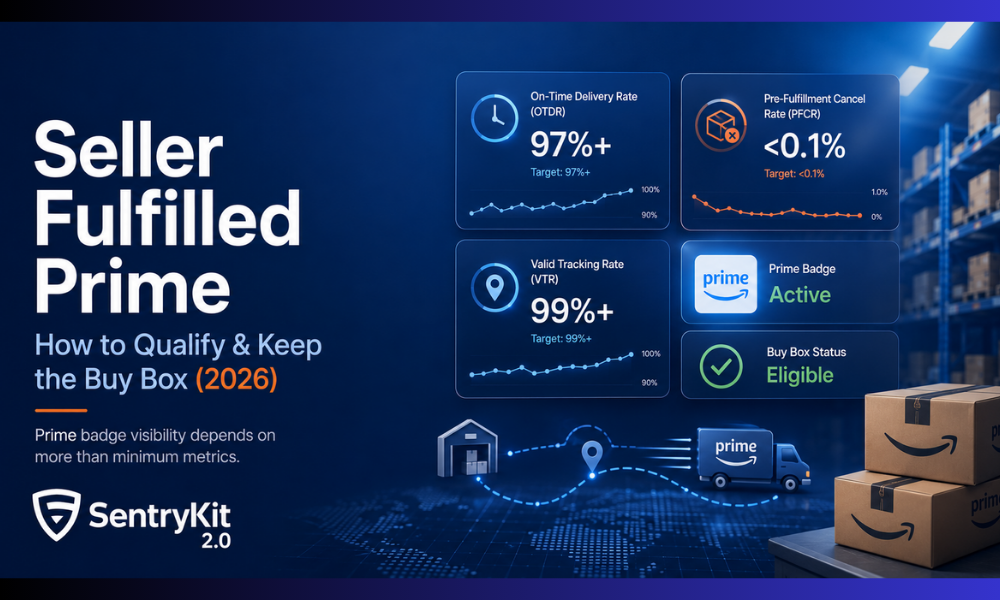
Amazon publishes minimum thresholds for keeping the SFP badge. The Buy Box algorithm applies a higher standard — these are the numbers worth actually targeting:
| Metric | SFP Minimum | Buy Box Target |
|---|---|---|
| On-Time Delivery Rate (OTDR) | 93.5% | 97%+ |
| Valid Tracking Rate | 99% | 99%+ |
| Order Defect Rate (ODR) | <1% | <0.5% |
| Pre-Fulfillment Cancel Rate (PFCR) | <0.5% | <0.1% |
| Late Shipment Rate (LSR) | <4% | <1% |
Meeting the minimum keeps your badge. Hovering near the minimum means you’re likely losing Buy Box share to FBA listings regardless. The most competitive SFP sellers treat the Buy Box target column as the real floor. These are the same FBM performance metrics that also govern SFP eligibility — and the tolerance for drift is narrow on both sides. Helium 10’s SFP guide notes that sellers who treat the minimum as the goal tend to find themselves bouncing in and out of Buy Box eligibility.
Beyond metrics, SFP requires:
You can use a third-party logistics provider for SFP, but the 3PL must meet the same performance standards as an in-house operation. The Prime badge is associated with your seller account, not the 3PL — if your provider misses deliveries, those failures count against your metrics. Choose a 3PL with a confirmed SFP track record and verify they can handle weekend fulfillment before committing.
To apply for SFP, your account needs at least 90 days of selling history and a good standing rating. The application is in Seller Central under the Seller Fulfilled Prime program page.
Once accepted, you enter a trial period — typically 5 to 30 days depending on your order volume. During the trial:
The trial is where most sellers encounter their first surprise. Weekend order handling is enforced from day one. Carriers that look suitable on paper sometimes don’t pass Amazon’s delivery confirmation requirements — tracking scans that show up 12 hours late can quietly push Valid Tracking Rate below the threshold before anyone notices.
Before you start the trial, run a test: ship a few orders through your intended carrier and confirm they track correctly in Seller Central. Discovering a tracking gap during the trial, rather than before it, is an avoidable failure mode that costs weeks.
Accounts that don’t meet trial metrics can re-apply after a waiting period.
Qualifying is the easier half. The metrics that got you into SFP can drift over time — seasonally, operationally, or because of changes to your product mix.
The most common post-qualification failures come from:
That last point is the one sellers most commonly underestimate. SentryKit’s FBM Stock Alert fires before you hit zero inventory — giving you time to restock or adjust availability before customer-facing cancellations start accumulating against your PFCR.
In February 2026, Amazon updated how On-Time Delivery Rate is calculated for SFP sellers. The change tightened the attribution window for late deliveries — specifically addressing orders where tracking showed a parcel as in-transit but undelivered at the expected delivery date. Previously, this created a measurement gap that masked real OTDR performance.
Sellers running OTDR near the 93.5% minimum were directly exposed. Sellers running 96–97% OTDR were untouched. Sellers at 94–95% found themselves suddenly at risk — some had their SFP status suspended before they identified the cause, because the change applied to existing order history rather than only new orders. Amazon’s Seller Central updates section framed it as a measurement clarification rather than a policy change. The practical effect was the same either way.
The clearest lesson: margin matters. If your OTDR sits close to the floor, you’re always one measurement update away from suspension.
Pre-Fulfillment Cancel Rate is directly tied to inventory management. When you cancel an order before shipping due to a stockout, that cancellation counts against your PFCR. Amazon treats this seriously because it’s a confirmed Prime delivery promise that the buyer now doesn’t get.
The challenge for SFP sellers is that inventory visibility is often imperfect — especially across multiple locations or through a 3PL. A stockout over a weekend, when no one is monitoring, produces a cluster of cancellations before it’s caught. The same dynamics that drive FBA stockout costs apply here: the damage is already done by the time you spot the gap in your dashboard. For SFP, the Buy Box PFCR target is 0.1%. There is almost no room for unplanned stockout-driven cancellations.
Both programs give you the Prime badge. The right choice depends on your products, margins, and operational setup.
| Factor | Seller Fulfilled Prime | FBA |
|---|---|---|
| Storage control | You control your inventory | Amazon controls storage |
| Fulfillment cost | Your cost (warehouse + carrier) | FBA fees per unit |
| Product suitability | Oversized, fragile, high-value | Standard-size, high-velocity |
| Operational overhead | High — weekend handling required | Low — Amazon handles shipping |
| Buy Box eligibility | Strong if metrics are maintained | Strong by default |
| Metric risk | Managed by you | Managed by Amazon |
| Returns handling | You handle returns | FBA returns process |
SFP makes the most sense if you’re already running a tight FBM operation, carry products that don’t work well in FBA (oversized, high-value, fragile), or want to preserve the margins that would otherwise go to FBA fees. FBA makes more sense if you want to remove fulfillment complexity and your product economics can absorb the per-unit costs.
Some sellers run both — FBA for standard-size, high-velocity SKUs and SFP for heavier or specialised products. If you split your catalog this way, it’s worth understanding how Buy Box rotation works on mixed-fulfillment listings before you go live. The rotation patterns on split-fulfillment ASINs aren’t always intuitive.
Getting into SFP takes work. Keeping it requires monitoring.
The metrics most vulnerable to operational gaps — OTDR, PFCR, Valid Tracking Rate — are the ones that fail silently. A carrier that underperforms over a holiday weekend, a stockout on a fast-moving SKU, a new delivery zone that hasn’t bedded in. By the time your dashboard shows the problem, orders have already been cancelled and metrics have already moved.
SentryKit’s FBM Stock Alert gives you advance warning before stock reaches zero, so you can act before inventory shortfalls translate into cancellations against your PFCR. For SFP sellers targeting a Buy Box PFCR of 0.1%, that early signal is the difference between a metric that holds and one that doesn’t.
See SentryKit’s pricing to find the right plan for your order volume.
Seller Fulfilled Prime is an Amazon program that lets third-party sellers display the Prime badge on their listings while fulfilling orders themselves — from their own warehouse or through an approved 3PL — rather than using FBA.
To maintain SFP status, you need: On-Time Delivery Rate ≥93.5%, Valid Tracking Rate ≥99%, Order Defect Rate <1%, Pre-Fulfillment Cancel Rate <0.5%, and Late Shipment Rate <4%. The Buy Box algorithm favours metrics higher than these minimums — targeting 97%+ OTDR and <0.1% PFCR is where competitive SFP sellers operate.
It depends on your products and margins. SFP suits sellers with oversized or specialised products, or those who want to avoid FBA fees while maintaining Prime visibility. FBA removes operational complexity but adds per-unit costs. Many sellers run both programs for different parts of their catalog.
Yes. Amazon allows third-party logistics providers for SFP, but the 3PL must meet all the same performance standards as your own operation. Choose a provider with confirmed SFP experience and weekend fulfillment capability — performance failures count against your account regardless of who ships the order.
Amazon removes the Prime badge from affected listings. In some cases, SFP status is suspended across your entire account. You’ll need to bring metrics back above the minimum and may need to re-qualify through a new trial period. With the February 2026 OTDR change, sellers running close to the floor are particularly exposed — maintaining a meaningful buffer above the minimum is the safest position to be in.

Nisha Shetty · Marketing Manager, SentryKit
Nisha is a marketing manager and former Amazon seller who writes about e-commerce growth, consumer behavior, and digital retail trends.