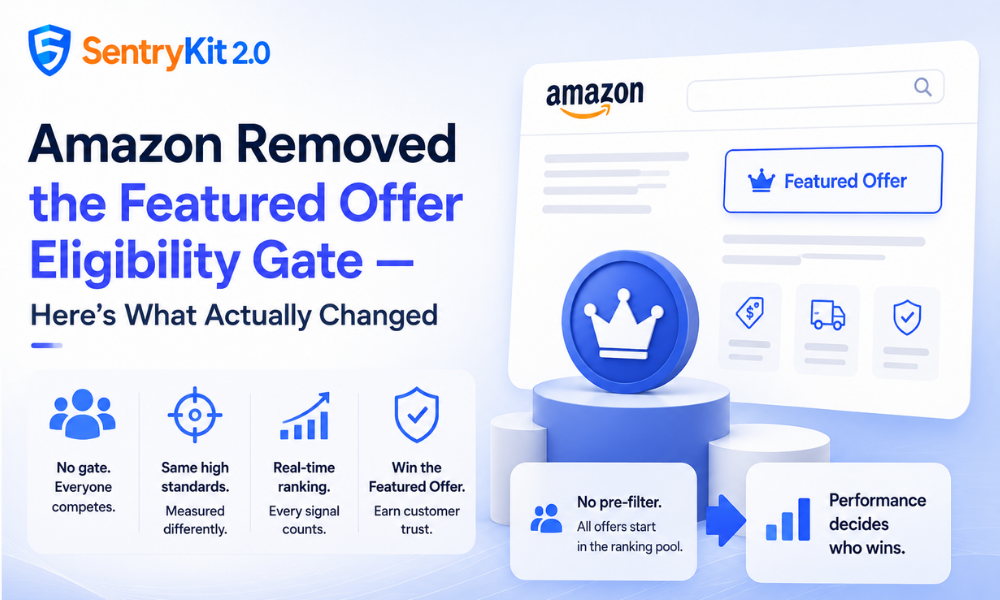
Amazon began removing the seller eligibility gate for the Featured Offer in July 2026, and the rollout runs through the end of the year. It’s rolling out gradually across every Amazon store, it started on July 20 in the EU and UK and reaching the US and remaining stores by the end of the year, and your existing offers are included automatically — no action required on your end.
Updated 17 September 2026. This change is still rolling out. Amazon said it would begin in July 2026 and complete globally by the end of the year, so depending on your marketplace you may or may not have crossed over yet.
Here is the announcement in Amazon’s own words, from Seller Central:
“Starting in July 2026, we’ll begin removing seller eligibility requirements for the Featured Offer. This change will roll out gradually across all Amazon stores globally, completing by the end of 2026. No action is required from you, and your existing offers will automatically be included with this update.”
“Currently, we determine which sellers are eligible based on seller performance criteria. Then, we rank all offers listed by eligible sellers for a particular product, and select the Featured Offer from that pool. As we’ve continued to improve our processes and hear feedback from sellers, we determined that the first seller eligibility step is no longer delivering additional value to customers, so we’re removing it.”
“We’re not changing how the Featured Offer is selected. We’ll continue to evaluate offers and select the Featured Offer based on criteria most important to customers, such as competitive pricing, delivery speed, and performance.”
Three things worth pulling out of that. The selection logic is unchanged — only the eligibility filter in front of it is going. Amazon still names competitive pricing, delivery speed and performance as what decides the Featured Offer. And nothing is required of you: your offers are included automatically.
This is the part sellers are most likely to misread. If your offer is slow to ship, priced above the market, or generating customer complaints, none of that changed — it’s just measured differently now.
Under the old system, a seller could clear the eligibility bar and then coast, because the ranking that followed was a smaller, pre-filtered pool. Under the new system, every offer on that ASIN is in the same pool from the start, including the ones that would have failed eligibility before. That makes the ranking layer do more work, not less. Price, delivery promise, and account health now sit together in one live decision, every time a customer loads that listing.
The sellers who should be paying closest attention are the ones who treated “eligible” as the finish line. Being considered for the Featured Offer was never the same as winning it — that gap just got more visible.
With no pre-filter separating strong offers from weak ones, these seven signals are doing the ranking work in real time:
None of these are new metrics. What’s new is that there’s no longer a pre-filter absorbing some of the weaker offers before the ranking runs. As Helium 10 has pointed out, several of these are exactly the kind of lesser-known metrics sellers tend to overlook until they’ve already cost a ranking position. If you’re only glancing at Featured Offer percentage once a week, you’re getting a lagging view of a ranking that now updates continuously.
Fulfillment method was already one input among several after the November 2025 change that made the Featured Offer fulfillment-neutral — merchant-fulfilled sellers could already win without a price or speed edge. This eligibility change is a different mechanic layered on top of that one: it’s about who gets considered, not who gets favored by fulfillment type.
For FBA sellers, the practical effect is smaller — Amazon’s own logistics already keep delivery-promise accuracy fairly consistent. Seller Fulfilled Prime and merchant-fulfilled sellers feel this more directly, because delivery promise accuracy is something you’re actively managing yourself, and it now factors into the same ranking as everyone else’s offer, gate or no gate.
If you’re chasing Featured Offer share on a wholesale ASIN with three or four sellers competing, this matters even more. Reviewing the seven factors that actually matter for the Buy Box alongside this change is worth the ten minutes.
Check your Featured Offer percentage today, not at your usual weekly review. If it moved and you can’t immediately explain why, work through the seven signals above in order — price first, then delivery promise, then stock position.
If you’ve been monitoring your MAP compliance or price floor already, you have half of this covered. What most sellers are missing is the delivery-promise and suppression side, because those didn’t used to matter until you cleared the eligibility gate — and now they’re live from the first moment a customer sees your listing.
That’s the gap SentryKit fills — a Buy Box Lost alert fires the moment a competitor takes the ranking on an ASIN you’ve been winning, and Competitor Price Change monitoring shows you exactly what shifted in the pool around you. You’re not waiting for a weekly report to find out your position moved. See SentryKit’s pricing to get that visibility running on your catalog.
No — starting in July 2026, Amazon removed the separate eligibility check for the Featured Offer. Every offer now enters the ranking directly, with performance metrics weighted inside that ranking instead of used as a pass/fail filter beforehand.
There’s no replacement filter — the two-step process (eligibility check, then ranking) became one step. Chargeback rate, Order Defect Rate, and Voice of the Customer complaints are now inputs in the same ranking score as price and delivery speed, rather than a separate gate.
No action is required — existing offers are included automatically as the rollout reaches your marketplace. What’s worth doing is checking your Featured Offer percentage, delivery promise accuracy, and offer suppression status now, since there’s no longer a gate absorbing weak offers before the ranking runs.
No. The November 2025 change made the Featured Offer fulfillment-neutral, so merchant-fulfilled sellers could win without an FBA edge. This eligibility-gate removal is a separate, later mechanic — it changes who gets considered for the ranking, not how fulfillment method is weighted within it.
Sellers who previously relied on strong performance metrics to clear the eligibility bar — and treated that as sufficient — are most exposed, since they’re now ranked continuously alongside offers that wouldn’t have been considered before. Merchant-fulfilled and Seller Fulfilled Prime sellers feel the delivery-promise component more directly than FBA sellers.
Check your Featured Offer percentage against your baseline from before July 2026. A drop without an obvious price or stock change is the clearest signal something shifted in the broader ranking pool around you, not on your own listing.

Nisha Shetty · Marketing Manager, SentryKit
Nisha is a marketing manager and former Amazon seller who writes about e-commerce growth, consumer behavior, and digital retail trends.