
- Nisha Shetty
Amazon’s AI Doesn’t Read the Rankings — What It Means for Buy Box
Table of Content
Subscribe for Offers & Amazon Selling Insights
New data on how Rufus recommends products should change how you think about Buy Box strategy — just maybe not in the direction you’d expect.
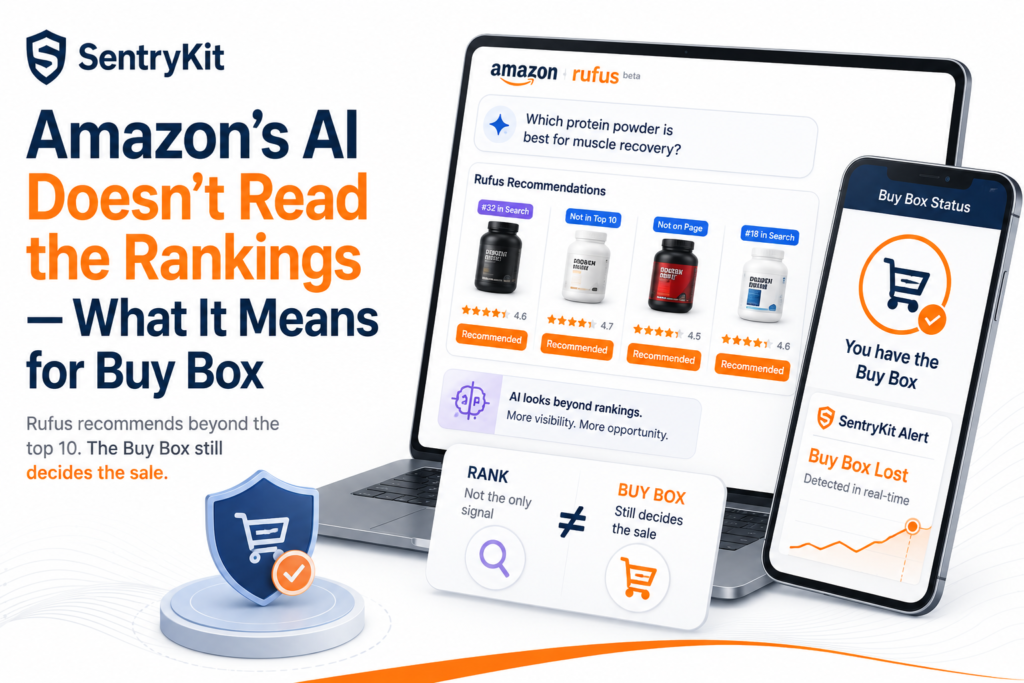
The Data: Rufus Mostly Ignores Organic Rank
Marketplace Pulse ran 1,963 queries through Rufus and logged 12,810 individual product recommendations that came back. The results, published by Ben Donovan on July 16, 2026, are worth sitting with: 63.9% of those recommendations were for products that didn’t appear in the organic top-10 search results at all. More strikingly, 40.9% of recommended products never showed up anywhere on the visible results page — a shopper scrolling manually would never have seen them, but Rufus surfaced them anyway.
Sponsored placements, meanwhile, played a smaller role than most sellers probably assume. Only 14.3% of Rufus’s recommendations were paid placements — and of those, 83% were already organic top-10 performers. In other words, ads mostly reinforced products that were already winning rather than creating visibility that didn’t exist organically.
What Rufus Actually Optimizes For (And What It Doesn't)
Here’s the honest answer: nobody outside Amazon fully knows. Christian Umbach of Autopilotbrand.com, quoted in the Marketplace Pulse piece, captured the uncertainty well — even close observers of Amazon’s AI systems are working from pattern recognition, not documentation. What the data does show is that rank position, as sellers have understood and tracked it for years, is not the primary signal Rufus uses to decide who to recommend.
This tracks with the rename to Alexa for Shopping that Amazon made official in May 2026 — it wasn’t just a name change. Amazon is treating this as a distinct discovery layer, not a rank-based extension of search.
Why 'Rufus Doesn't Care About Rank' Doesn't Mean 'Buy Box Doesn't Matter'
Here’s where sellers tend to draw the wrong conclusion from this data. If Rufus is recommending products that never crack the top-10 organically, it’s tempting to think Buy Box optimization has become irrelevant — that the game has moved somewhere else entirely.
It hasn’t. Rufus determines who gets surfaced to the shopper. It does not determine who gets the sale. Once a shopper clicks through on a Rufus recommendation — or asks Rufus to complete a purchase directly — the transaction still routes through the same mechanics it always has. If you’re not the seller holding the Buy Box on that listing at that moment, someone else’s offer is what the shopper actually buys, or a hijacker’s listing is what shows up instead. How Buy Box eligibility actually works hasn’t changed just because the path to discovery has.
What’s changed is that you can no longer assume you know how a shopper found your listing. A sale that used to come from position #3 in search might now come from a Rufus recommendation that bypassed the search results page entirely, on a query you weren’t even tracking.
The Visibility Gap This Creates for Sellers
This is the uncomfortable part. Amazon isn’t publishing which signals drive Rufus recommendations, and 40.9% of recommended products aren’t discoverable through the search results page you’d normally monitor. That means the tools most sellers use to gauge their visibility — rank trackers, keyword position monitors — are increasingly measuring a slice of demand, not the whole picture.
What doesn’t disappear in that gap is the Buy Box. Regardless of whether a shopper arrives through organic search, a sponsored ad, or a Rufus recommendation you had no idea was happening, the Buy Box status on your listing at the moment of purchase is still what decides whether you get the sale. That’s arguably more true now than it was before Rufus existed at scale — because it’s the one part of the transaction path that hasn’t become opaque.
What to Do About It
Don’t abandon rank tracking — the data shows sponsored spend still overwhelmingly reinforces organic winners, so rank isn’t irrelevant. But stop treating rank as a proxy for total visibility. Pair it with the broader set of strategies that influence AI shopping agent visibility, and treat Buy Box monitoring as the constant in an increasingly unpredictable discovery landscape — not an afterthought behind SEO and ads.
The Bottom Line
Rufus made the path to discovery harder to see. It didn’t touch what happens at the moment of purchase. That’s the gap SentryKit’s Buy Box Lost alert is built for — it fires the moment a competitor takes the Buy Box on your listing, regardless of whether the shopper who’s about to buy from them arrived through search, an ad, or a recommendation you never saw coming. Take a look at real-time Buy Box alerts if visibility into that moment isn’t something you currently have.
Frequently Asked Questions
Does Rufus check who holds the Buy Box before recommending a product?
Amazon hasn’t published its recommendation logic, and the Marketplace Pulse data doesn’t isolate Buy Box status as a factor. What’s clear is that Rufus recommendations and organic rank are only loosely correlated — treat them as separate signals.
If Rufus recommends my product, do I still need to win the Buy Box to get the sale?
Yes. A Rufus recommendation gets a shopper to your listing or into a purchase flow — it doesn’t change who fulfills the order if a competitor holds the Buy Box at that moment.
Are sponsored placements a reliable way to get into Rufus recommendations?
Only 14.3% of recommendations in the study were sponsored, and most of those were already organic top performers. Sponsored placement isn’t a shortcut into Rufus visibility on its own.
Should I stop tracking organic rank?
No — rank still correlates with a meaningful share of both organic and Rufus visibility. The mistake is treating rank as the complete picture rather than one input among several.

Nisha Shetty · Marketing Manager, SentryKit
Nisha is a marketing manager and former Amazon seller who writes about e-commerce growth, consumer behavior, and digital retail trends.