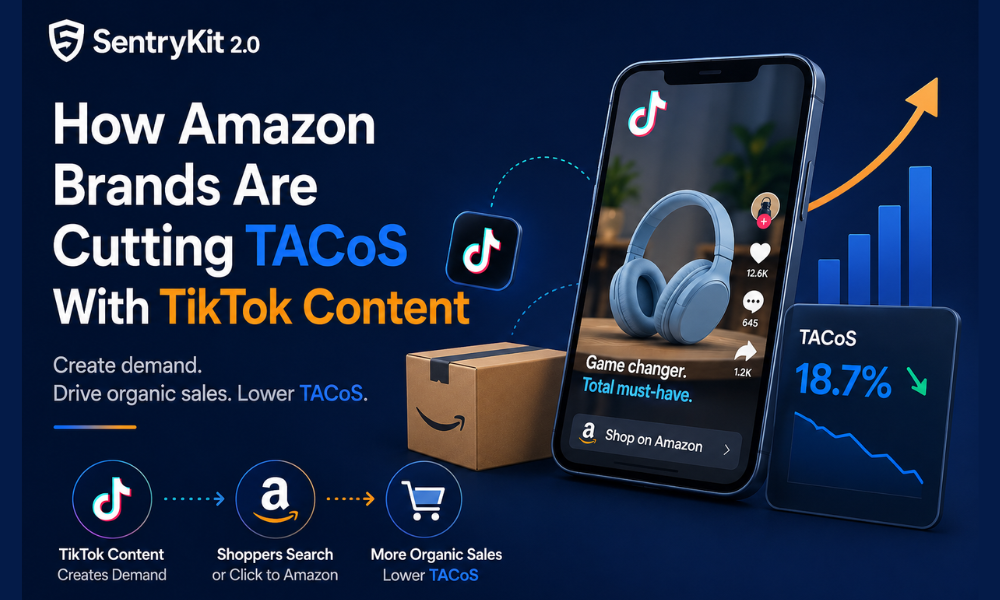
TACoS has been creeping up for most Amazon sellers over the last two years, even as ad efficiency improves on a campaign-by-campaign basis. The reason isn’t usually the ads — it’s that organic sales aren’t growing fast enough to keep the ratio down.
A growing number of brands are addressing that gap outside Amazon entirely, using TikTok content to drive organic demand that shows up as a lower TACoS without touching ad spend at all.
TACoS (Total Advertising Cost of Sale) divides total ad spend by total revenue — organic and paid combined, as Helium 10 breaks down in its TACoS primer. Unlike ACoS, which only looks at ad-attributed sales, TACoS shows whether your brand is becoming less dependent on ads over time.
A falling TACoS means organic sales are growing faster than ad spend. A rising TACoS — even with strong ACoS on individual campaigns — usually means organic demand is flat or declining, and paid traffic is doing more of the work to hold your sales steady. That distinction matters for margin, not just ad efficiency — a business propped up by paid traffic looks very different on a profit margin breakdown than one where organic demand is carrying its weight.
TikTok content drives Amazon sales through a different mechanism than Amazon ads do. Instead of showing up in front of shoppers already searching for your category, it creates demand that didn’t exist before someone saw the video — then routes them to Amazon through a product link, TikTok Shop integration, or simple brand-name search.
That demand shows up in your organic sales, not your ad-attributed sales, which is exactly what pulls TACoS down. A brand that adds a consistent flow of product-demonstration or use-case content to TikTok is effectively building an organic acquisition channel that Amazon’s own ad auction doesn’t touch — Jungle Scout has documented the same spillover pattern across categories well beyond the products that go viral on their own.
Not every TikTok format converts to Amazon sales at the same rate. The formats brands report working best share a common thread: they solve a specific problem before they mention the product.
Straight product ads ported over from other platforms tend to underperform on TikTok specifically because the format rewards content that doesn’t feel like an ad in the first three seconds. As Marketplace Pulse has framed it, TikTok is a content-first shopping platform where demand gets manufactured by video rather than retrieved by search — the opposite of how Amazon itself works, which is exactly why the two channels complement each other instead of competing for the same intent.
The safest way to test this is to hold your Amazon ad spend flat for the duration of the test, rather than cutting it in anticipation of organic lift that hasn’t happened yet. Run a consistent cadence of TikTok content — most brands testing this post at least 3 times a week — for a minimum of 6 to 8 weeks before drawing conclusions, since organic sales lift tends to lag content publication by several days to a couple of weeks.
Track your TACoS weekly rather than daily during the test. Daily TACoS is noisy enough that a single viral video or a single slow day can make the trend look better or worse than it actually is.
Watch three numbers together: organic sales growth, branded search volume on Amazon, and TACoS itself. If TikTok content is working, branded search volume typically moves first — people who saw the video searching your brand name directly on Amazon — followed by organic sales growth, with TACoS improvement showing up last as the lagging confirmation. Your Search Query Performance report is the fastest place to confirm that branded-search movement, since it separates branded from category search volume week over week.
One thing worth watching for while you’re running this test: a lower TACoS from stronger organic performance is exactly the kind of win a competitor can undercut quickly if they’re watching your pricing. A Competitor Price Change alert means a price cut on your best-performing ASIN doesn’t erase weeks of organic content work before you notice. See what SentryKit’s pricing looks like if that visibility isn’t already part of your setup.
TACoS divides total ad spend by total revenue, including organic sales, showing overall ad dependency. ACoS only measures ad spend against ad-attributed sales, so it doesn’t reflect organic performance.
TikTok content drives organic demand that routes to Amazon outside the ad auction, increasing organic sales relative to ad spend and pulling the TACoS ratio down.
Problem-first demonstrations, use-case-specific unboxings, before/after comparisons, and creator-led organic reviews tend to outperform straight product ads ported from other platforms.
Most brands need 6 to 8 weeks of consistent posting before organic sales lift becomes visible, since the effect typically lags content publication by days to a couple of weeks.
No — hold ad spend flat during the test so any TACoS improvement reflects genuine organic lift rather than a reduction in the ad spend side of the ratio.
Branded search volume on Amazon typically moves first, followed by organic sales growth, with TACoS improvement appearing last as the lagging confirmation signal.
Nisha Shetty · Marketing Manager, SentryKit
Nisha is a marketing manager and former Amazon seller who writes about e-commerce growth, consumer behavior, and digital retail trends.