Brand protection on Amazon is not one problem — it is several. Who controls your listing. Who holds your Buy Box. Whether your product content has been quietly rewritten. Whether a hijacker appeared at 2am and took your revenue with them.
Take a private label brand with 40 ASINs across supplements and wellness. Brand Registry enrolled, trademarks filed, A+ Content live. All of that protection is real — and none of it fires an alert when a competitor undercuts them by $1.20 on a Friday night and holds the Buy Box through the weekend.
The tools that solve these problems are different tools. Amazon’s own programs — Brand Registry, Project Zero, Transparency — are built around intellectual property and counterfeits. They are essential, but they leave real gaps. Third-party monitoring platforms cover what Amazon’s programs do not: real-time Buy Box changes, unauthorized pricing, listing alterations, and suppression events.
This post covers all seven tools and programs worth using in 2026. For each one: what it does, who it is for, what it costs, and where it falls short.
The starting point for every brand selling on Amazon.
Brand Registry is not optional — it is the prerequisite for nearly every other brand protection tool covered in this post. Over 800,000 brands are enrolled globally, and for good reason: without it, you have limited control over your own listing.
Brand Registry grants you authoritative control over your product detail pages. Your brand name, logo, and product descriptions are tied to your trademark registration, making it significantly harder for unauthorized sellers to alter your listing content. You also gain access to Report a Violation tools, A+ Content, Amazon Stores, Sponsored Brands, and Brand Analytics.
When infringers are detected — counterfeit listings, unauthorized use of your brand name, fraudulent sellers — you can submit reports directly. Amazon’s automated systems then scan for similar violations across the catalog.
This is the part most guides skip. Brand Registry does not:
Every brand selling on Amazon. Non-negotiable.
Free. Requires a registered trademark (or pending trademark application through Amazon IP Accelerator).
Brand Registry is a foundation, not a full solution. Think of it as establishing your ownership — it doesn’t actively monitor what happens to that ownership in real time.
Proactive counterfeit removal — no waiting for Amazon to act.
Project Zero is what Brand Registry’s IP tools look like when you add AI automation and self-service. It is built for brands that deal with recurring counterfeit problems and need faster removal than standard infringement reporting allows.
Project Zero operates on three mechanisms:
Automated protections: Amazon’s machine learning engine scans over 5 billion listing updates daily, looking for patterns that match known counterfeits of your brand. When something is flagged, it is removed proactively — before you ever see it.
Self-service counterfeit removal: Rather than submitting a report and waiting, you can remove counterfeit listings directly through the Project Zero dashboard. Removals typically process within minutes.
Product serialization: You apply unique Amazon-generated codes to each unit during manufacturing. Amazon then verifies these codes before fulfilling orders, blocking counterfeit units from reaching customers.
Brands with established counterfeiting problems — particularly those who have already submitted infringement reports through Brand Registry and want a faster removal path.
Free for enrolled brands. Requires active Brand Registry enrollment and a reporting accuracy rate of at least 99%. (Amazon revokes access if your accuracy drops below that threshold, so only report what you are certain about.)
Project Zero is invitation-accessible and enrollment sits around 25,000+ brands — a fraction of the 800,000+ in Brand Registry. It also requires maintaining clean reporting history. And like Brand Registry, it does not touch Buy Box dynamics, pricing conflicts, or listing suppression from content issues.
Unit-level authentication — the most powerful counterfeit deterrent Amazon offers.
Transparency is the most operationally demanding program in this list, and the most effective at preventing counterfeits from reaching customers at all.
Every unit of an enrolled product gets a unique 2D matrix code before it enters the supply chain. Amazon scans this code when units arrive at fulfillment centers and again before shipping. Customers can scan the code themselves using the Amazon Shopping app to verify authenticity — a green check mark confirms the real product.
The result: counterfeit units physically cannot enter the Amazon fulfillment network for enrolled products. A fake without a valid Transparency code gets rejected.
Brands with high-volume SKUs, premium price points, or documented counterfeiting problems. Particularly effective for products where buyer trust is critical — supplements, electronics accessories, luxury goods.
Approximately $0.01–$0.05 per unit, depending on volume. For a brand shipping 500,000 units annually, that is $5,000–$25,000/year. Add labeling and operational costs for applying codes during manufacturing.
Fewer than 25% of Brand Registry enrollees have activated Transparency, largely because of this per-unit cost and the operational lift of code application at scale.
Cost scales directly with volume. For brands selling high-volume commodity products at thin margins, Transparency may be economically impractical. It also requires integration at the manufacturing or pre-fulfillment stage, which adds complexity for brands using third-party manufacturers.
Like Brand Registry and Project Zero, it does not protect the Buy Box, monitor pricing, or alert you to listing changes.
The gap all three Amazon programs above leave open: your Buy Box, your pricing, your listing — monitored in real time.
Brand Registry tells you who owns the listing. SentryKit tells you what is happening to your revenue right now.
These are different problems. Brand Registry does not fire an alert when a competitor takes your Buy Box at 11pm on a Friday. It does not tell you that a listing change just pushed your conversion rate off a cliff. It does not distinguish between a Buy Box you lost to a competitor (who holds it) and a Buy Box that was suppressed (which no longer exists). SentryKit tracks all of it.
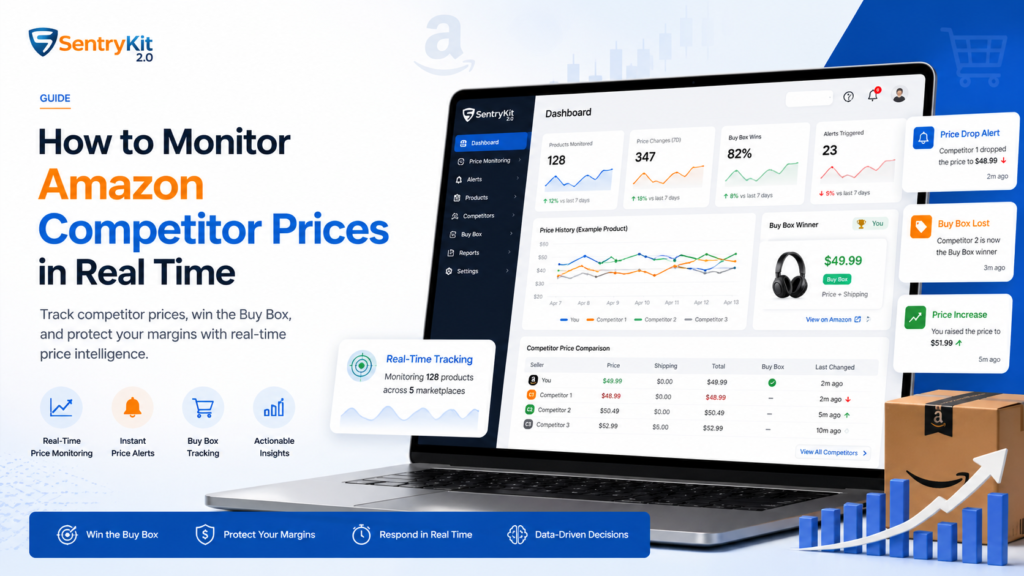
SentryKit is a Buy Box intelligence platform. It monitors every signal across your catalog — Buy Box status, competitor moves, listing content, inventory levels, pricing gaps, sales velocity, product badges, and listing health — simultaneously, across every ASIN.
Alerts fire within minutes of a change, not on an hourly check cycle. Every Buy Box Lost alert includes the competing seller’s storefront, their price, the exact price gap to your listing, whether matching that price is above your floor, and three ranked recovery options with context.
The platform distinguishes clearly between Buy Box Lost (a competitor holds it) and Buy Box Suppressed (no Buy Box exists because Amazon pulled it). These are different problems with different fixes — and conflating them wastes time.
For listing monitoring, SentryKit catches content changes — including AI rewrites that Amazon applies to titles and bullets without notifying you.
FBA brands that need real-time Buy Box intelligence and listing change alerts. Particularly effective for brands managing multiple ASINs, running promotions, or operating in categories with active third-party competition.
SentryKit is a monitoring and intelligence platform — not a repricer. It gives you the data and context to make pricing decisions; it does not automate them. If you need automated repricing, that is a separate tool category. SentryKit’s value is in the speed and quality of the signal, not in acting on it for you.
Dedicated per-ASIN monitoring at a transparent per-unit price.
AMZAlert takes a different pricing approach from the order-volume models above: you pay per ASIN, per month. For sellers with a small number of high-value ASINs, this can work out cheaper than volume-based plans.
AMZAlert monitors listings for price changes, competitor activity, inventory shifts, review changes, and Buy Box events. Alerts arrive via email or SMS. The tool is built around straightforward monitoring without deep analytics layers.
Sellers with a focused catalog who want reliable alert coverage without committing to a platform-level tool. Good fit for brands tracking fewer than 50 ASINs.
Three tiers, all priced per ASIN/month with volume discounts:
14-day free trial (Advanced Seller features, up to 50 ASINs, no credit card required).
Monitoring runs on 4-hour intervals — not real-time.
The 4-hour monitoring cycle means you may not catch a Buy Box change until hours after it happens. For high-velocity products or competitive categories, that lag has real revenue impact. The per-ASIN pricing also becomes expensive at scale — 100 ASINs on Elite Seller runs $135/mo before volume discounts. For a direct comparison with a tool in the same category, see SentryKit vs AMZMonitor.
Listing and competitor monitoring with a generous trial and keyword tracking included.
SellerSonar combines listing monitoring with keyword rank tracking, making it a reasonable option for sellers who want both in one platform.
SellerSonar monitors listing changes, competitor activity, Buy Box events (on higher tiers), review shifts, and keyword rankings. Alerts are delivered by email. The platform covers multiple marketplaces.
Sellers who want listing monitoring and keyword tracking combined. The Pro tier covers up to 150 ASINs — useful for mid-size catalogs.
Note: Buy Box Lost/Won alerts are not included on the Pro plan. You need Premium ($39.98/mo) to get Buy Box event monitoring.
The polling interval — 4 hours on Pro, 2 hours on Premium — means SellerSonar is not a real-time monitoring tool. If your primary concern is catching Buy Box changes immediately, this matters. Also: Pro-tier users expecting Buy Box alerts will need to upgrade to Premium to get them, which nearly doubles the cost.
For a dedicated monitoring comparison, see the full breakdown. For a direct feature-by-feature comparison, see SentryKit vs SellerSonar.
Order-volume-based monitoring from an established Amazon software provider.
Bindwise is part of the Threecolts ecosystem — a broader Amazon seller software suite — which means it benefits from ongoing development and enterprise-grade infrastructure.
Bindwise monitors Buy Box changes, listing alterations, ASIN suppressions, price changes, and feedback events. Alerts go out via email, SMS, or Slack. The platform covers multiple Amazon marketplaces.
Sellers who want reliable, straightforward listing and Buy Box monitoring. The free plan works for low-volume testing; the entry paid tier is accessible for sellers processing up to 1,000 orders/month.
The free plan’s 7-days-per-month monitoring and 50-alerts-per-day cap limits its usefulness for active sellers. The entry paid tier at $19/mo is competitive, but pricing scales with order volume — high-volume sellers will move up tiers quickly. As a monitoring-focused tool within a larger software ecosystem, Bindwise does not offer the Buy Box intelligence depth that dedicated platforms provide. See SentryKit vs Bindwise for a direct comparison.
The right answer for most brands is not one tool — it is a layered stack:
Foundation (every brand needs this):
If you face recurring counterfeits:
For operational Buy Box and listing monitoring (every active brand needs this):
The gap between Brand Registry’s IP protection and what actually affects your revenue day-to-day — Buy Box changes, pricing shifts, listing alterations, suppression events — is where third-party monitoring tools earn their keep. Brand Registry tells Amazon you own the brand. A monitoring platform tells you what is happening to your revenue.
For a complete breakdown of dedicated monitoring tools, see the Buy Box monitoring comparison.
Amazon brand protection software includes tools and programs that help sellers detect and respond to threats on Amazon — counterfeits, listing hijackers, Buy Box changes, and listing alterations. It spans Amazon’s own programs (Brand Registry, Project Zero, Transparency) and third-party monitoring platforms like SentryKit, AMZAlert, SellerSonar, and Bindwise.
Partially. Brand Registry lets you report and remove counterfeit sellers and those misusing your brand name. It does not stop legitimate resellers from listing your products, and it does not prevent competitors from winning your Buy Box through lower pricing. Real-time hijacker detection requires a third-party monitoring tool alongside Brand Registry.
Project Zero uses three mechanisms: AI-automated scanning of 5+ billion daily listing updates to proactively remove counterfeits, self-service removal allowing you to take down fake listings in minutes, and product serialization with unique per-unit codes that Amazon verifies before fulfillment. It requires Brand Registry enrollment and a 99%+ reporting accuracy rate.
Brand Registry is an IP enforcement system protecting your trademark and listing content. A monitoring tool is an operational intelligence system that watches your Buy Box, pricing, listing content, and inventory in real time. Brand Registry establishes your rights; monitoring tools protect your revenue. You need both.
For brands with premium products, active counterfeiting problems, or high-trust categories, yes. At $0.01–$0.05/unit, Transparency prevents counterfeit units from entering Amazon’s fulfillment network entirely. For high-volume, thin-margin products, the per-unit cost and labeling complexity may not be justified. Fewer than 25% of Brand Registry enrollees currently use it.

Nisha Shetty · Marketing Manager, SentryKit
Nisha is a marketing manager and former Amazon seller who writes about e-commerce growth, consumer behavior, and digital retail trends.