
Quick answer: which Buy Box tool fits you
Losing the Buy Box doesn’t announce itself. One moment you’re winning it consistently; the next, a competitor has undercut you and taken it — and unless something alerts you, you’ll find out hours later when you check your dashboard. By then, a day’s worth of sales is already gone.
That gap between when something goes wrong and when you find out is exactly what a Buy Box monitoring tool is designed to close. This guide covers the best options available in 2026, how they compare on the features that actually matter, and how to pick the right one depending on how you sell.
Buy Box monitoring means tracking your Buy Box win rate and status continuously — not checking it manually once a day. A monitoring tool watches your listings and alerts you the moment something changes: you lose the Buy Box, a competitor undercuts your price, a new seller appears, or your listing becomes suppressed.
The value isn’t the data itself — it’s the speed. Amazon’s Buy Box algorithm updates constantly. If you catch a loss within minutes, you can act before the damage compounds. If you catch it the next morning, the window has already closed.
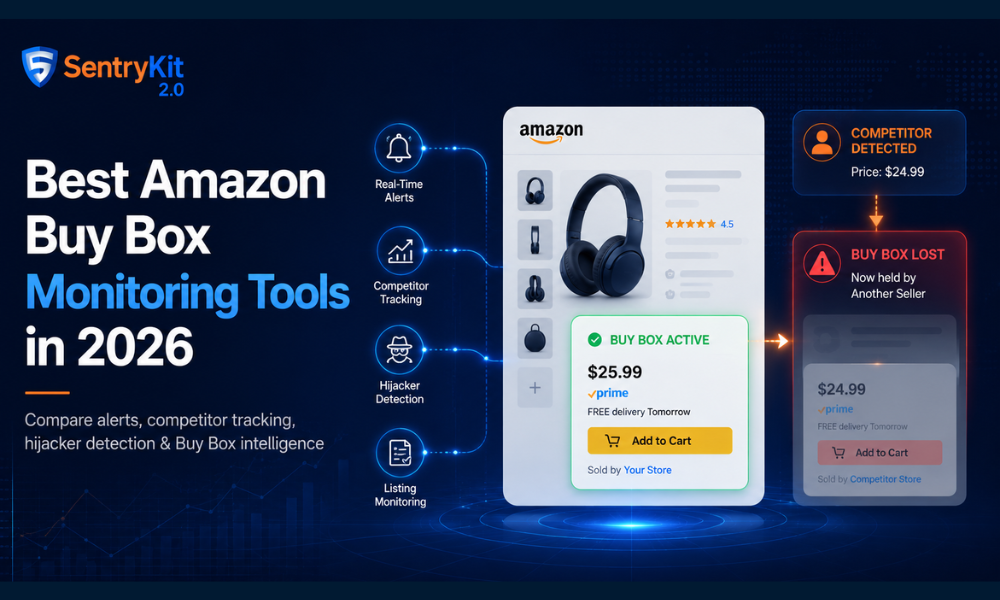
Good Buy Box monitoring covers four things at minimum:
The tools in this guide vary significantly in how many of these they cover — and how fast.
SentryKit tells you whether you lost the Buy Box to a competitor or Amazon suppressed it, with the price gap on every alert.
Three changes have made real-time monitoring more important than it was even two years ago.
More sellers entering established ASINs. As Amazon’s catalogue matures, resellers are entering categories that private label brands previously had to themselves. A listing with low competition in 2023 may now have five or six sellers rotating the Buy Box on a rolling basis. According to Marketplace Pulse, third-party seller activity on Amazon has continued to grow consistently — meaning more competition on more listings.
Amazon removed the Buy Box eligibility gate. In July 2026 Amazon began removing the seller eligibility check for the Featured Offer. The rollout started in the EU and UK and completes across all Amazon stores by the end of 2026. More offers now compete for the same Buy Box, including sellers who used to be filtered out, and Amazon still suppresses the Buy Box when the price is above its threshold. Read what changed in our post on the Featured Offer eligibility gate removal.
Competitor repricing tools are faster too. When sellers across the marketplace are running automated repricing — and many are — a strategy based on manual checks simply can’t keep pace.
Not all tools are equivalent. Here’s what separates the ones worth paying for from the ones that look good until you actually need them.
Alert speed. This is the most important differentiator. A tool that checks every 15 minutes is not the same as one that checks every few hours. In a competitive category, even a 15-minute lag means lost sales. A 6-hour lag in a fast-moving category is a material revenue hit.
Alert channels. Email is the baseline. The better tools also send alerts to Slack, Microsoft Teams or ClickUp, and let you choose which alert types go where. A Hijacker Detected alert that arrives in a Slack channel where your team is active will get acted on faster than one buried in an inbox.
Coverage across your catalogue. Some tools cap how many ASINs you can monitor on a given plan. If you’re managing 50+ ASINs, check the limits before committing.
Competitive context, not just notifications. Knowing you lost the Buy Box is useful. Knowing which seller took it and at what price is actionable. The best tools give you both.
Lost or suppressed. A lost Buy Box (another seller won it) and a suppressed Buy Box (Amazon removed it because the price is above its threshold) need opposite fixes. Matching a competitor does nothing for a suppression. Look for a tool that tells you which one happened and shows the price Amazon expects, so you know why you lost the Buy Box before you change anything.
Suppression and content change detection. Buy Box losses aren’t always about pricing. Listings get suppressed for policy reasons; other sellers can alter your title, images, or bullet points. A monitoring tool that only tracks price-related changes will miss these.
Historical data. Can you look back at when you typically lose the Buy Box, how long losses last, and which competitors are most disruptive? That pattern data is essential if you want to move from reactive to proactive.
| Tool | Real-Time Alerts | Competitor Price Tracking | Hijacker Detection | Suppression Alerts | Content Change Alerts | Historical Data | Starting Price |
|---|---|---|---|---|---|---|---|
| SentryKit | ✅ Real time | ✅ Yes | ✅ Yes | ✅ Yes | ✅ Yes | ✅ Yes | $19/mo |
| Bindwise | ✅ Real-time | ✅ Yes | ✅ Yes | ✅ Yes | ✅ Yes | ⚠️ Limited | $25/mo |
| SellerSonar | ✅ Real-time | ✅ Yes | ✅ Yes | ✅ Yes | ✅ Yes | ⚠️ Limited | $19/mo |
| AmzMonitor | ⚠️ Every 24h (down to 2h) | ⚠️ Basic | ✅ Yes | ✅ Yes | ✅ Yes | ❌ No | $12/mo |
| Helium 10 (Alerts) | ✅ Real-time | ❌ No | ✅ Yes | ✅ Yes | ✅ Yes | ❌ Limited | From $129/mo (suite) |
| Sellerboard | ⚠️ Hourly | ❌ No | ⚠️ Limited | ✅ Yes | ❌ No | ✅ Yes | $19/mo |
Features and pricing checked October 2026 and vary by tier.
SentryKit is an Amazon monitoring tool built for sellers who need fast, accurate alerts across their entire catalogue. Most tools treat Buy Box tracking as one feature among many. SentryKit is built around it.
What it does well
Alerts fire in real time, the moment Amazon changes something, not on an hourly check cycle. When the Buy Box moves, SentryKit tells you which of two things happened. If another seller won it, you get a Buy Box Lost alert with the seller who took it and their price. If Amazon suppressed it because your price is above its threshold, you get a Buy Box Suppressed alert with the expected winning price, so you know exactly what wins it back. If an unauthorised seller joins your ASIN, you get a Hijacker Detected alert. That distinction matters more than it sounds: the right response to a hijacker is completely different from the right response to a competitor undercut. Conflating them leads to the wrong action, or no action at all. Where it can, SentryKit narrows each alert down to the actual cause and gives you recovery options to guide your next step, so you can see why you lost the Buy Box without digging through Seller Central.
You can name the sellers you know, Amazon included. Losses to them are labelled clearly and can go into a digest instead of an instant alert, so the alerts that reach you are the ones worth acting on.
SentryKit also monitors 50+ other signals, including search suppression, content changes (title, images, bullet points altered by another seller), and Competitor Price Changes across all sellers on your ASIN. It also alerts on best seller rank and keyword rank changes, and reads your Account Health Rating and order defect rate. See how the Amazon Buy Box alert separates a lost Buy Box from a suppressed one. The result is a complete picture of your listing’s health — not just whether you hold the Buy Box right now, but why you may lose it next.
Alert channels: Email, Slack, Microsoft Teams and ClickUp, plus webhooks and an API to feed alerts into your own tools. You choose which alerts you get and where they go.
Historical data: Full win rate history, loss events with timestamps and competitor data.
Pricing: Starting at $19/month. See the pricing page for current plan details.
Who it suits: Private label sellers managing their own brand listings, wholesale sellers across multi-ASIN catalogues, and agencies monitoring on behalf of clients.
The one thing it doesn’t do: SentryKit won’t reprice for you. It tells you what’s happening and who’s responsible — your response is your decision. Sellers who want automated repricing need to pair SentryKit with a dedicated repricer (more on that below).
Bindwise is one of the more direct competitors to SentryKit in the monitoring space. It focuses specifically on listing protection — hijackers, Buy Box changes, suppression, content changes — without trying to be a research or repricing platform.
What it does well
Bindwise covers the core alert types in real time and has a stable, well-tested alert engine. If your primary need is getting notified quickly when something goes wrong on a listing, it handles that reliably. Setup is straightforward, and it’s been around long enough that most of the rough edges have been smoothed out.
Where it falls short
Bindwise gives you the alert without much competitive context. You’ll know you lost the Buy Box; you often won’t know which seller took it or what they’re charging. Historical Buy Box data is limited too, which makes it harder to spot patterns — like a competitor who consistently undercuts you on Tuesday mornings, or a listing that reliably loses the Buy Box when your price exceeds a certain threshold.
If you want to understand why you’re losing the Buy Box, not just be told that you did, that gap becomes frustrating quickly.
Who it suits: Sellers who want dedicated listing monitoring and don’t yet need deep competitive analytics.
Worth knowing: as of October 2026, bindwise.com redirects to FeedbackWhiz, another Threecolts product. Check what’s included before you sign up.
SellerSonar pairs Buy Box and listing monitoring with keyword rank tracking. For sellers running organic SEO alongside their Buy Box strategy, having both in one dashboard is a genuine convenience.
What it does well
Real-time alerts for hijackers, Buy Box losses, suppression, and content changes — the full standard set. The keyword tracking integration lets you correlate a drop in rankings with a listing event, which adds useful context. A sudden keyword rank drop that coincides with a Listing Suppressed event tells a cleaner story than either data point alone.
Where it falls short
The dual focus means neither side runs as deep as a specialist. SentryKit goes further on Buy Box analytics and competitive intelligence. A dedicated rank tracker goes further on keyword data. SellerSonar sits between them — useful if you want both in one tool, but not the strongest option if Buy Box monitoring is what you actually need most.
Who it suits: Sellers actively managing keyword rankings and listing health who prefer fewer separate subscriptions. Comparing it head to head? See our SellerSonar alternative breakdown.
AmzMonitor is a no-frills listing alert tool. It covers hijacker detection, Buy Box loss, listing suppression, and content changes at one of the lowest price points in the category.
For a seller with a small catalogue who primarily wants to know when something goes wrong, it does the job. It checks each ASIN every 24 hours by default (as often as every 2 hours, with fewer ASINs per plan) and sends email notifications. Plans start at $12/month for 20 ASINs. Setup is straightforward.
The gap shows up when things get complicated. AmzMonitor doesn’t give you competitor pricing data, win rate history, or any context around why you lost the Buy Box. A wholesale seller managing 80 ASINs across a competitive category will hit the ceiling fast — not because the alerts fail, but because the alerts are all you get. No pattern data. No Slack integration. No way to understand what’s driving the losses.
Who it suits: New sellers or very small catalogues where cost is the primary constraint and basic alerting is sufficient.
Helium 10 is best known as a research and keyword tool. Its Alerts module covers hijacker detection, content changes, and listing suppression — and if you’re already paying for a Helium 10 subscription, activating it costs nothing extra.
On those three alert types, it performs well. The hijacker detection is genuinely fast, and content change alerts are reliable. For sellers whose primary concern is protecting their listing from external interference — unauthorised sellers and content manipulation — Helium 10 Alerts covers the essentials.
What it doesn’t do: track Buy Box win rate over time or show you which seller is currently holding your Buy Box and at what price. It tells you something happened. It doesn’t give you the competitive picture to understand what to do about it.
For sellers who’ve outgrown incident alerts and want to understand Buy Box dynamics at a strategic level, that’s the gap that eventually pushes them to add a dedicated tool.
Who it suits: Sellers already on Helium 10 who want baseline listing protection without adding another subscription.
Sellerboard is a profit analytics platform. Its primary job is showing your true margins — factoring in FBA fees, returns, refunds, PPC costs, and promotions. Buy Box monitoring is in there, but it’s not what the tool is designed around.
The integration that does work well: when you lose the Buy Box, you can immediately see the revenue impact alongside the alert in the same dashboard. For sellers who think primarily in P&L terms, that connection between listing event and financial outcome is genuinely useful.
The limitations are real, though. Sellerboard checks on an hourly cycle rather than continuously. It doesn’t track competitor pricing at the ASIN level. And it won’t tell you who took your Buy Box or why. If you’re in a fast-moving category with active competition, hourly checks aren’t sufficient.
Who it suits: Sellers already using Sellerboard for profit tracking who want Buy Box alerts built in, without managing a second tool.
You manage your own brand, 10–100+ ASINs, and Buy Box defence matters: SentryKit. The combination of fast alerts, granular competitive data, and historical win rate analysis is built specifically for this. It’s the difference between knowing you lost the Buy Box and understanding the pattern behind why.
You want dedicated monitoring without deep analytics: Bindwise or SellerSonar cover the core use cases well. Move to SentryKit when you need to understand the competitive picture — not just be notified that something changed.
You’re already on Helium 10: Use Helium 10 Alerts for hijacker and content protection. Add SentryKit when Buy Box win rate data and competitor pricing context become important to your strategy.
You sell wholesale across a large catalogue: SentryKit. Wholesale sellers don’t always hold the Buy Box exclusively — but a sudden drop in win rate is a clear signal that something has shifted, either in a competitor’s pricing or in your own seller health metrics. You need the data to tell the difference.
You’re just starting out and cost is the primary constraint: AmzMonitor covers the basics at the lowest price. Plan to upgrade as your catalogue and competitive complexity grows — the ceiling comes sooner than most sellers expect.
You run Sellerboard for margin tracking: Its built-in alerts may be sufficient if you’re in a lower-competition category. In competitive categories, the hourly lag is a real limitation.
“If I already have a repricer, do I still need a monitoring tool?” Yes — and here’s why they’re not the same thing.
A repricer adjusts your price automatically based on rules you’ve set: match the lowest offer, hold a margin floor, chase the Buy Box at the cheapest viable price. It reacts to competitor pricing to change your price.
A monitoring tool watches what’s happening on your listing and alerts you. It tells you when you’ve lost the Buy Box, who has it, what they’re charging, whether a hijacker has appeared, and whether your listing has been suppressed.
The blind spot with a repricer alone: it can’t distinguish between a legitimate competitor undercut and a hijacker triggering a race to the bottom. It will reprice in response to both. A hijacker isn’t just a Buy Box problem — it’s a brand and margin problem that requires a different response entirely. That’s the case a repricer can’t handle on its own, and exactly what a tool like SentryKit catches.
Most sellers end up running both. The repricer handles routine price competition; SentryKit catches the edge cases the repricer can’t fix. If you’re evaluating repricers to pair with SentryKit, Seller Snap, BQool, Aura, and RepricerExpress are commonly used alongside it.
Know the moment your Buy Box changes hands
SentryKit watches 50+ signals on your ASINs, from Buy Box and hijackers to suppressions and price changes, and alerts you with the before and after, in your language and currency. Plans from $19/mo.
Start 14-day free trialRelated alerts
SentryKit is the strongest dedicated Buy Box monitoring tool in 2026 for sellers who want fast alerts, hijacker detection, suppression monitoring, and competitive pricing data in one platform. For sellers already on Helium 10 who primarily need hijacker and content change alerts, Helium 10 Alerts covers the fundamentals without an additional subscription.
Amazon doesn’t send a notification when you lose the Buy Box, so you need a monitoring tool connected to your Seller Central account. SentryKit sends a real-time Amazon Buy Box alert by email, Slack, Microsoft Teams or ClickUp, with who took it and the price that wins it back. Without a tool, you only find out when you check your account manually.
Buy Box alert software monitors your Amazon listings and notifies you when your Buy Box status changes — whether you’ve lost it to a competitor, had it suppressed due to a pricing or policy issue, or had an unauthorised seller appear on your listing. The most important differentiator between tools is alert speed: real-time monitoring versus hourly checks.
Yes. All major monitoring tools support multi-ASIN tracking, with the number of monitored ASINs varying by plan. SentryKit starts at $19/month — check the pricing page for current plan details and coverage limits.
No. Buy Box monitoring tracks what’s happening on your listing and alerts you. Repricing automatically adjusts your price based on rules you’ve set. Most competitive sellers use both: a repricer for routine price competition, and a monitoring tool to catch situations a repricer can’t handle — hijackers, suppressions, and Buy Box losses that have nothing to do with price.

Nisha Shetty · Marketing Manager, SentryKit
Nisha is a marketing manager and former Amazon seller who writes about e-commerce growth, consumer behavior, and digital retail trends.