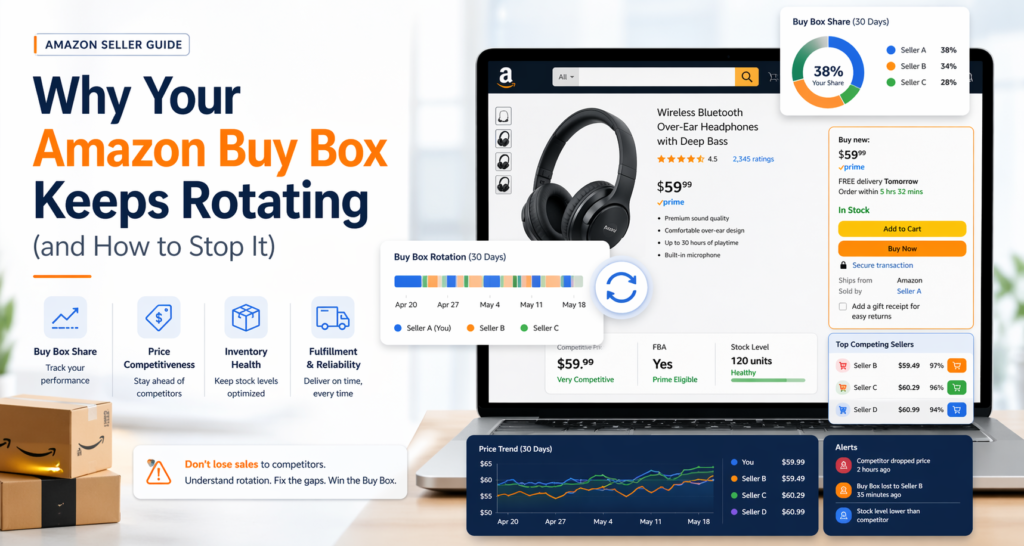
You check your dashboard on Monday — you have the Buy Box. Tuesday morning, you’ve lost it. Tuesday afternoon, you have it again. By Wednesday, your sales are down 30% and no one on the listing actually changed their price. That’s buy box rotating — and it’s one of the most frustrating signals for Amazon sellers to diagnose because nothing on the surface looks broken.
Buy box rotating happens when Amazon splits Buy Box ownership between multiple sellers who all meet eligibility thresholds at similar levels. Unlike a clean Buy Box Lost, rotation is intermittent — which means it slips past most once-a-day dashboard checks and quietly erodes your profit margin across listings.
This guide breaks down why the Buy Box rotates between sellers, how to tell rotation apart from a true loss, and the four plays that consistently hold more share — with real data signals rather than guesswork. If you’ve been burned by a repricer “going rogue” in response to phantom price moves, this is the underlying pattern you were chasing.
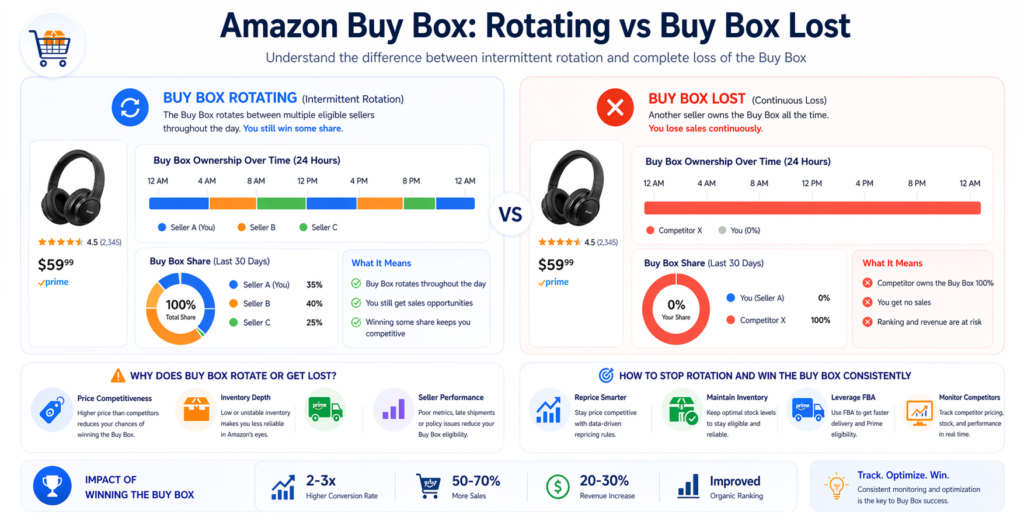
The distinction between buy box rotating and Buy Box Lost matters for your response. If you misclassify rotation as a clean loss, you’ll respond with a full price match when you only needed a small adjustment — eroding margin unnecessarily.
Three signals tell you it’s rotation, not a clean loss:
If you only check the Buy Box once a day, rotation looks identical to a flicker. You need granular snapshots to see the pattern. This is why real-time listing monitoring is foundational for any seller serious about Buy Box share.
A related scenario is Buy Box loss without price drops — where your price didn’t change but share dropped. That’s often buy box rotating being misread as a true loss, and the fix is different than a price response.
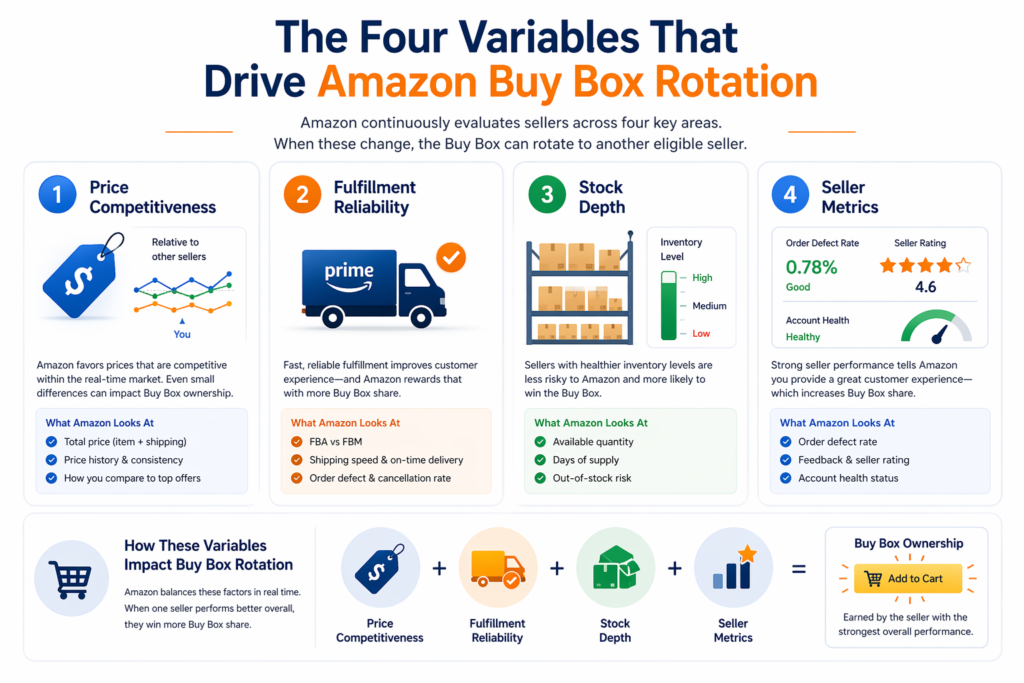
Once you’ve confirmed it’s buy box rotating, these four plays consistently move the needle:
Don’t drop to match — drop to re-enter the eligibility band. A $0.40 price cut is often enough to move from 35% share to 70% share, and that’s far cheaper than matching a competitor to the cent. Knowing your true profit margin and landed cost is the prerequisite — you can’t make a surgical price move without a clear floor.
If your units on hand are low, Amazon rotates against you regardless of price. Replenishment timing is a Buy Box lever, not just a logistics concern. FBA stockout alerts and inventory alerts pay for themselves in Buy Box share alone.
ODR creeping from 0.3% to 0.8% won’t trigger account warnings, but it will quietly cost Buy Box share. Pull your performance dashboard the first of every month. Common operational mistakes are often the silent cause.
Rotation is driven by the sellers closest to you on eligibility. If there are 12 offers on a listing, only 3–4 are actually taking share from you. Focus there. Hijacker detection is a related signal — an unauthorized seller on your listing can appear as rotation and needs a different response.
SentryKit tracks Buy Box ownership in near real-time, not once-a-day snapshots. When the Buy Box shifts between sellers within the same day, you get a Buy Box Lost alert for each flip — so buy box rotating shows up as a pattern of alerts, not a single event. This is what distinguishes intelligence from raw monitoring.
On Pro, you also see the competing sellers’ display names, whether they’re FBA, and their feedback rating. That’s what turns “I’m losing share to someone” into “I’m losing share to Seller X, who’s FBA with 4.8 stars and consistently prices $0.30 below me.” See our full comparison with other Amazon monitoring tools and FBA alert tools to see where SentryKit fits.
If you’re currently experiencing sales drops with no clear cause, rotation is one of the first signals to rule out. Start with a free trial on the SentryKit homepage — no repricer automation, just the intelligence layer.
Buy box rotating is the silent version of Buy Box Lost. You’re still eligible — you’re just sharing share with competitors who match you on the variables that matter. The fix isn’t to race every price move. It’s to know which variable is tightest and widen your lead there.
The sellers who hold the Buy Box consistently aren’t always the cheapest. They’re the ones who see rotation in real time and respond to the right signal, not every signal. With granular monitoring, clear margin floors, and disciplined competitor triage, rotation becomes a solvable problem rather than a mystery.
Buy box rotating means Amazon is splitting Buy Box share between multiple eligible sellers over the course of a day. You hold it for part of the day, competitors hold it for the rest. It looks like intermittent loss but the cause is different from Buy Box Lost.
No. Buy Box Lost means a competitor holds the Buy Box continuously. Buy box rotating means Amazon is distributing Buy Box share between multiple eligible sellers because they all meet the eligibility thresholds at similar levels.
There’s no fixed interval. Amazon recalculates Buy Box eligibility continuously based on price, stock, fulfillment speed, and seller metrics. Buy box rotating happens when multiple sellers stay within tight bands on all four variables.
You can reduce buy box rotating by widening your lead on the variable that’s tightest — usually price or stock depth. You can’t eliminate rotation entirely when multiple sellers are equally eligible, but you can shift share significantly in your favor.
Yes. Because SentryKit tracks Buy Box state in near real-time, multiple flips within a single day appear as a pattern of Buy Box Lost alerts — which is how buy box rotating shows up in practice. On Pro, you also see competing seller details to diagnose which competitor is taking share.
Yes. Rotation reduces your Buy Box share, which proportionally reduces your sales on that ASIN. It’s not as severe as losing the Buy Box outright, but it compounds across listings if unaddressed and is often the hidden cause when revenue drops without an obvious trigger.

Raghav Tiwari · Founder, SentryKit
Raghav is the founder of SentryKit, a real-time Amazon Buy Box intelligence platform. He writes about competitive dynamics, pricing strategy, and the data signals that matter most for third-party sellers.