
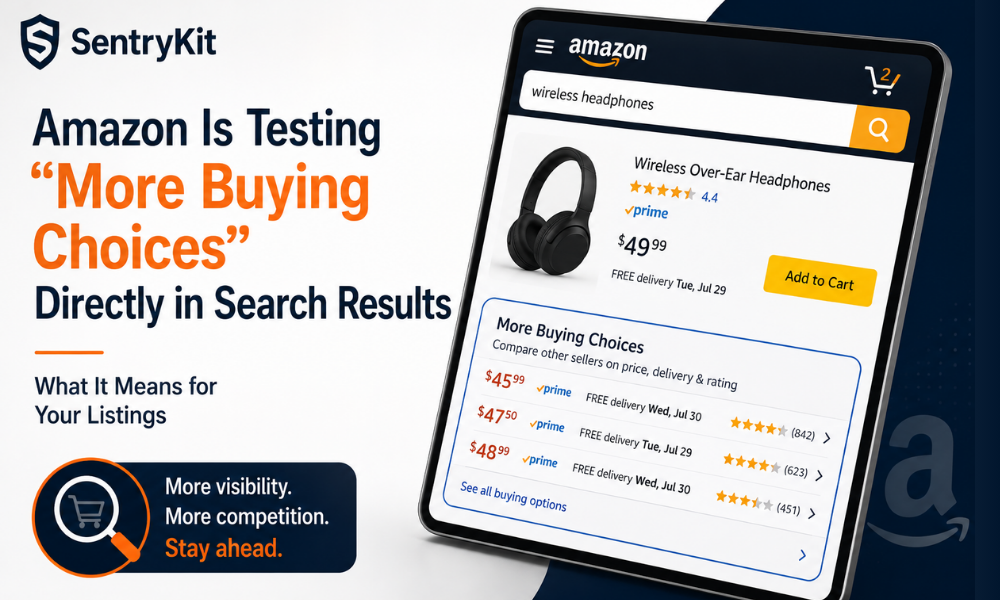
If you sell on Amazon, you already know the More Buying Choices box — the small link on a product page that shows other sellers competing for the same listing. Amazon is now reportedly testing something different: surfacing those competing offers directly in search results, before a shopper ever opens your listing page. Nothing about who’s eligible to appear has changed. What’s changed is how early, and how visibly, your competitors get seen — and that raises the stakes on catching undercutting and unauthorized sellers fast.
More Buying Choices has always been a product-page feature. When a seller doesn’t win the Featured Offer, but still meets the performance bar for Buy Box eligibility, their offer gets listed in a box further down the page — one to three sellers, with price and shipping shown. It’s not the Buy Box itself, and it’s never guaranteed traffic the way the Featured Offer is. Amazon’s own explanation of how the Featured Offer gets selected confirms the mechanic: price, availability, and seller performance metrics are compared in real time, and everyone who doesn’t win still gets a shot at that secondary box.
Here’s the new part, according to trade coverage of Amazon’s marketplace and advertising changes: a search-results experience where shoppers can view additional seller offers — price, delivery date, and rating — without opening the product page at all, through a “More Buying Choices” prompt sitting right under the Add to Cart button in search. What surprised me digging into this is that none of the existing guides on More Buying Choices even mention it — they’re all still written for a mechanic that’s lived on the product page for years. Amazon hasn’t announced this as a confirmed, permanent feature, so treat it as a reported test rather than settled policy.
Eligibility didn’t move. Visibility did.
Right now, a shopper has to actively click into your listing to see who else is selling the same product. If this test rolls out broadly, that comparison happens one step earlier — inside search results, where a shopper hasn’t committed to your listing yet. A competitor with a lower price or a faster delivery date doesn’t need to outrank you organically anymore; they just need to show up in that box before the shopper clicks anything. That’s the same logic behind Amazon removing the Featured Offer eligibility gate and loosening the Buy Box eligibility bar in the UK and EU — competitive exposure has been widening all year, not narrowing.
The sellers who benefit most from earlier visibility aren’t always the ones you want competing for your traffic. An unauthorized seller riding your listing, or a legitimate competitor undercutting your price by a few percent, gets a shot at the shopper’s attention before you’ve had a chance to respond. A private label brand with one flagship ASIN and a loyal repeat-buyer base has the most to lose here — there’s no second product cushioning the hit if even a small share of clicks start going to someone else. The revenue math behind a Buy Box displacement event already shows how quickly lost visibility turns into lost sales — this test just moves the moment of exposure earlier, which means less time to catch it.
If a competitor’s price has been undercutting yours a little more often lately, this may be part of the reason. You don’t need to overhaul anything based on a test that hasn’t been confirmed as permanent. But a few checks are worth doing regardless of whether this specific rollout expands:
For private label brands in particular, this is one more reason unauthorized-seller visibility can’t be a once-a-week check. If a competing offer becomes visible to shoppers earlier, you need to know it exists earlier too.
That’s the gap a Buy Box Lost alert, a Hijacker Detected alert, and a Competitor Price Change alert close — each one fires the moment a competing offer appears, rather than after a shopper has already compared prices somewhere in Amazon’s search experience.
It’s a section on Amazon product pages listing other sellers who have the same item for sale but didn’t win the Featured Offer. Sellers need to meet Amazon’s Buy Box eligibility bar — price, availability, and account performance metrics — to appear there.
It’s being reported by trade coverage of Amazon’s marketplace and advertising changes, not confirmed by an official Amazon announcement. Treat it as an active test rather than a settled feature until Amazon confirms it directly.
No. The eligibility criteria — price, availability, and seller performance metrics — haven’t changed. What’s being tested is where that competing-offer visibility shows up, not who qualifies for it.
Nothing drastic. Keep your price floor, delivery reliability, and “Other sellers on Amazon” checks current, since earlier visibility for competing offers means less time to react if an unauthorized seller or aggressive undercutter shows up.

Nisha Shetty · Marketing Manager, SentryKit
Nisha is a marketing manager and former Amazon seller who writes about e-commerce growth, consumer behavior, and digital retail trends.