
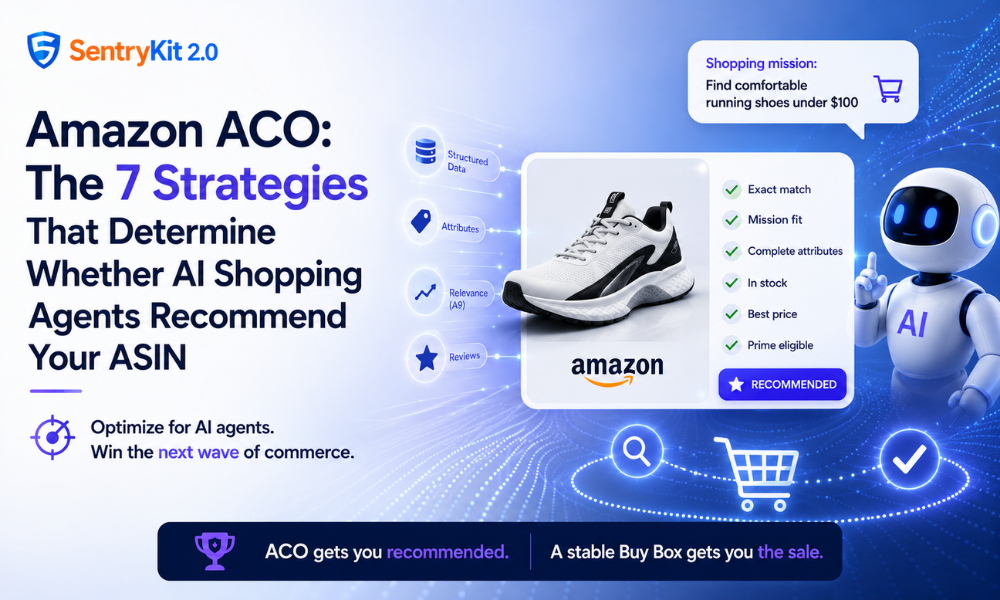
A growing share of Amazon purchases are now initiated or completed by AI agents — Alexa for Shopping’s auto-buy feature, Rufus recommendations, and third-party shopping agents that browse and transact on behalf of users. These agents don’t shop the way humans do. They don’t scroll search results and read bullet points. They evaluate structured product data, match it against a shopping mission, and make a binary decision: this ASIN fits, or it doesn’t.
That distinction reshapes what optimization actually means for your ASIN.
A framework called Agentic Commerce Optimization — ACO — defines what it means to optimize your ASIN for agent-driven purchasing rather than traditional human search. It comprises seven strategies, each targeting a different signal that AI purchasing agents evaluate when deciding whether to recommend or buy a product.
ACO is the practice of optimizing product listings for AI purchasing agents rather than — or in addition to — human searchers. The fundamental shift: human search is keyword-driven and visual. A buyer types a query, scans results, reads bullets, looks at images, and decides. Agent-driven purchasing is structured-data-driven and inferential — the agent receives a user’s shopping goal, evaluates ASINs against explicit attributes and semantic compatibility, and transacts without the visual step.
This creates a new optimization challenge. Listings built entirely for human search may rank well in traditional results but get passed over by agents that can’t confidently match the product to the user’s need.
ACO isn’t a replacement for keyword strategy. It’s an additional layer that makes your ASIN legible to an increasingly important class of buyer.
Marketplace Pulse’s analysis of Amazon’s agentic strategy frames the underlying dynamic: every autonomous capability Amazon builds on the seller side — AI listing management, automated inventory, agentic pricing — is infrastructure it will eventually deploy on the buyer side. The AI that helps sellers run their business is the precursor to the AI that will shop on behalf of consumers.
Traditional Amazon SEO optimizes for keyword relevance (title, bullets, backend keywords), conversion signals (reviews, images, price), and fulfillment credibility (FBA, Buy Box ownership, Prime eligibility).
ACO optimizes for different signals:
An ASIN with perfect keyword optimization can fail ACO if its attributes are incomplete, its title is too clever to parse literally, or its use cases aren’t stated explicitly.
As Search Engine Land’s analysis of agentic AI for ecommerce puts it: an agent needs to understand what you sell, who it’s for, how much it costs, and whether it’s available — all from structured signals rather than marketing language. Keyword-optimised copy that a human reads contextually is not the same as attribute-complete data that an agent parses literally.
AI agents parse product titles and bullets as structured language. They look for noun phrases — precise, category-specific terms that map directly to what the user asked for.
Human-optimized title: “Premium Non-Stick Cooking Set — Great for Home Chefs Who Love Easy Cleanup”
ACO-optimized title: “Non-Stick Cookware Set, 12-Piece, Aluminum with Silicone Handles, Oven Safe to 450°F”
The second title is less marketable to a human browser. But an agent shopping for “non-stick cookware set oven safe” parses it immediately. Audit your titles and lead bullets for noun phrases. If your primary differentiators are communicated through adjectives and marketing language rather than product-type noun phrases,
One related timing pressure: Amazon’s July 2026 title character cap automatically rewrites titles over 75 characters without seller input. An auto-rewritten title may strip out the specific noun phrases your ACO work depends on — making this audit time-sensitive.
this is your first fix.AI shopping agents receive shopping missions, not just search queries. A user might instruct Alexa: “restock my kitchen supplies” or “get me what I need for camping this weekend.” The agent builds a cart around that mission — your ASIN either fits or doesn’t. Semantic bridging means making your product’s adjacent use cases explicit. If you sell a silicone spatula that works equally well for camping cookware as everyday cooking — say so. This isn’t keyword stuffing; you’re stating actual use cases the product genuinely supports.
Agents can’t infer what isn’t stated. A human buyer might look at a product photo and infer it’s waterproof. An agent reads what’s there — if “waterproof” doesn’t appear in the listing, the agent can’t confidently include the product. Inference optimization means converting implicit features into explicit statements. Common examples: waterproof, dishwasher-safe, BPA-free, compatible with specific device models. If it’s true and relevant, write it explicitly.
A9 — Amazon’s traditional search ranking algorithm — remains one input in how agents discover ASINs. Agents don’t bypass A9; they use it as a relevance signal. Strong backend keyword coverage, title keyword placement, and healthy conversion signals all feed A9 performance that agents rely on. Don’t abandon your keyword strategy in pursuit
One complication: Amazon is increasingly rewriting listing content through its AI systems — titles, bullets, and images — without seller notification. Your A9 signals and listing copy can shift overnight, which is why monitoring your listing for unauthorised changes is part of your ACO maintenance baseline.
of ACO — it’s foundational, not replaced.When Alexa or a third-party shopping agent executes a purchase, it’s typically operating within a broader shopping mission — “back to school supplies,” “weekly grocery restock,” “home office setup.” The agent plans a cart around the mission, not individual SKUs. To appear in mission-based carts, your listing needs to signal which shopping missions it belongs to through: category placement, use-case language in bullets (“for home office setups,” “for school lunches”), and A+ content that positions the product within recognizable purchase contexts.
Before an agent reads your title or bullets, it filters on structured attributes — size, weight, material, color, compatibility, item type. An ASIN with incomplete or inaccurate attributes can be filtered out before the agent ever evaluates the content. In Seller Central, go to Manage Inventory → Edit → Product Details and work through every attribute field. Many sellers leave optional fields blank — but agents filter on them.
Attribute accuracy also matters for catalog compliance: Amazon’s 2026 ASIN deactivation notices — covering brand-generic abuse, duplicate ASINs, and variation stuffing — have flagged attribute inconsistencies as a contributing factor. Review what the crackdown covers before filling in attribute fields, especially for products shared across multiple ASINs or variations.
This is the highest-ROI quick win in ACO.Modern AI purchasing agents are multimodal — they evaluate images, A+ content, and video, not just text. A text-only listing scores lower on purchase confidence when agents assess quality signals. Product page coverage means: a main image that clearly shows the product, lifestyle images showing the product in use, A+ content that reinforces structured attribute data, and — where possible — a product video.
Amazon’s overview of its agentic AI shopping infrastructure confirms that multimodal content quality — images, A+ content, and video — is a factor agents weigh when assessing purchase confidence for a given ASIN.
If you’re resource-constrained, prioritize attribute optimization and inference optimization first. Product page coverage compounds over time.If you’re looking at seven strategies and wondering where to start, here’s the prioritized order:
ACO gets your ASIN recommended. But if your Buy Box is unstable when an AI agent fires the purchase, the sale still doesn’t go to you.
Alexa for Shopping’s auto-buy feature completes purchases automatically at the user’s target price — routing the transaction to whichever seller holds the Buy Box at that moment. An ACO-optimized ASIN that loses the Buy Box to a competitor or unauthorized seller routes agent-driven purchases away from you regardless of how well-optimized the listing is.
The two requirements work in parallel: ACO makes your ASIN the recommended choice. A stable Buy Box position ensures that recommendation converts to your revenue.
It’s also worth noting that Amazon’s Featured Offer algorithm went fulfillment-neutral in November 2025, removing the structural FBA preference. Agent-driven purchases can now route to merchant-fulfilled sellers as easily as FBA sellers, which widens the Buy Box competitive set that ACO-optimised ASINs need to hold against at the moment of checkout.
Agentic Commerce Optimization (ACO) is the practice of optimizing Amazon product listings for AI purchasing agents — such as Alexa auto-buy, Rufus, and third-party shopping agents — rather than exclusively for human searchers. ACO focuses on structured attribute completeness, semantic use-case coverage, and explicit feature statements that AI agents can evaluate when matching products to shopping missions.
AI shopping agents evaluate products based on structured attributes (size, material, compatibility), semantic match to the user’s shopping mission, explicit feature statements in listing content, A9 ranking signals, and product page quality including images and A+ content. Products with incomplete attributes, vague titles, or implicit-only features are less likely to be confidently matched and recommended.
No — ACO includes A9 optimization as one of its seven strategies, but it goes beyond traditional keyword-based SEO. ACO adds structured attribute optimization, noun phrase precision, inference gap filling, semantic bridging for shopping missions, and multimodal product page coverage. A listing optimized only for keyword rankings may still be passed over by AI agents evaluating structured signals.
Attribute optimization. Audit every attribute field for your product type in Seller Central and fill in anything missing — especially material, size dimensions, compatibility, and feature flags like waterproof or BPA-free. Agents filter on attributes before reading content, and incomplete attribute sets are the most common and most fixable ACO gap.
ACO principles apply to any marketplace where AI purchasing agents operate. Alexa for Shopping and third-party shopping agents access Amazon’s global catalog. The seven strategies apply globally, though attribute field requirements and category structures vary by marketplace — attribute optimization work needs to be completed per-marketplace to be fully effective.
It can. Amazon’s AI systems — including its Enhance My Listing tool and the broader Project Starfish initiative — rewrite titles, bullets, and images without seller approval. An auto-rewritten title may lose the noun phrases and explicit feature statements you added for ACO. Monitoring your listing for unauthorised changes is part of maintaining ACO readiness — when changes happen without your input, catching them within hours rather than days is what limits the damage.

Nisha Shetty · Marketing Manager, SentryKit
Nisha is a marketing manager and former Amazon seller who writes about e-commerce growth, consumer behavior, and digital retail trends.