
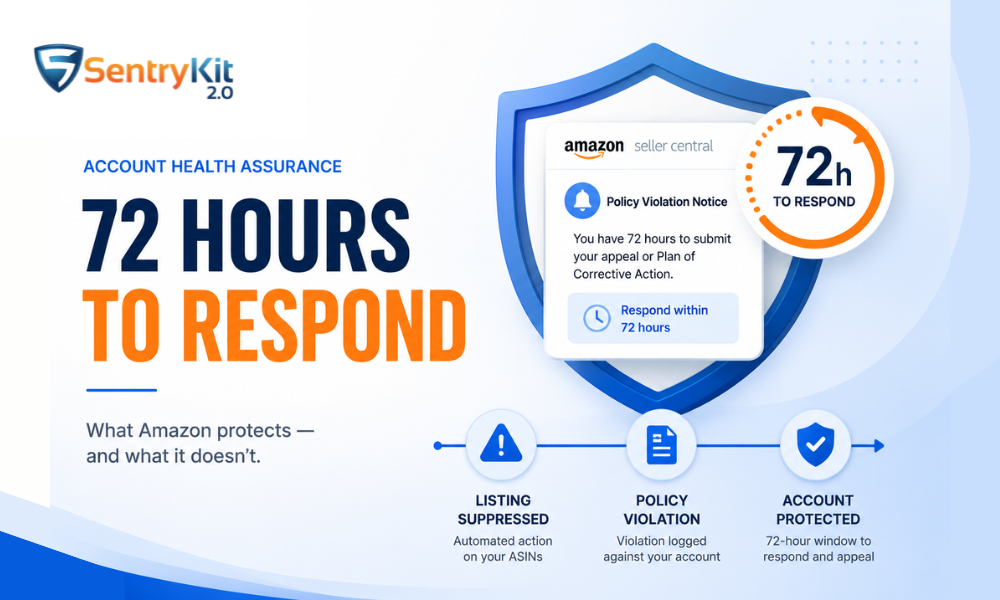
Account Health Assurance sounds like a safety net that covers every Amazon seller the moment something goes wrong. The reality is more specific than that — and more limited. AHA is an eligibility-gated program that protects your account from deactivation under certain conditions. It does not protect individual listings, it does not activate automatically for every seller, and it does not prevent Amazon’s automated enforcement systems from acting on your ASINs before any 72-hour window opens.
Here’s what AHA actually covers, who qualifies, how the 72-hour window works, what automated enforcement does independently of it, and what kind of monitoring fills the gap AHA doesn’t touch.
Account Health Assurance is Amazon’s formal commitment to give qualifying sellers advance notice before deactivating their selling account over a policy violation. Before AHA existed, sellers could wake up to a deactivated account with no warning — no email, no grace period, no window to respond. AHA changed that sequencing for eligible sellers by inserting a mandatory notification step into the enforcement process.
What AHA covers is specific: the account-level deactivation decision. If you’re enrolled and eligible when a qualifying violation is flagged, Amazon commits to notifying you and giving you 72 hours to submit an appeal, a Plan of Corrective Action (POA), or a direct acknowledgment that the issue has been resolved before it moves forward with account deactivation.
That is a meaningful protection — for sellers who qualify. But it is important to be precise about what AHA is not. It is not amnesty. If you receive the AHA notice and do not act within the 72-hour window, Amazon will still proceed with deactivation. AHA changes the timing of enforcement, not the outcome if you fail to respond. It also does not apply to listing-level enforcement actions — individual ASIN suppressions, content removals, and Buy Box losses happen on a separate track entirely. AHA is one layer of protection. Understanding its exact scope is the first step to using it effectively.
AHA is not available to all sellers by default. Eligibility is tied to your Account Health Rating (AHR) and your standing with Amazon over time. Based on Amazon’s program guidance and updated 2026 documentation, the qualification criteria include:
Your Account Health Rating is a composite score. It rises and falls based on policy violation points logged against your account, buyer feedback metrics, your Order Defect Rate, your response time to customer messages, and your overall compliance track record. Violations in categories like product authenticity and restricted products carry heavier penalties than listing quality issues.
The part most coverage of AHA glosses over: the program is a reward for maintaining good account health, not a fallback for sellers already in trouble. If your AHR drops below the qualifying threshold when a violation fires, AHA will not be active. You will face Amazon’s enforcement process without the 72-hour window. This is why monitoring your AHR continuously — not just during crisis moments — is the only reliable way to ensure AHA is available when you actually need it. Sellers who treat AHR as a vanity metric, rather than an operational one, routinely discover the gap when it is too late to close it.
When you receive a policy violation notification and you’re AHA-eligible, the 72-hour clock starts the moment Amazon sends the AHA notice — not when the underlying violation occurred, and not when you open the email. If you check your Seller Central account or inbox infrequently, you may already be down 12 or 24 hours before you realize the window is open.
Your response options within the window are: submit a formal appeal, submit a Plan of Corrective Action (POA), or acknowledge the violation directly and demonstrate that the root issue has been resolved. Amazon’s Seller Performance team must receive and register a valid response. A partial or incomplete POA that Amazon cannot act on does not satisfy the requirement — the clock runs regardless of Amazon’s internal processing speed.
What the 72-hour window does not cover:
Sellers who assume AHA covers all enforcement activity are often caught off guard when they find listings suppressed and sales stopped — while they’re technically still inside the 72-hour window. For a detailed guide on how to fix a suppressed listing, see our full guide on recovering from listing suppression.
Amazon’s enforcement operates in two distinct layers, and the distinction matters for how you prepare and respond.
The first layer is automated and fast. Amazon’s systems monitor listings continuously for compliance signals — policy violation patterns, IP complaints, content flags, restricted product triggers, and safety indicators. When the system identifies an issue that crosses a threshold, it acts without waiting for human review: suppressing the listing, removing the ASIN from search results, or pausing the Buy Box on the affected product. This automated layer moves quickly and has no built-in grace period. A Listing Suppressed event is typically the earliest visible signal that a listing has entered Amazon’s enforcement queue — and it happens before any AHA notice is generated.
The second layer is account-level. After the automated system flags a pattern or after a policy violation is formally logged, Amazon’s Seller Performance team evaluates whether the underlying issue warrants account-level action. This is the layer where AHA applies. If you are enrolled and eligible, Amazon commits to notifying you before taking the account-level deactivation step.
The typical enforcement progression looks like this: a content flag or complaint is filed → the automated system suppresses the affected listing → the policy violation is logged against the account → if the pattern is serious enough, an AHA notice is issued (if eligible) → account deactivation follows if the window expires without a valid response.
The practical implication: you can be inside the 72-hour AHA window for your account while simultaneously having multiple listings that are already suppressed and generating no revenue. AHA does not reactivate those listings. It only protects the account-deactivation decision. Resolving the listing-level issue is a separate action you must take in parallel — which is why catching suppressions the moment they happen, rather than hours later, directly affects how much damage you absorb during an enforcement event. Understanding Amazon enforcement tactics used against sellers can help you prepare for and respond to these situations more effectively.
The most effective AHA strategy is never reaching the 72-hour window in the first place. The sellers who avoid enforcement escalations are not the ones who respond fastest to AHA notices — they’re the ones who catch listing-level signals early enough that violations never reach the account health layer.
Listing health monitoring gives you that early visibility. A Listing Suppressed alert fires at the moment a tracked ASIN goes dark — before the suppression compounds into a longer outage, before it registers as a policy violation in your account health dashboard, and before you would have noticed it manually. Every hour a suppressed listing sits unaddressed is revenue lost and a signal logged in Amazon’s enforcement systems. Getting the alert in real time means you can open an appeal or fix the underlying content issue within the same business day.
A Content Changed alert gives you a second line of defense. Unauthorized edits to your listing — title changes, bullet point swaps, image replacements — are a common pathway to listing suppression. Amazon’s compliance systems flag content that doesn’t match category requirements, and if a third party or Amazon’s own systems have quietly changed your listing content, you may not realize it until the suppression fires. Content change monitoring surfaces those edits as they happen, before they trigger enforcement.
An Out of Stock alert matters too. Under Amazon’s updated availability standards, sustained stockouts can trigger listing suppression and affect your Account Health Rating over time. Catching a low inventory signal before it becomes an out-of-stock event — via a Low Stock Warning — keeps you in the proactive category rather than the reactive one.
SentryKit’s Buy Box intelligence platform monitors all of these signals across your portfolio continuously. The Daily Portfolio Digest surfaces Content Changed events and listing status shifts overnight, while individual alerts for Listing Suppressed, Out of Stock, and Low Stock Warning deliver real-time notification the moment a signal fires. AHA is one layer of account protection. Listing health monitoring is the layer that keeps your Account Health Rating strong enough to qualify for it — and that catches enforcement signals before they become enforcement events. For context on how AI-driven listing changes fit into this picture, see: Amazon listing changes without notice: AI and Project Starfish.
Amazon Account Health Assurance (AHA) is a program that gives qualifying sellers a 72-hour window to resolve a policy violation before Amazon proceeds with account deactivation. When you receive a violation notification and you’re AHA-eligible, Amazon commits to not deactivating your account until you’ve had a chance to appeal, submit a plan of action, or acknowledge and address the issue.
No. AHA is eligibility-gated. You need a Professional selling account, an Account Health Rating above the qualifying threshold (generally 250 or higher), no recent severe violations, and an active selling history of approximately one year or more. Sellers with a low or declining AHR are not enrolled in the program and do not receive the 72-hour window.
No. The 72-hour AHA window applies to the account-level deactivation decision only. Individual ASIN suppression, listing removal for policy violations, and safety-related product actions can still happen immediately — before or independently of the account-level window. Your listings can go dark while your account remains within the AHA response period.
The Account Health Rating (AHR) is Amazon’s measure of your compliance and performance as a seller. It is calculated from policy violation points, buyer feedback ratings, response time to customer messages, and order defect rate. A higher AHR reflects cleaner compliance and better performance metrics. Maintaining a strong AHR is what keeps you enrolled in programs like AHA — and eligible for the protections they offer.
If you’re not enrolled in AHA when a policy violation is issued, Amazon is not obligated to provide a 72-hour window before taking action on your account. In practice, Amazon often still notifies sellers and allows time to respond — but that is at Amazon’s discretion, not a guaranteed program benefit. This is why maintaining a high Account Health Rating matters: it keeps the program active so the protection is there when you actually need it.

Nisha Shetty · Marketing Manager, SentryKit
Nisha is a marketing manager and former Amazon seller who writes about e-commerce growth, consumer behavior, and digital retail trends.