
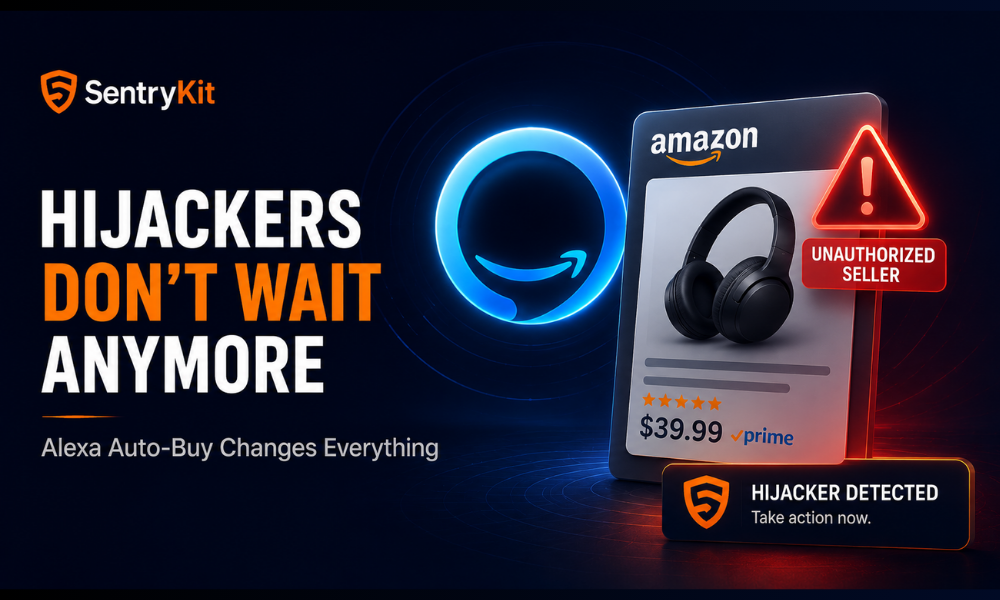
For years, the standard advice for dealing with Amazon hijackers was this: check your listings daily, catch the unauthorized seller as fast as possible, and respond before too many shoppers buy from the wrong place. The window between a hijacker appearing and your first lost sale was measured in hours. You had time.
That window has shrunk to seconds.
On May 13, 2026, Amazon renamed its Rufus AI shopping assistant to Alexa for Shopping and rolled out a new auto-buy feature to all US Prime members — roughly 250 million people. The feature lets shoppers set a target price for any product and have Alexa automatically complete the purchase the moment any listing for that product hits their price point. No confirmation screen, no second look. Alexa buys it.
If an unauthorized seller lists your product below your price, Alexa will buy from them — not from you.
The mechanic is straightforward. A shopper finds a product they want, taps “set a price alert,” and enters the price they’re willing to pay. When any listing for that ASIN drops to or below that target, Alexa automatically triggers the purchase using their saved payment method and default shipping address. The shopper gets a notification and has 24 hours to cancel before the order ships.
From the consumer’s perspective, it’s convenience. From a seller’s perspective, it’s a purchasing system that evaluates price across all offers on a listing — including offers from sellers who shouldn’t be there.
As eMarketer noted in their analysis of Amazon’s agentic commerce push, this kind of automated purchasing signals a meaningful shift in how platform commerce works: the shopper is no longer the final decision-maker in that moment. An algorithm completes the transaction.
That matters enormously for how the Buy Box algorithm works, which is already explained in detail in our post on what changed for the Buy Box when Alexa for Shopping launched. But the Buy Box algorithm is only part of the story — because auto-buy doesn’t just favor the Buy Box holder. It executes a purchase based on price, and price alone can be set by anyone who attaches to your ASIN.
The takeaway: auto-buy turns price into an automatic purchase trigger. Any seller who lists below your price is now in a position to capture an automated sale before a shopper even sees your offer.
Here is how the hijacker risk worked before auto-buy:
Here is how it works now:
Consider a specific scenario: you sell a private label supplement at $39.99. A hijacker lists the same ASIN at $34.99. Any Prime shopper who had auto-buy set for this product at $35 or more — a perfectly reasonable price alert to set for a $39.99 item — now has an automated order placed from the unauthorized seller. They receive the hijacker’s version of your product. You receive none of that revenue. Your brand takes the reputational risk.
The detection window — the time between a hijacker appearing and your first lost sale — has collapsed. PYMNTS, reporting on Amazon’s agentic commerce positioning, described auto-buy as giving Amazon a structural advantage in the “agentic commerce race.” That framing is accurate. But for sellers, the flip side of that advantage is clear: any pricing vulnerability on your listing is now exploitable automatically, at scale.
You can read more about the tactics hijackers use to attach to legitimate listings — the mechanics haven’t changed, but the speed at which they cause harm has.
Not every Amazon seller faces this risk equally. Three groups are most exposed.
Private label sellers own the listing. There is no authorized secondary seller. Any other offer on the ASIN is, by definition, unauthorized. Before auto-buy, that was a meaningful but manageable problem. Now, the moment a hijacker undercuts your price, automated purchases route to them without any shoppers making an active choice to pick the unauthorized listing. The harm happens before you can respond.
Wholesale sellers often share ASINs with other authorized sellers. The issue isn’t necessarily a hijacker in the traditional sense — it’s an unauthorized seller entering a distribution channel they aren’t part of and undercutting the authorized price. In a world with auto-buy, an unauthorized seller who lists below the authorized price floor triggers automated purchases before any authorized seller can react. If you’re managing a wholesale Buy Box strategy, the price floor discipline required across your distribution chain has just become more consequential.
Brand Registry offers meaningful IP protections: faster takedown of counterfeit listings, automated removal of infringing content, access to Project Zero. What it does not do is prevent an unauthorized seller from attaching to your ASIN and setting a lower price. An unauthorized offer can appear on a Brand Registry-enrolled listing, undercut your price, and trigger auto-buy from that unauthorized seller — all before your Brand Registry protections result in a takedown. Brand Registry is not a real-time listing guard; it’s an enforcement mechanism that operates after the unauthorized activity is reported and reviewed.
This is worth being clear about because Brand Registry enrollment is sometimes described as comprehensive listing protection. For AI-driven listing changes and silent modifications, as with hijacker activity, Brand Registry has a response lag that auto-buy can exploit within.
The structural problem is that Amazon does not enforce MAP. Its pricing system is explicitly designed to surface the most competitive offer at all times. You set your price; Amazon’s system evaluates all offers on your ASIN and routes shoppers — and now automated purchases — toward the lowest one. A MAP agreement between you and your distributors is a business arrangement, not an Amazon enforcement policy. Auto-buy makes that reality more expensive to ignore.
Gray Falkon has documented this clearly: the “Featured Offer” pricing logic favors the lowest-price competitive offer, and there is no mechanism in Amazon’s system to automatically protect a seller’s MAP price.
Given that, your defense comes down to detection speed and response speed. Specifically:
Real-time hijacker detection. Daily reports aren’t useful anymore. If a hijacker appears at 9 AM and your report runs at midnight, you’ve lost nearly a full day of auto-buy traffic. The detection tool has to fire at the moment an unauthorized seller appears — not hours later.
Price floor monitoring. Even if a seller is technically authorized to be on your listing, a price drop below your floor has automated consequences now. Knowing when any competitor drops price on your ASIN needs to happen in real time, not at the end of the day.
The detection-to-response window is the whole game. Auto-buy has made the window between “hijacker appears” and “first automated sale goes to the wrong seller” effectively zero. Your response window is measured from the moment you’re alerted, not from the moment you check your dashboard.
That’s where SentryKit’s alerting is directly relevant. The Hijacker Detected alert fires the moment an unauthorized seller appears on any listing you’re monitoring. The Competitor Price Change alert fires when a competitor drops price on your ASIN — including a drop that could trigger auto-buy thresholds shoppers have already set. Together, they give you the shortest possible window between a hijacker appearing and you knowing about it.
Responding fast enough to matter — filing a Brand Registry report, adjusting your price, contacting your account manager — depends entirely on knowing within minutes, not hours.
Auto-buy doesn’t change how hijackers operate. It changes how fast they can cause damage. An unauthorized seller who would have cost you a handful of sales over a few hours can now drain a full day’s worth of auto-buy demand in the time it takes you to open your seller dashboard.
Getting ahead of it means getting alerted in real time and responding before the second automated purchase goes through.
SentryKit monitors every listing you track around the clock. When a hijacker appears, the Hijacker Detected alert fires immediately. When a competitor drops their price on your ASIN, the Competitor Price Change alert fires immediately. You’re not waiting for a report. You’re acting on what’s happening right now.
Start your 30-day free trial — see who’s on your listings today.
Alexa for Shopping’s auto-buy feature lets Amazon Prime members set a target price for any product. When any listing for that product on Amazon reaches or drops below that target price, Alexa automatically completes the purchase using the shopper’s saved payment information. The shopper has 24 hours to cancel before the order ships. The feature is available to all US Prime members, a group that numbers approximately 250 million people.
Yes. Alexa for Shopping’s auto-buy feature evaluates all offers for a given product, not just the Buy Box holder’s offer or the brand’s authorized listing. If an unauthorized seller — a hijacker — lists your product at a price that falls within a shopper’s auto-buy target range, Alexa can and will automatically purchase from that unauthorized seller. The shopper does not receive a prompt to review which seller the purchase is coming from.
Brand Registry provides IP enforcement tools — faster takedowns, automated counterfeit removal, access to Project Zero. It does not prevent an unauthorized seller from attaching to your ASIN and setting a lower price. An unauthorized offer can appear on a Brand Registry-enrolled listing and trigger auto-buy purchases from that seller before Brand Registry enforcement processes result in a takedown. Brand Registry is an enforcement mechanism, not a real-time listing guard.
Potentially within minutes of appearing. Before auto-buy, there was typically a window of hours between a hijacker listing going live and meaningful sales loss — because shoppers had to actively find and choose the hijacker’s offer. With auto-buy, any shopper who has already set a price alert at or above the hijacker’s price will have an automated purchase triggered the next time Amazon’s system processes their alert. The detection window has effectively collapsed.
In a normal purchase, the shopper actively selects a product, reviews the offer (including which seller it’s from), and confirms the transaction. Auto-buy removes the shopper from the decision point entirely. The shopper sets the price condition once; Alexa executes the purchase automatically when that condition is met — without a review step, without the shopper seeing which seller the offer comes from, and without a confirmation prompt before the purchase is placed.

Nisha Shetty · Marketing Manager, SentryKit
Nisha is a marketing manager and former Amazon seller who writes about e-commerce growth, consumer behavior, and digital retail trends.