
Most Buy Box guides are written for private label sellers who own the listing. Wholesale is a different game entirely.
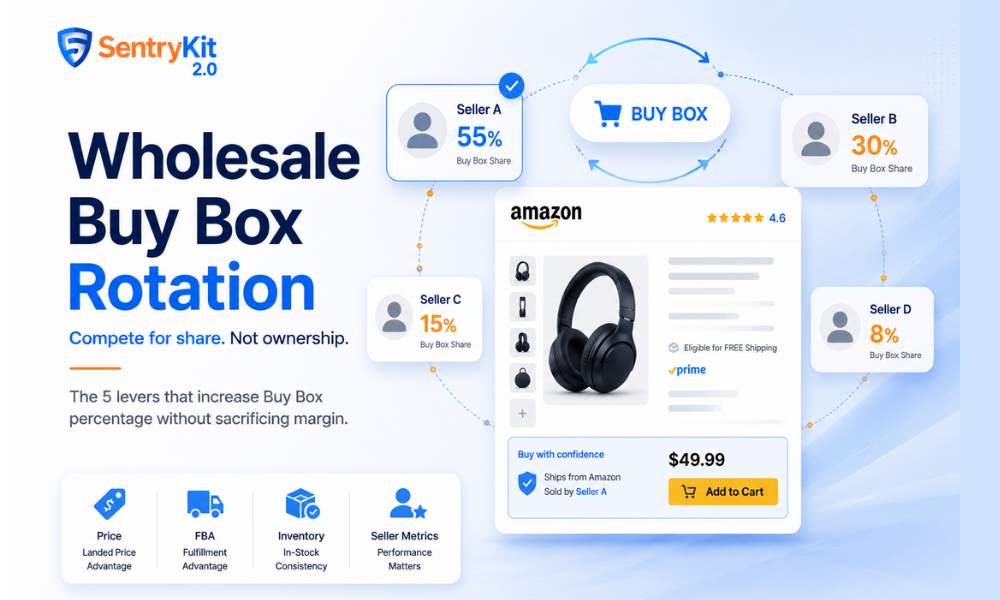
On a wholesale ASIN, three to six eligible sellers are all competing for a share of the same rotation. Nobody “wins” the Buy Box outright — Amazon allocates sessions across eligible sellers based on a relative score, and your percentage of that allocation is what you’re optimising for. A wholesale seller managing 300 ASINs across competitive categories who treats Buy Box as binary — won or lost — is looking at the wrong metric entirely.
Here’s how the rotation actually works, what a good share target looks like, and the five levers that move your percentage without sacrificing margin.
Private label sellers typically control the listing and are the only eligible seller. The Buy Box question for them is: am I eligible, and am I winning it against hijackers or counterfeit sellers? Wholesale sellers are legitimate, eligible competitors on ASINs they don’t control. The question becomes: what share of the rotation am I capturing, and is it worth the margin I’m giving up to capture it?
On a competitive ASIN with three eligible sellers, one seller might hold 50% of sessions, another 30%, another 20% — all three are in the Buy Box rotation, just at different rates. Your business report shows this as Buy Box Percentage. The target isn’t 100%. It’s maximising your share at a price that still makes sense — a point Marketplace Pulse data on Buy Box competition consistently bears out.
Amazon’s algorithm reassesses Buy Box allocation continuously. On a high-traffic ASIN during peak hours, the Featured Offer can rotate every few minutes. A competitor repricing down by $0.50 can shift your share meaningfully within the hour — you won’t see it in Business Reports until the following day, but the sales velocity drop shows up immediately.
That real-time gap — between when a competitor moves and when you know about it — is where wholesale sellers lose share they don’t recover.
Sellers new to wholesale often panic when they see a 40% Buy Box Percentage in Amazon Business Reports. That number may be entirely healthy.
On a competitive ASIN with three to four eligible sellers, here are realistic share ranges:
A wholesale seller with 200+ ASINs averaging 55% Buy Box share at healthy margins is in a better position than one with 70% share at margins too thin to absorb a fee increase. The percentage is meaningless without the margin context.
The biggest lever. Amazon’s algorithm uses landed price — the total cost to the customer including shipping — not just the listed price. This matters especially for FBM sellers: an FBM seller matching an FBA seller’s listed price is not matching their landed price. Amazon applies an implicit fulfilment cost to FBA offers that factors into the comparison. The practical result: FBM sellers need to price noticeably lower than FBA competitors to achieve equivalent Buy Box share.
FBA has a structural advantage in the Buy Box algorithm beyond just landed price. Amazon weights FBA fulfilment for reliability, shipping speed, and return processing independently of price. If you’re FBM on an ASIN where the other eligible sellers are FBA, you’re competing uphill on two dimensions simultaneously. This isn’t a reason to switch everything to FBA — it’s a reason to be clear-eyed about which ASINs are worth pursuing as an FBM seller.
The most underestimated lever. A seller who goes out of stock — even briefly — loses their Buy Box allocation during that window, and that allocation doesn’t fully recover the moment they restock. Amazon’s algorithm takes recent stock history into account. For wholesale sellers managing high-volume catalogs, in-stock consistency is often a more reliable lever than price.
Feedback rating, Order Defect Rate, and shipping performance all feed into Buy Box score. A degraded account health metric can quietly reduce your share across your entire catalogue. Check your Account Health dashboard regularly, not only when something goes wrong.
Less a lever, more a guardrail — but essential. Without a pre-set floor, rotation incentives create downward pressure across every ASIN simultaneously. The right response when a competitor prices below their floor is to hold your price. Sellers clearing inventory or running a loss leader will cycle out within days.
When your Buy Box Percentage drops in Business Reports, there are three likely causes: a competitor repriced lower, a competitor restocked after being out of stock, or a new seller entered the ASIN.
Start with the “Other Sellers on Amazon” section on the product page. If a new seller appears at a lower price, that’s your answer. If no new sellers and no obvious price change, check whether a competitor who was out of stock recently came back into inventory — their return often redistributes share before Amazon’s algorithm rebalances.
The diagnostic challenge for wholesale sellers is scale. Manually checking the “Other Sellers” section on 300 ASINs when you notice a revenue dip isn’t realistic. The sellers who catch share drops early have real-time competitor price monitoring in place — they’re alerted when a competitor moves, not when they notice a revenue decline.
Here’s where wholesale Buy Box strategy goes wrong most often: a seller sees their share drop from 55% to 35%, drops their price to recover it, and gets back to 50%. Then a competitor adjusts. They drop again. Within two weeks, the ASIN is running at margins that don’t justify the inventory cost.
Buy Box rotation creates a gravitational pull toward lower prices. The only protection is a pre-defined floor and the discipline to hold it. A 35% share at your target margin is a better business outcome than 60% share at breakeven.
One note on repricers: a repricing tool can help you stay competitive on price — but it can’t tell you why your share dropped or that a new seller appeared at $2 below your floor. That’s a separate signal.
Wholesale Buy Box strategy at scale comes down to two things: knowing when a competitor moves before your revenue shows the impact, and having a floor you don’t cross regardless of what they do.
The Buy Box algorithm factors — price, fulfilment, in-stock rate, seller metrics — are all optimisable. But optimising them across hundreds of ASINs manually isn’t viable. SentryKit’s Competitor Price Change alert fires the moment a seller on your ASIN reprices, and the Buy Box Lost alert fires the moment your share drops to zero.
Start your free 30-day trial and know what’s happening on your ASINs before your Business Reports catch up.
On a 3–4 seller ASIN, 40–60% is healthy. Above 70% is strong but monitor whether the margin justifies it. Below 30% consistently suggests a structural issue — check your FBA vs. FBM status and seller metrics first.
Structurally yes. Amazon weights FBA fulfilment separately from landed price, so an FBM seller at the same listed price will typically receive a lower Buy Box score. FBM sellers should plan for pricing 5–10% below FBA competitors to achieve equivalent share on most ASINs.
Within hours, sometimes minutes on high-traffic ASINs. Amazon’s algorithm runs continuously. Business Reports update daily — but sales velocity shows the impact immediately if the shift is large enough.
A repricer is useful at scale — it helps you stay competitive on price automatically. The critical step is setting a minimum price that reflects your actual floor before activating any rules, so the tool enforces that limit rather than following competitors into a price war.

Nisha Shetty · Marketing Manager, SentryKit
Nisha is a marketing manager and former Amazon seller who writes about e-commerce growth, consumer behavior, and digital retail trends.