
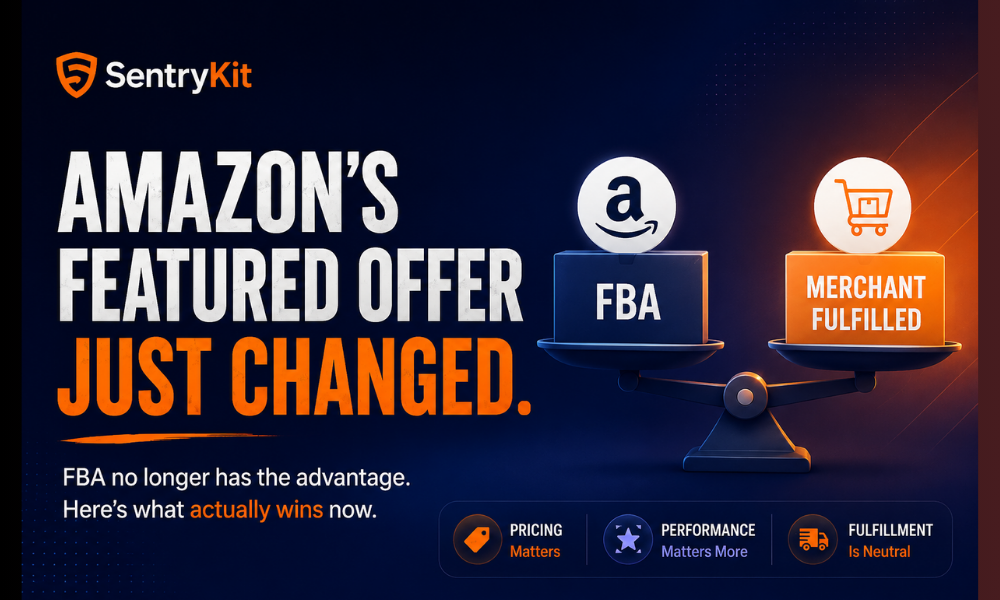
Amazon removed FBA’s structural advantage from the Featured Offer algorithm on approximately November 1, 2025. If you’re still pricing on the assumption that FBA beats merchant-fulfilled at equivalent prices, you are competing against a rulebook that no longer exists.
The old model was simple: use FBA, price competitively, win the Buy Box. That model was directionally accurate for over a decade. It also produced antitrust scrutiny — and it’s gone.
Amazon’s Featured Offer algorithm now evaluates offers in a fundamentally different sequence. Fulfillment method no longer carries a built-in weight that FBA sellers receive by default. Instead, eligibility is determined first, then offers are sorted by condition tier, then price competitiveness and seller metrics are weighed together — with a tolerance band that allows slightly higher-priced sellers to win if their other metrics are stronger.
This post breaks down exactly what changed, how the new algorithm works, and what it means depending on how you sell.
Amazon renamed “Buy Box” to “Featured Offer” before November 2025 — the terminology shift was a quieter, earlier change. The Featured Offer is the primary purchase widget on a product detail page: the seller and price displayed in the prominent “Add to Cart” or “Buy Now” position. Winning it is, for most sellers, the difference between capturing a sale and being buried in the “Other Sellers” section.
For new readers, our primer on what the Featured Offer is and how it has historically worked covers the foundational mechanics. For this post, the relevant history is what the algorithm used to weight — and what changed.
From roughly 2014 onward, FBA offers received a structural lift in Featured Offer eligibility scoring. The conventional wisdom — “lowest-price FBA wins” — was directionally accurate for most categories for most of that period. Amazon treated FBA fulfillment as a proxy for delivery reliability, and the algorithm baked in a preference that merchant-fulfilled sellers could rarely overcome without significantly undercutting on price.
Seller Labs framed this directly in their Buy Box strategy guidance: FBA was the single highest-leverage variable a seller could control for Featured Offer capture. Price second, everything else after.
That model produced a clear playbook. It also produced antitrust scrutiny.
The change is frequently described as “Amazon removing the FBA Buy Box advantage,” which is technically imprecise. The structural preference was removed — the built-in algorithmic weight that FBA received regardless of other factors. FBA still contributes to Featured Offer outcomes through delivery reliability metrics, which remain an input. The advantage has narrowed, not disappeared.
What “fulfillment-neutral” means in practice: a merchant-fulfilled seller with strong performance metrics and a price within the tolerance band can now win the Featured Offer against an FBA seller at the same or slightly lower price. That was not a realistic outcome under the prior algorithm except in narrow edge cases.
The change was confirmed by widespread seller reporting, independently documented by BookScouter and Gray Falkon, and is consistent with regulatory pressure from the US and EU antitrust investigations into Amazon’s marketplace practices.
The current Featured Offer algorithm evaluates offers in a three-stage sequence. Understanding the sequence matters because each stage can knock a seller out before the next stage is even reached.
Before price or fulfillment is weighed, offers are sorted into condition tiers: New, Used, Collectible, and Refurbished. A new-condition offer does not compete against a used-condition offer for the same Featured Offer position. Each condition tier has its own Featured Offer.
This is a significant structural change documented by BookScouter’s analysis of the November 2025 update. Previously, condition was a factor in the mix — now it’s the first filter, before anything else is evaluated. For multi-condition sellers (particularly booksellers and refurbished goods sellers), this means your new inventory and your used inventory now operate in entirely separate competitive pools.
The practical implication: if you’re losing the Featured Offer in one condition tier while holding it in another, those are separate problems with separate causes. Treating them as a single pricing problem will lead to the wrong fix.
Within a condition tier, Amazon does not simply award the Featured Offer to the lowest price. A tolerance band allows higher-priced offers to win if the seller’s performance metrics are stronger than the competition.
The tolerance band is not publicly documented as a fixed percentage by Amazon, but it has been independently observed and named by BookScouter and confirmed across Seller Central forum analysis. The implication is that a seller with an outstanding Order Defect Rate, Late Shipment Rate, and Valid Tracking Rate can hold the Featured Offer at a price slightly above the lowest competitor — and that this was not consistently achievable under the prior algorithm’s FBA structural preference.
The tolerance band also means that cutting price to recover the Featured Offer is not always the right move. If a competitor is holding it despite being priced higher than you, the problem may be your metrics, not your price. That’s a critical distinction — and one that repricing tools cannot diagnose for you.
Once an offer clears the condition tier and falls within the tolerance band, seller performance metrics determine Featured Offer share. Amazon’s current eligibility criteria, per Seller Central documentation, include:
For SFP sellers specifically, Amazon tightened On-Time Delivery Rate (OTDR) enforcement in February 2026, with further changes effective July 6, 2026. Meeting the SFP badge threshold is no longer sufficient to maintain Featured Offer competitiveness if OTDR slips.
For full detail on how to optimize for each metric, our 2026 guide to winning the Featured Offer covers the current thresholds and improvement paths.
FBA sellers who built their pricing model on the assumption that FBA plus competitive pricing equals Featured Offer capture are the most exposed to this change. The structural preference is gone. If your FBA price is above a merchant-fulfilled competitor with strong metrics, you may now be losing the Featured Offer — something that would have been unlikely before November 2025.
This does not mean FBA is a worse choice. Delivery reliability remains a factor in metrics scoring, and FBA sellers tend to perform well on Late Shipment Rate and Valid Tracking Rate by default. The change is that these advantages now have to earn their place in the evaluation rather than arriving pre-loaded.
The risk for FBA sellers is the assumption that FBA status is doing work it no longer does. If your Featured Offer win rate has declined since November 2025 and you haven’t changed your price or fulfillment, the algorithm change is the likely cause — and the fix is metric-focused, not pricing-focused.
Seller Fulfilled Prime sellers are the clearest structural beneficiaries of the November 2025 change. Previously, SFP competed against an algorithm that rewarded FBA by default. Now, SFP sellers with strong performance metrics can compete for the Featured Offer on merit — without needing to undercut on price to overcome a built-in disadvantage.
The catch is that Amazon has raised the bar on metrics at the same time. The February 2026 OTDR enforcement tightening was not coincidental — Amazon is making the marketplace more fulfillment-method-neutral while simultaneously requiring higher operational standards from non-FBA sellers.
For SFP sellers, the full 2026 SFP guide including July 6 enforcement changes is worth reading before adjusting your strategy. Meeting SFP eligibility is now necessary but not sufficient.
Consider a wholesale seller holding an authorized position on a shared ASIN, using FBA. Before November 2025, a competing unauthorized seller using merchant fulfillment could rarely take the Featured Offer without undercutting significantly. That buffer is gone. An unauthorized seller with a Late Shipment Rate of 0.5%, Valid Tracking above 99%, and a price within the tolerance band can now win — not as an edge case, but as the expected algorithm outcome.
The authorized-distributor moat was never absolute. It’s now thinner. Brand relationship, inventory depth, and pricing strategy matter more than they did when FBA alone was holding the position.
Our wholesale Buy Box strategy guide covers how to rethink competitive positioning for multi-seller ASINs in 2026.
1. It assumes FBA beats MFN at equivalent prices.
Under the prior algorithm, that was reliably true in most categories. Under the current algorithm, a merchant-fulfilled seller with a Late Shipment Rate of 0.5% and a Valid Tracking Rate of 99% can win the Featured Offer against an FBA seller at the same price. The structural tie-break in FBA’s favor is gone.
2. It ignores the tolerance band.
“Lowest price wins” implies you need to be the cheapest offer in the condition tier. The tolerance band means that’s not always true. If your performance metrics are meaningfully stronger than the field, you may be leaving margin on the table by pricing at the floor. Conversely, if you’re priced at the floor and still not winning, the problem is your metrics — and dropping price further won’t fix it.
3. It creates a false diagnosis when you lose the Featured Offer.
If you lose the Featured Offer and the reflex is to drop price or check FBA inventory, you may be solving the wrong problem. Under the current algorithm, the loss could be caused by ODR creeping above 1%, a delivery reliability dip, or a competitor entering your condition tier with a strong metrics profile. Understanding your Featured Offer win rate and the attribution behind losses is now a prerequisite for any corrective action.
This is where the gap between strategy and execution gets expensive.
Seller Central provides Featured Offer performance data — but not in real time, and not with the competitive attribution sellers need to act on losses. You can see your win percentage in retrospective reporting. You cannot see, in a live view, whether you currently hold the Featured Offer, when you lost it, or which seller took it from you.
There is also a critical data problem with third-party repricer tools. Repricers pull pricing signals from Amazon’s API — and as documented by BookScouter‘s analysis and confirmed across Seller Central forums, that API has not been updated to fully reflect the new algorithm’s condition-tier sequencing and fulfillment-neutral weighting. Sellers using a repricer to set prices based on “Buy Box price” data may be acting on FBA-biased signals. For more on how automated pricing rules interact with the current algorithm, see our post on Amazon’s automated pricing rules.
That distinction — Featured Offer lost (a competitor holds it) versus Featured Offer suppressed (no Featured Offer exists on the listing, often due to pricing policy violations or listing issues) — also matters for diagnosis. A suppressed Featured Offer requires a different fix entirely: the condition is not competitive, it’s a listing health or pricing policy issue. Conflating the two leads to price cuts on listings where price isn’t the problem.
Sellers who want to operate on current data — not pre-November 2025 assumptions — need visibility into their actual Featured Offer status by ASIN, in real time.
SentryKit is built specifically for this. As a Buy Box intelligence platform, SentryKit shows you whether you’re holding the Featured Offer right now, when you’re losing it, and which competitor took it — so your pricing and fulfillment decisions are based on what the algorithm is actually doing, not what it did a year ago.
See your real Featured Offer win rate — not what your repricer guesses. Start with SentryKit →
The November 2025 Featured Offer change reshuffled competitive dynamics across every fulfillment type. FBA sellers are losing positions they held by default. Merchant-fulfilled sellers are winning positions they couldn’t before. Wholesale sellers are competing against a thinner authorized-distributor moat. And repricer tools are working from API data that hasn’t kept pace with the new algorithm.
None of this is visible in Seller Central’s standard reporting — at least not in time to act on it. Featured Offer status changes within minutes. By the time retrospective reports surface a win rate decline, a competitor has already captured days of sales that should have been yours.
If you’re making pricing and fulfillment decisions based on pre-November 2025 assumptions, you’re optimizing for an algorithm that no longer exists.
SentryKit gives you real-time Featured Offer intelligence: which ASINs you’re holding, when you lose the position, and who took it. Not a weekly summary. Not a repricer’s approximation. Actual status, right now.
If Prime Day amplifies your Featured Offer exposure — and it will — building a pricing defense before it starts is worth doing with current data.
See your real Featured Offer win rate — not what your repricer guesses. Start with SentryKit →
Amazon removed the structural preference FBA received in the Featured Offer algorithm, effective approximately November 1, 2025. FBA still contributes to Featured Offer outcomes through delivery reliability metrics, which remain a factor in scoring. The advantage has narrowed significantly, not disappeared entirely. Merchant-fulfilled sellers with strong performance metrics can now compete for the Featured Offer without needing to significantly undercut FBA sellers on price.
Yes. Under the current algorithm, a merchant-fulfilled seller with an Order Defect Rate below 1%, a Late Shipment Rate below 4%, and a Valid Tracking Rate above 95% can win the Featured Offer — including against FBA sellers — if their price falls within the tolerance band. This is a material change from the pre-November 2025 algorithm, where MFN sellers rarely won the Featured Offer against FBA at equivalent prices.
The tolerance band is the range above the lowest competitive price within a condition tier within which Amazon will still consider an offer eligible to win the Featured Offer. A seller priced above the floor can still win if their performance metrics are stronger than lower-priced competitors. Amazon has not publicly documented the tolerance band as a fixed percentage. It has been observed and named by third-party analysts including BookScouter and confirmed across Seller Central seller reporting.
Several causes are possible under the new algorithm. If your strategy relied on FBA status as a tie-breaker, that structural advantage is now gone. If you’re using a repricer, it may be feeding you pricing signals based on pre-November 2025 FBA-weighted data. Your performance metrics may have drifted close to threshold, which now has more impact than it did under the old algorithm. Diagnosing the cause requires real-time visibility into your Featured Offer status and competitor activity.
A lost Featured Offer means a competitor currently holds the Featured Offer position on your listing — someone else is in the “Add to Cart” widget. A suppressed Featured Offer means no seller holds the Featured Offer — the widget is absent from the listing entirely. Suppression is typically caused by a pricing policy issue, a listing health issue, or restricted product flags. These are mechanically distinct: losing the Featured Offer is a competitive problem; suppression is a listing health or pricing policy problem. The fix for each is different.
Yes. FBA fulfillment contributes to the delivery reliability metrics that Amazon uses in Featured Offer scoring — Late Shipment Rate and Valid Tracking Rate tend to be strong for FBA sellers by default. What changed is that these advantages now compete on merit rather than being pre-loaded as a structural preference. An FBA seller with strong delivery metrics will still outperform a merchant-fulfilled seller with poor metrics. The difference is that the algorithm no longer awards FBA a head start.

Nisha Shetty · Marketing Manager, SentryKit
Nisha is a marketing manager and former Amazon seller who writes about e-commerce growth, consumer behavior, and digital retail trends.
Published in:
Blog
Featured Offer
Algorithm Updates
Share: