
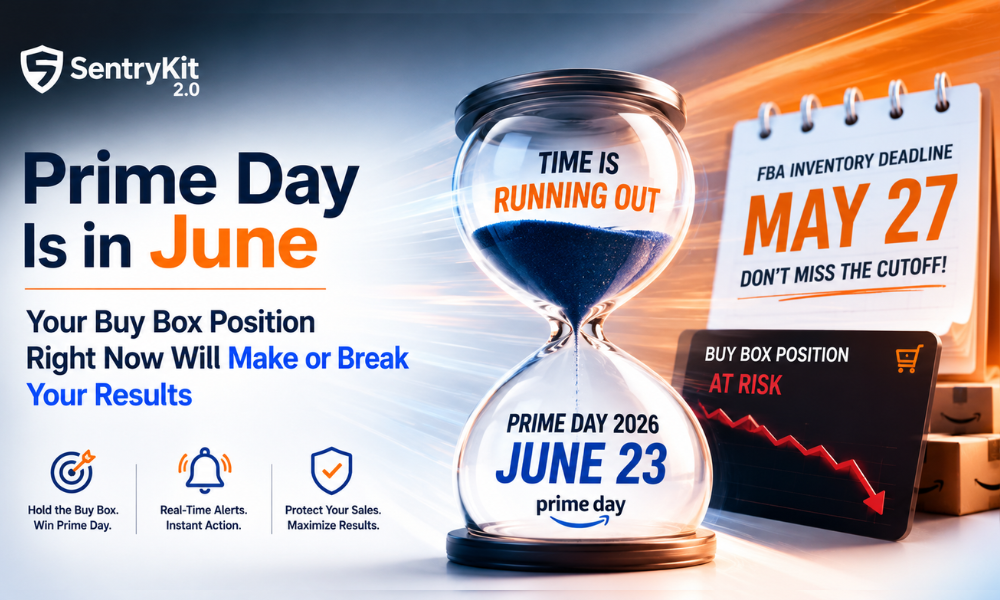
Prime Day 2026 is happening in June — officially confirmed, likely the week of June 23. The FBA inventory deadline is May 27. That’s 14 days from today.
Most sellers are thinking about deals, ads, and inventory replenishment. All of that matters. But there’s one variable that can nullify every bit of it: your Amazon Buy Box position going into the event.
If you don’t hold the Buy Box on Prime Day, your Lightning Deal still runs. It just sends buyers to whoever does.
The June date is a bigger shift than it looks. Prime Day has run in July for years. Sellers had time. This year, the prep window is compressed by three to four weeks — and competitors have already adjusted.
The two to four weeks before Prime Day are the most aggressive Buy Box attack period of the year. Sellers competing in your category are already dropping prices to spike their sales velocity, build their metrics, and lock in Buy Box eligibility before the event starts. They’re not waiting until June 23 to begin.
Amazon confirmed the FBA inventory cutoff at May 27 and the deal submission deadline at May 26. Same week. If your Buy Box is unstable right now, you have less than two weeks to fix it before your event position locks in.
Every Prime Day tactic sits on top of Buy Box control. When you lose it, the math breaks completely.
Here’s what it looks like for a private label seller running three ASINs: you’ve submitted a Lightning Deal. You’re running Sponsored Products at a higher bid to capture Prime Day traffic. Your deal badge is live. A competitor — who has been quietly undercutting your price for the past week — holds the Buy Box. Every impression your deal generates drives a buyer to their listing. Every click your PPC budget pays for leads to an add-to-cart button that benefits them.
This isn’t a hypothetical. It happens every Prime Day, and sellers only catch it after the fact when PPC sales have already dropped and Buy Box share is the culprit.
A $500 Prime Day ad budget with a lost Buy Box is a donation to your competitor.
Three specific threats are active right now — not in June, now.
Competitor pre-event repricing. Sellers who plan to run deals or heavy advertising on Prime Day are already adjusting their prices to build velocity and lock in Buy Box eligibility. If they’re cheaper than you and also FBA-eligible, they’re a real-time Buy Box threat. This isn’t random. It’s calculated, and it’s happening across every competitive category.
Buy Box rotation. If you’re already sharing the Buy Box with another seller, a Prime Day traffic spike will expose that immediately. Buy Box rotation is survivable in slow periods. During a four-day high-velocity event, even a 30% share means you’re handing a third of your Prime Day revenue to a co-owner you didn’t invite. That’s not a rounding error.
FBA inventory timing. If your inventory doesn’t arrive at a fulfillment center by May 27, you risk a gap in FBA status. A merchant-fulfilled competitor who has their stock sorted can step into your Buy Box position while yours lapses. An Amazon stockout in the run-up to a major event compounds — the ranking and eligibility damage doesn’t reset when your inventory arrives.
Don’t wait until June to run this. Do it today.
1. Confirm you’re the current Buy Box holder.
Log into Seller Central → Business Reports → By ASIN. Check Buy Box Percentage for your top ASINs. If it’s not at or near 100%, you have an active problem, not a potential one.
2. Check your Buy Box share percentage.
A number below 90% means someone else is winning the Buy Box part of the time. Identify who and why. A competitor pricing $0.50 lower on an FBA-eligible listing may be enough to split it.
3. Price-check against your top 3 competitors.
Are they already undercutting you? By how much? Amazon’s 2026 algorithm signals show how price-to-competitor benchmarking has become more weighted in eligibility decisions. Be competitive — but don’t race to the bottom before you understand the margin math during a deal event.
4. Verify your FBA inventory is inbound and will arrive before May 27.
If you’re shipping from a 3PL, factor in fulfillment center receiving lead times. Some FCs are running five to seven day windows right now. PPC Land’s Prime Day inventory deadline reporting puts the safe ship date at May 20–23 for most categories.
The checklist is a snapshot. It tells you where you stand today. It doesn’t tell you what changes at 11pm on June 24.
By the time you notice your numbers look wrong on Day 2, you’ve already lost 36 hours of the year’s highest-traffic window.
That’s the problem with dashboard checks. They’re backward-looking. Competitors adjust in real time. A hijacker doesn’t announce themselves. An inventory hold doesn’t send you a notification. You find out after the damage is done.
I’ve seen sellers come out of Prime Day with strong deal impressions and terrible conversion numbers, only to find out a competitor had been holding their Buy Box since Day 1. The deal ran. The badge showed. Every click went somewhere else.
Real-time Buy Box monitoring closes that gap. When a competitor cuts their price and moves into Buy Box position, a Buy Box Lost alert fires within minutes — before the sale goes to them. When a third-party seller attaches to your listing without authorisation, a Hijacker Detected alert does the same. When a competitor makes a pricing move that puts your position at risk, a Competitor Price Change alert gives you the signal to respond while you still can.
As Seller Labs noted in their 2026 Buy Box strategy guide, the sellers who come out of Prime Day profitable treat Buy Box control as a continuous activity, not a setup task. Helium 10’s Buy Box algorithm breakdown reinforces why: the factors that determine eligibility shift based on event conditions, not just baseline metrics.
SentryKit — a Buy Box intelligence platform — monitors your ASINs continuously. If you don’t have real-time visibility right now, you’re making decisions based on yesterday’s data during a four-day event where competitors are moving by the hour. Start a free 30-day trial and have alerts running today.
Your Prime Day results are being set right now — not on event day. The Buy Box position you hold going into June 23 determines whether your deal investment pays off or subsidises a competitor.
Run the 4-point check today. Fix what needs fixing before May 27. And if you want continuous eyes on your Buy Box between now and Prime Day — SentryKit’s free 30-day trial has you covered. The sellers who profit from Prime Day aren’t the ones who planned the best deals. They’re the ones who held their position.
Amazon’s confirmed FBA inbound arrival cutoff for Prime Day 2026 is May 27, 2026. The deal submission deadline is May 26. If you’re shipping from a 3PL, build in five to seven days for fulfillment center receiving — shipping on May 20–23 is the safe window for most categories.
Yes. Amazon’s late 2025 algorithm update moved toward fulfillment-channel neutrality, meaning merchant-fulfilled and Seller-Fulfilled Prime sellers compete on more even terms. During Prime Day, FBA tends to edge out merchant-fulfilled in contested categories when delivery reliability is weighted more heavily. If you’re MF, your seller performance metrics need to be spotless going in.
Check your Buy Box Percentage in Seller Central’s Business Reports daily for the next two weeks. A drop — even five or ten points — is your first warning. Real-time monitoring catches the shift as it happens rather than the next time you log in.
Your deal still runs and the Prime Day badge still displays — but the add-to-cart button goes to whoever holds the Buy Box. You’ve paid for the placement. Your Sponsored Products are driving traffic. The sale goes to your competitor. This is the most expensive version of a Buy Box loss because the deal itself amplifies the problem.
Start now. Competitor repricing and Buy Box positioning activity picks up three to six weeks before any major sales event. A problem you catch today is fixable before May 27. A problem you discover on June 23 isn’t.

Nisha Shetty · Marketing Manager, SentryKit
Nisha is a marketing manager and former Amazon seller who writes about e-commerce growth, consumer behavior, and digital retail trends.