
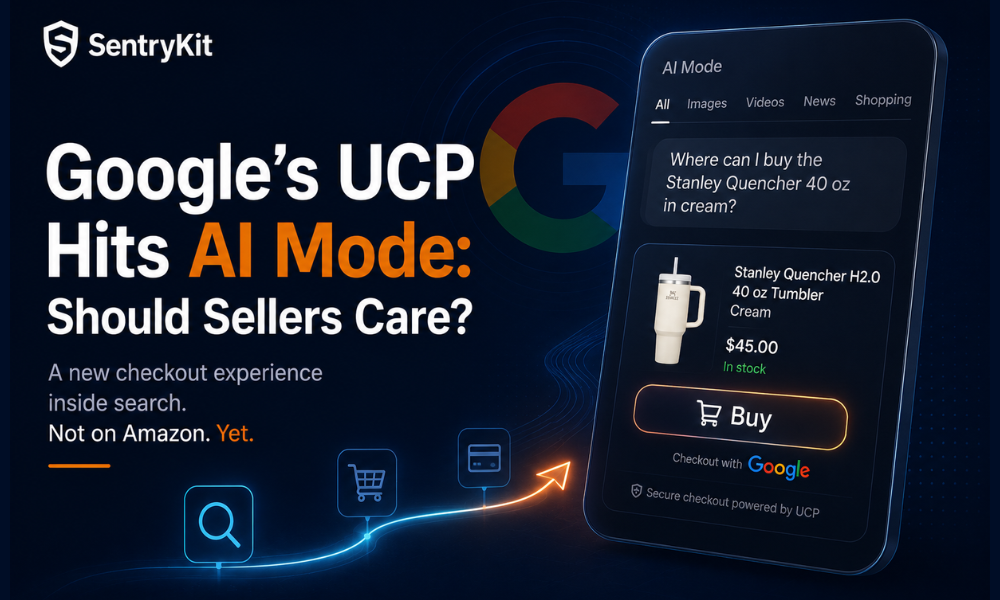
Google’s Universal Commerce Protocol has started appearing inside AI Mode search results. It’s early, it’s limited to a handful of retailers, and no Amazon product is anywhere near it. Here’s what’s actually happening, and why it’s still worth five minutes of an Amazon seller’s attention.
Universal Commerce Protocol, or UCP, is Google’s framework for agentic shopping — letting a shopper complete a purchase without leaving the search results page. It’s recently been observed live inside AI Mode, Google’s conversational search experience, on a small number of branded search prompts.
The interface is simple. Search for a specific branded product, and instead of a standard link, you see the product name underlined with a “buy” button next to it. Tap it, and the checkout happens inside Google, not on the retailer’s site.
Reports point to a small set of participating retailers so far, with Target and Etsy named among them. That’s it. This isn’t a marketplace-wide feature yet, and it isn’t triggering on generic category searches — only on prompts where a shopper names a specific brand or product.
It’s real, and it’s live. It’s also a narrow pilot, not a feature worth reacting to this quarter.
The mechanical shift is straightforward: the retailer’s storefront disappears from the transaction. Normally, a shopper clicks through to a product page, sees the brand’s photography, reviews, related items, and checkout flow, then buys. With UCP, the purchase happens as a line item surfaced directly inside Google’s results.
That raises two questions nobody has a confirmed answer to yet.
First, what does average order value look like through this flow compared to a normal storefront checkout? A one-tap buy button is frictionless, which usually helps conversion — but it also strips out the upsells, bundles, and browsing behavior that typically push order value up on a proper product page.
Second, how does brand identity hold up when a product is reduced to a name and a buy button inside someone else’s feed, rather than presented on a page the brand controls? Packaging, storytelling, trust signals — all of that lives on the product page today. It’s not clear yet how much of it survives when the transaction moves into Google’s interface.
Anyone telling you they’ve already got the AOV or brand-equity numbers figured out on this is guessing. These are open questions, worth tracking and not worth acting on yet.
To be direct about it: no Amazon product is flowing through Universal Commerce Protocol. Amazon is not a participating retailer, based on everything reported so far, and there’s no indication that’s changing soon. If you sell exclusively on Amazon, UCP has zero effect on your listings today.
So why is this showing up on a Buy Box intelligence blog at all? Because it’s a preview of a pattern, not a one-off feature. UCP is Google building the plumbing for a checkout experience where the retailer’s storefront gets bypassed and a product becomes a line in a feed a large platform controls. That pattern isn’t unique to Google.
Amazon sellers have already been watching a version of this play out inside their own marketplace. Rufus and Amazon’s other AI shopping agents are moving in a similar direction — deciding what gets recommended and surfaced based on structured product data, not a seller’s brand presentation. If you’ve read through how agentic commerce optimization changes what gets recommended to shoppers, the underlying shift is the same one Google is now testing on its own turf: an AI layer sitting between the shopper and the storefront, deciding what gets bought.
Amazon’s own AI shopping agent has already gone through a meaningful evolution recently — worth reading in contrast to what Google is testing, since Amazon’s shift from Rufus toward a more assistant-driven shopping experience shows the same underlying trend from the platform sellers actually depend on.
This isn’t an Amazon headline yet. But Amazon sellers are already living a parallel version of this shift inside Rufus — which is exactly why it’s worth watching now, not later.
The second reason this matters has nothing to do with Amazon directly. If Google’s agentic shopping model gains real traction — more retailers, more search volume, better conversion data — it becomes a genuine new demand channel sitting outside Amazon entirely.
Picture a supplement brand that sells on Amazon and also runs its own Shopify storefront. Right now, UCP doesn’t move enough volume to matter to that brand’s numbers. But if Google expands the retailer list and search volume follows, that brand’s DTC checkout is exactly where this shows up first — long before it touches Amazon at all.
This also isn’t a reason to panic or rush into anything. Two retailers piloting a feature inside a conversational search mode is not evidence of a shift in shopper behavior yet. It’s evidence Google is testing the plumbing.
Watch the participant list and the reported performance data as they come out. If UCP expands past Target and Etsy, or either retailer starts talking publicly about conversion numbers, that’s the point where this moves from “interesting” to “actionable.”
No Amazon product is involved in UCP, and there’s no signal that’s changing soon.
What it does offer Amazon sellers is an early look at what agentic checkout looks like when a major platform builds it end to end — a preview worth comparing against what’s already happening with AI shopping agents inside Amazon itself. And if a DTC storefront is part of the business, it’s a channel worth tracking as it develops, not one to build a strategy around yet.
Early and limited beats invisible. Keep an eye on it, and don’t overreact to two retailers piloting a buy button.
No. Based on current reporting, Amazon is not a participating retailer in UCP. The rollout so far reportedly includes retailers like Target and Etsy, surfaced inside Google’s AI Mode search experience.
UCP is Google’s framework for agentic shopping, allowing a shopper to complete a purchase directly inside Google’s search results — currently AI Mode — without navigating to the retailer’s own site.
On a limited set of branded search prompts, as an underlined product name with a “buy” button next to it. It’s not yet appearing on generic category searches, and it’s limited to a small number of participating retailers.
No. UCP operates entirely outside Amazon right now. It’s relevant as a signal of where agentic checkout is heading generally, not as something currently touching Amazon listings or the Buy Box.
Not urgently. If you also run a DTC storefront, it’s worth tracking how UCP expands and whether performance data becomes public. Amazon-only sellers should watch it mainly as a preview of agentic checkout mechanics, similar to what’s already unfolding with Rufus and Amazon’s own AI shopping agents.

Nisha Shetty · Marketing Manager, SentryKit
Nisha is a marketing manager and former Amazon seller who writes about e-commerce growth, consumer behavior, and digital retail trends.