
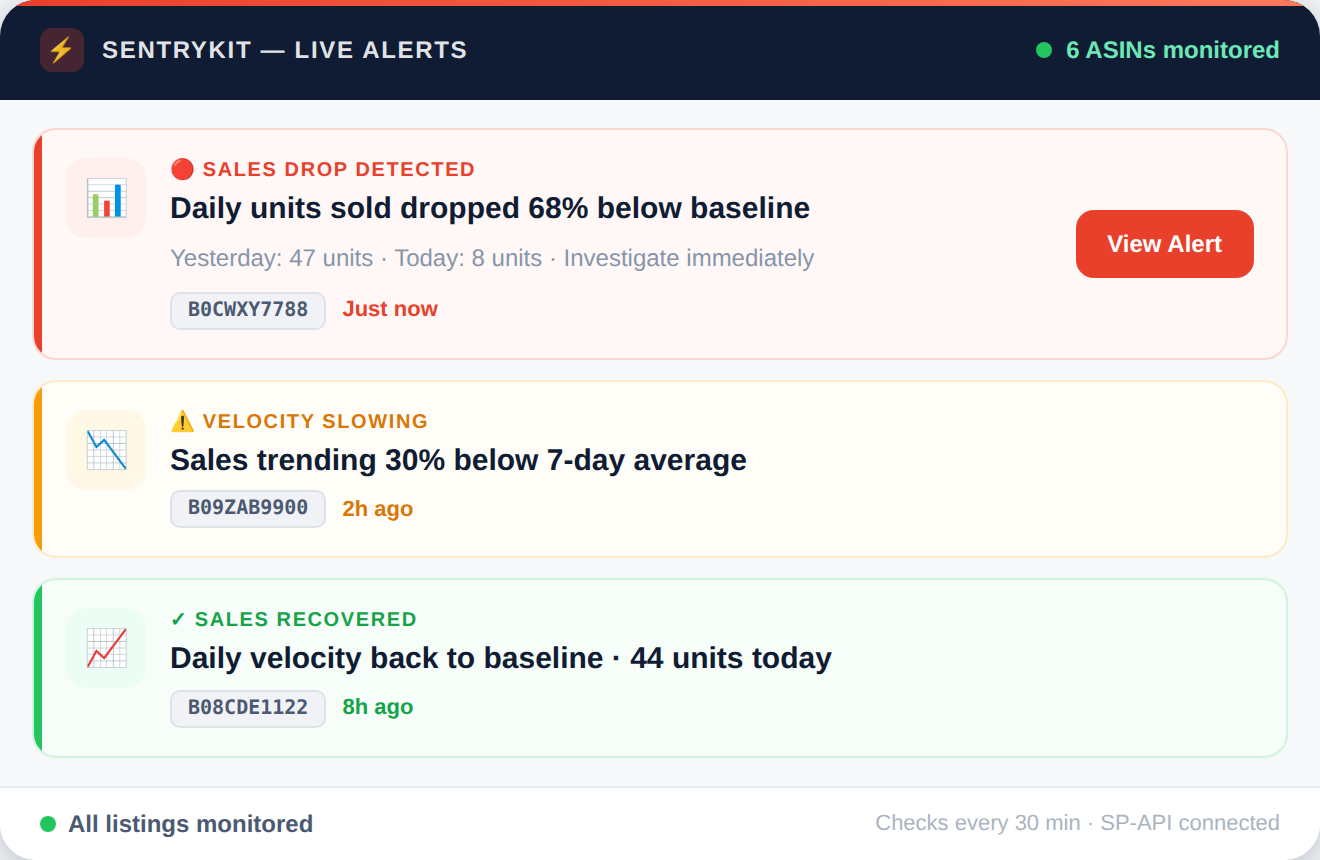
A sudden drop in sales volume can signal a hijacking, suppression, listing change, or competitor action. SentryKit monitors sales velocity on every tracked ASIN and alerts you when volume deviates significantly from your baseline - so you can investigate before the cause compounds.
hours is the average time sellers take to detect a significant sales volume drop without automated monitoring - long enough for a hijacker to hold the Buy Box through an entire weekend
SentryKit alert time — fix problems before most sellers even notice
Continuous monitoring — because Amazon listing issues don’t wait for business hours.
….. what SentryKit does
The short version — what it monitors, what it sends, and why it matters
SentryKit connects to your Amazon account via SP-API and monitors sales velocity on every tracked ASIN. When order volume drops below or exceeds your configured deviation threshold, you receive an email alert with the ASIN, volume change, and timestamp. Sales volume alerts are most powerful as a secondary signal - when combined with Buy Box, suppression, and hijacker alerts, a sudden volume drop helps sellers triage whether the cause is competitive, technical, or operational. SentryKit's sales log provides the correlated data needed to investigate quickly.
It monitors and alerts — giving you the early detection and evidence you need to act before revenue is lost.
….. the problem
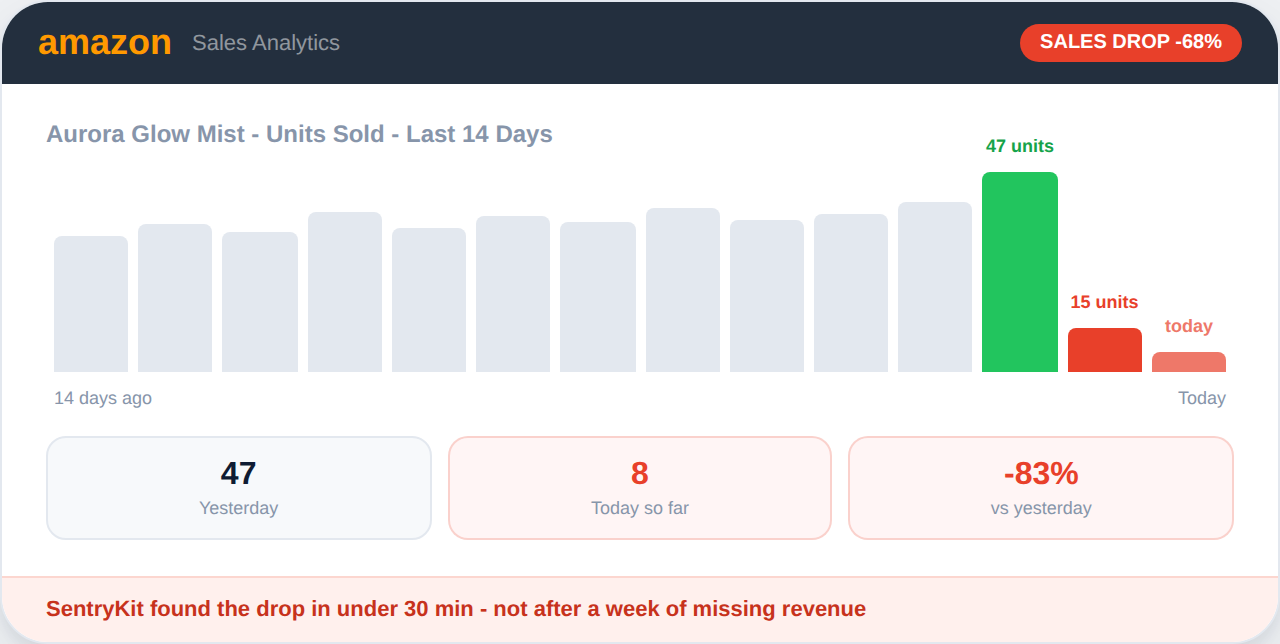
A significant drop in Amazon sales volume is never random. Something caused it - a listing suppression, a hijacker winning the Buy Box, a search ranking decline, a competitor price cut, or a paid campaign pausing unexpectedly. The problem is that by the time a sales drop appears in weekly revenue reports, the event that triggered it may have occurred days ago. For sellers managing multiple ASINs, identifying which specific product drove a revenue decline requires manual investigation across multiple Seller Central reports. Without automated monitoring, this triage happens reactively - during which time the root cause continues to compound. Sales volume spikes also require monitoring - they can indicate a competitor going out of stock, a viral traffic event, or an unauthorized promotion that may not be sustainable and requires immediate inventory planning adjustment.
The average Amazon seller discovers a significant sales volume anomaly 72 hours after it begins - by which point the Buy Box, ranking, or conversion issue has already caused compounding revenue loss that requires weeks to reverse.
Set up in 5 minutes. Monitor unlimited ASINs.
Get a Sales Volume instantly — not hours later when you finally open Seller Central.
….. how to fix it
These are the steps sellers take when sales volume deviates from baseline. SentryKit tells you the moment it happens.
When a sales volume drop alert fires, immediately check your SentryKit dashboard for concurrent Buy Box alerts, suppression alerts, hijacker alerts, or price change alerts on the same ASIN. The volume drop is typically a downstream symptom of one of these upstream events - identifying the cause determines the correct response.
Check the affected ASIN's listing status in Seller Central and review your advertising campaign performance for the same period. A volume drop with stable traffic suggests a conversion issue - check for listing content changes, new negative reviews, or Add to Cart suppression. A traffic drop suggests a search visibility or ranking issue.
Check whether a major competitor dropped price significantly, launched a promotion, or returned to stock after a period of absence. Competitive events are a common driver of volume anomalies that have no on-listing resolution and require a pricing or positioning response instead.
….. why SentryKit
Monthly revenue reviews are too slow to catch and address volume anomalies before they compound. SentryKit surfaces them within hours.
SentryKit monitors rolling sales velocity per ASIN and sends an alert when current volume deviates significantly from baseline - whether the deviation is a drop or an unexpected spike. Each alert includes the ASIN, direction of change, and timestamp.
SentryKit's combined alert system connects sales volume drops with concurrent listing events. When a volume drop correlates with a Buy Box loss or search suppression detected at the same time, the root cause is identified immediately - reducing triage time from hours to minutes.
Daily and hourly sales data per ASIN is logged with timestamps. This history enables baseline recalibration, seasonal pattern identification, and post-event analysis to understand the full revenue impact of listing incidents and competitive events.
….. the comparison
For most FBA sellers, manual Seller Central checks are the only alternative.
Here’s what that actually looks like.
Capability
SentryKit Hijacker Alert
Manual Seller Central
Detection speed
Under 30 minutes
Hours or days — only when you check
Monitoring hours
24/7 including weekends & holidays
When you’re at your desk
Number of ASINs covered
Unlimited, automatically
One at a time, manually
Alert delivery
Instant email notification
None — you discover it yourself
Buy Box ownership data
Real-time per ASIN
Manual product page refresh
Historical seller logs
Full timestamped event history
Nothing retained automatically
Brand Registry documentation
Exportable event log
Nothing retained automatically
Works while you’re offline
Yes
No
“SentryKit caught issues I would have missed—saved me time and money instantly.“
David R., Amazon FBA Seller

“The alerts are spot-on and fast; I finally feel in control of my Amazon business.”
Priya K., Private Label Seller
“Switching to SentryKit was the best decision—my listings are safer and my profits clearer.”
Mark T., 7-Figure Seller
Set up in 5 minutes. Monitor unlimited ASINs.
….. all alerts
Each alert protects a different part of your Amazon business. Most sellers activate all of them on day one.
A sales volume alert is triggered when your order volume on a monitored ASIN deviates significantly from your rolling baseline - either dropping below or spiking above expected levels. The alert includes the ASIN, direction of change, magnitude, and timestamp so you can immediately begin investigating the cause.
Common causes include: Buy Box loss to a hijacker or competitor, listing search suppression, Add to Cart button deactivation, a significant competitor price reduction, a negative review cluster impacting conversion, an advertising campaign pausing unexpectedly, or FBA inventory depletion. SentryKit correlates the volume alert with concurrent listing events to help identify the root cause.
Yes. While spikes are typically positive, unexpected volume surges can indicate FBA inventory depleting faster than planned, a competitor going out of stock creating a temporary demand surge, or a viral traffic event requiring immediate inventory planning. Monitoring spikes prevents a positive event from becoming a stock-out.
Recovery time depends on the root cause. A hijacker removal or listing reinstatement can restore volume within 24-48 hours. A keyword ranking drop caused by a prolonged stock-out or conversion decline may take weeks of consistent sales velocity to recover. Early detection through real-time alerts is the primary factor in minimizing recovery time.
No. Amazon does not send real-time notifications for sales volume changes. Sellers are expected to monitor their own order metrics through Seller Central reports, which are typically reviewed daily or weekly - creating a significant detection lag for sudden anomalies.
SentryKit uses Amazon's SP-API to monitor order data on all tracked ASINs in real time. Sales velocity is calculated against a rolling baseline, and alerts are sent when significant deviations occur. All volume data is logged with timestamps for trend analysis and correlation with listing events.