
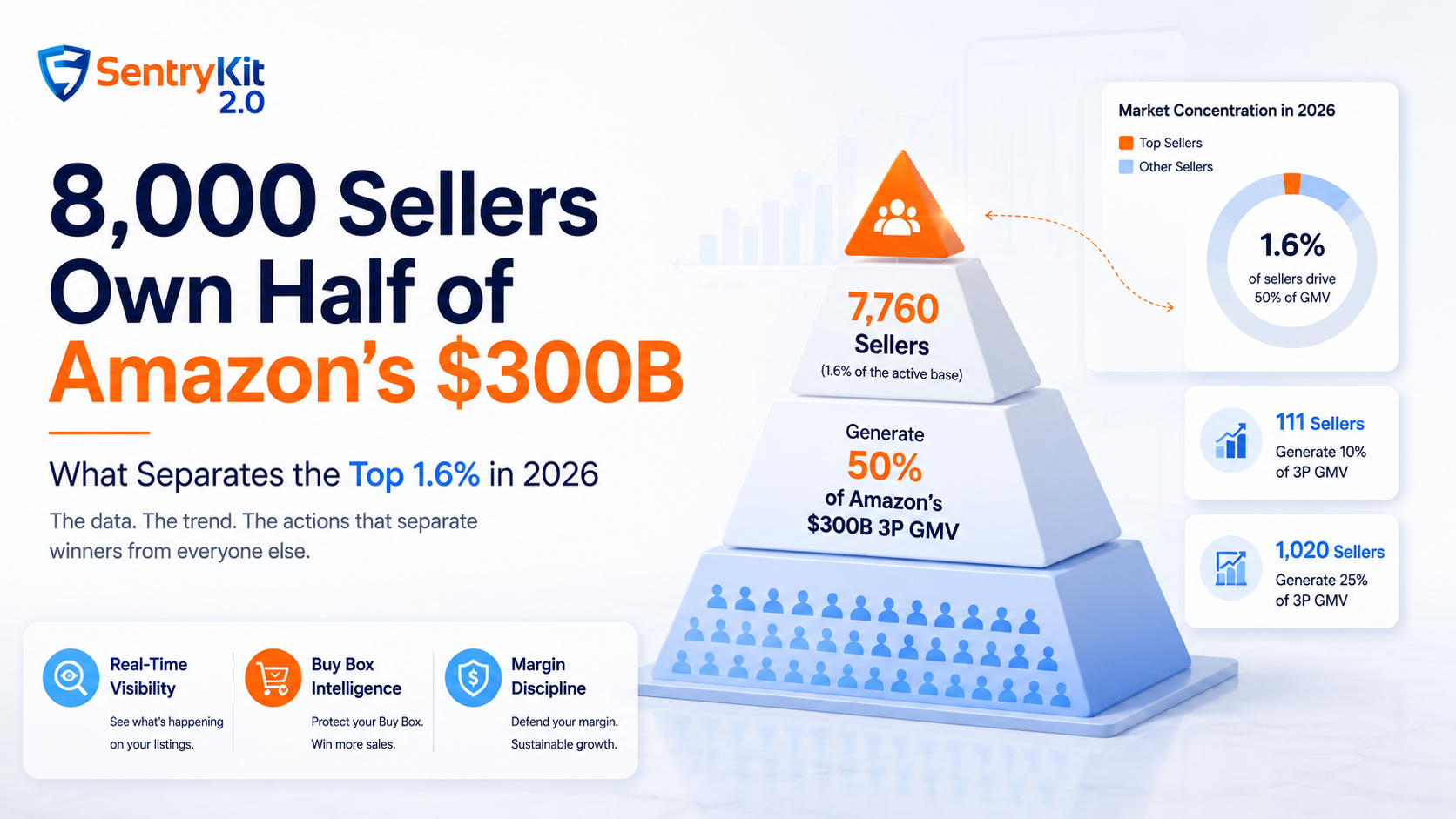
Marketplace Pulse published a number last quarter that should change how every Amazon seller thinks about the next year. 7,760 sellers — 1.6% of the active US seller base — now generate 50% of Amazon’s estimated $300 billion in third-party US GMV. Three years ago, that same 50% threshold required 15,000 sellers. The concentration has nearly doubled in under three years.
That’s not a slow trend line. That’s a consolidation event.
This post is about what’s actually happening underneath that headline, what separates the sellers who are still winning from the ones who are leaving, and what to do about it if you’re somewhere in the middle.
Five data points worth sitting with.
The active US seller count fell from 584,000 in January 2025 to roughly 500,000 in March 2026 — 14 months, about 84,000 sellers gone. That’s the steepest sustained drop in the platform’s reported history.
7,760 sellers (1.6% of the active base) produce 50% of US 3P GMV — roughly 68% of total US Amazon GMV. Each of those 7,760 does $5 million or more in annual sales. At the very top, just 111 sellers generate 10% of Amazon’s third-party GMV. 1,020 sellers account for 25%.
Third-party share of paid units fell to 60% in Q1 2026 — down from 61% in Q4 2025 and 62% the quarter before that. That’s the first two-quarter consecutive decline since Amazon began reporting the metric in 2004. Twenty-two years of upward trajectory, broken.
Three years ago, 15,000 sellers held the 50% threshold. Now it takes 7,760. The middle of the distribution didn’t move evenly — it collapsed inward.
I credit Juozas Kaziukenas at Marketplace Pulse for the cleanest reporting on this, and the Modern Retail briefing on the same data set for the broader marketplace framing.
It would be easy to read those numbers as “Amazon is getting harder.” That framing is half right and entirely useless.
What’s actually happening is that the execution threshold required to run a profitable Amazon business has risen sharply. Higher fees. Higher ad spend pressure. More AI-driven complexity on the listing side. The marketplace stopped tolerating casual operations somewhere around 2024, and the lagging tail is now visibly being pruned.
The 84,000 sellers who left over the last 14 months didn’t leave because Amazon is bad. They left because the level of operational discipline required to extract margin from Amazon now exceeds what casual operations can sustain. The 500,000 still in the marketplace are competing in a denser, sharper environment than the marketplace they signed up for.
The 7,760 at the top of the distribution aren’t the same sellers who were in that group three years ago, either — that part is important. The top tier is reshuffling as much as it’s consolidating. Discipline is the through-line.
Here’s where I’ll be blunt.
The sellers leaving — and I’ve watched this happen to smart, well-funded private label operators in particular — are not failing at Amazon because their listings are bad. They’re failing because they’re optimizing at the wrong layer.
Most of them are spending 80% of their attention on the visible layer: listing copy, ad spend tweaks, repricer settings, A+ content. Meanwhile, profit has moved to layers most of them aren’t watching — sourcing, cash flow, inventory discipline, and Buy Box health across the day-to-day operational cycle. They run automation tools whose decisions they can’t see — repricers, AI listing enhancers, ad platforms — and they inherit the volatility those tools introduce without inheriting the visibility to push back.
I’ve watched wholesale sellers do everything textbook-correct at the listing layer and still lose ground, because they couldn’t see what was happening one layer up. The Buy Box rotating. A competitor’s repricer cascade dropping prices through their floor. A new authorized seller appearing and quietly taking share. Their dashboard caught up the next morning, by which point the damage was a P&L issue, not an operational one.
The other mistake is treating Amazon as the business instead of as a channel. Sellers who built their entire identity around being “an Amazon seller” are the ones most exposed when Amazon shifts. Sellers who treat Amazon as their largest customer — important, optimized, but not their company — have more degrees of freedom when the platform raises the bar.
The top-tier behavior is more boring than people expect. It’s not algorithm tricks or growth hacks. It’s a stack of operational habits that compound.
The mental model matters. Survivors run Amazon like a major channel they could survive losing — they wouldn’t want to, but they could. That mindset changes everything about pricing discipline, inventory exposure, and capital allocation. The sellers most damaged by Amazon’s fee changes are the ones whose entire business is Amazon. The sellers absorbing those same fees and growing are the ones who diversified before they needed to.
This is the single biggest separator I see between sellers in the top tier and sellers leaving. The top tier knows, within seconds or minutes, when a competitor changes price, when a new seller appears on their listing, when a Buy Box gets handed off, when a listing health issue triggers. The leaving tier finds out tomorrow morning, from the dashboard.
That gap — minutes versus a day — is the difference between an operational adjustment and a margin event. Real-time competitor price monitoring, Buy Box state tracking, and hijacker detection are the table stakes for the top tier. Not nice-to-have. Required.
Buy Box discipline at the top tier looks like this: written price floors per ASIN, calculated against current landed cost and FBA fees, updated whenever inputs change. Inventory forecasting tied explicitly to Buy Box eligibility, because stockouts disqualify you from rotation. Fulfillment metrics treated as a moat — late shipments, cancellations, refund rates all read as inputs to Buy Box win rate, not as customer-service metrics in isolation. Price floor discipline is foundational, not optional.
The leaving tier hands Buy Box decisions to a repricer with a rule, walks away, and hopes. The top tier holds the floor manually when it matters and uses tools where they fit.
This is the one most worth saying out loud. The top sellers I see all have repricers — but they treat them as execution layers, not decision layers. The decision logic stays with the operator. The repricer obeys.
Compare that to the leaving tier, where the repricer is making the decisions and the operator is just hoping the rules are right. When the rules are wrong (and they usually are during high-volatility windows), the operator finds out from their P&L two weeks later.
The pattern across categories I watch: sellers who protect their margins from race-to-the-bottom pricing dynamics survive. Sellers who delegate that decision to a tool with a rule do not.
Buy Box win rate alone is not enough. Competitor price alone is not enough. Sales velocity alone is not enough. The top sellers read these together — Buy Box state plus competitor pricing plus listing health plus velocity — and act when patterns emerge across signals, not when a single number moves.
Sellers chasing single-signal optimization (chase the Buy Box, chase the lowest price, chase the conversion rate) tend to over-correct on one axis and damage two others.
Here’s the way I think about it. The leaving tier optimizes. The top tier sees, then optimizes.
You can’t fix what you can’t see. The top sellers I watch have built — or bought — an intelligence layer that sits across all the operational signals. Buy Box state in real time. Competitor pricing without polling delays. Listing health and content drift. Hijacker activity. Sales velocity. Inventory exposure. Read as a system, not as isolated alerts.
This is the layer SentryKit was built for. Real-time Buy Box and competitor intelligence, hijacker detection, listing suppression alerts, all read together as a feed an operator can actually scan in the morning and act on by 10am. Not autopilot. Intelligence. The seller still decides. The tool just makes sure the seller has the data when the decision needs to be made.
I will not pretend tools alone get a seller into the top 1.6%. They don’t. Sourcing discipline, capital management, brand work, and channel diversification matter at least as much. But every operator I’ve watched cross from struggling to growing in this market has the visibility layer in place before they have the optimization layer. Visibility precedes optimization. That order matters.
Most readers of this post will not hit $5M annually on Amazon. That’s a real number and worth being honest about. Most operators run businesses at scales the data above doesn’t directly describe.
That’s fine. The discipline scales down.
Set written price floors for every ASIN. Calculate them against current landed cost and current-year FBA fees — not last year’s numbers. Update them whenever inputs change.
Get real-time visibility on Buy Box, competitor pricing, hijacker activity, and listing suppression. The morning-after dashboard is not enough anymore. The marketplace moves faster than it did when most current playbooks were written.
Audit your automation. Every tool making decisions on your behalf should be one you understand well enough to override. If you can’t explain to yourself why your repricer just dropped your price, that’s not a tool — that’s an exposure.
Diversify beyond Amazon while operating Amazon better. The two are not opposed. The sellers who survive marketplace shifts the cleanest are the ones whose Amazon operations are sharp and whose non-Amazon channels are real.
And read the data without panicking. The marketplace is not collapsing. It’s restructuring. The execution threshold is rising. Operators who treat the platform like a system they can see into and act on are the ones the consolidation is leaving room for.
The marketplace is rewarding operators. That’s the through-line on every data point Marketplace Pulse has published this year.
You can read that as bad news, or you can read it as the clearest signal the platform has ever given about what it takes to grow on it. The top 1.6% is not a closed club. It’s a behavior pattern. The sellers in it have visibility into their operations that the leaving tier doesn’t have. They protect the Buy Box. They don’t delegate pricing decisions to tools they don’t watch.
You don’t need to hit $5M annually to operate that way. You just need to choose the layer you build at — visibility first, optimization second — and stop optimizing at the wrong one.
Approximately 500,000 active US sellers as of March 2026, defined as sellers receiving at least one seller feedback in the past year. This is down from roughly 584,000 in January 2025, per Marketplace Pulse research.
In Q1 2026, third-party sellers accounted for 60% of paid units sold on Amazon, down from 61% in Q4 2025 and 62% in Q3 2025. It’s the first two-quarter consecutive decline since Amazon began reporting the metric in 2004.
7,760 sellers — about 1.6% of the active seller base — generate 50% of Amazon’s estimated $300 billion in US third-party GMV. Three years ago, that same 50% threshold required roughly 15,000 sellers.
The execution threshold required to run a profitable Amazon business has risen sharply — higher fees, higher ad spend pressure, and increased operational complexity. Casual operations no longer survive at the current threshold.
They treat Amazon as their biggest channel rather than their entire business. They have real-time visibility into Buy Box state, competitor pricing, listing health, and hijacker activity. They protect the Buy Box via written price floors, inventory discipline, and fulfillment metrics. They don’t delegate pricing decisions to black-box automation. And they make decisions on multi-signal data rather than single indicators.

Raghav Tiwari · Founder, SentryKit
Raghav is the founder of SentryKit. He writes about Amazon Buy Box dynamics, marketplace intelligence, and the operational reality of running a private label or wholesale business at scale.