
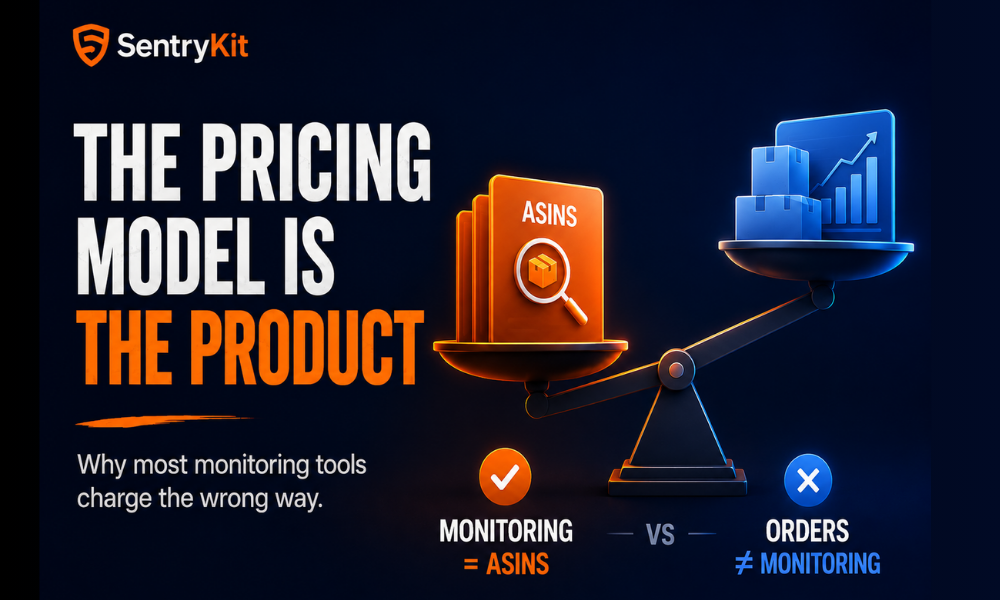
The way a tool charges you tells you what it thinks you’re buying.
A repricer charges per order — makes sense, because it touches every order. A profit and loss tool charges by monthly order volume — makes sense, because order volume drives the data it processes. A research suite charges by feature tier — makes sense, because it’s selling access to a bundle.
None of that makes sense for a monitoring tool.
Monitoring watches ASINs. It doesn’t touch your orders. It doesn’t care whether your five products sold 50 units this month or 5,000. It runs the same number of checks, generates the same category of alerts, and does the same amount of work regardless of your sales volume.
So when you see a monitoring tool pricing itself on order volume — or bundling alerts deep inside a $129/mo research suite — that’s not a neutral business decision. That’s a signal about what the product actually is.
The pricing model is the product. Pick the wrong axis and you’re not just overpaying — you’re using the wrong tool.
Every Amazon seller monitoring tool lands in one of three pricing categories.
Per-ASIN. You pay based on the number of products you’re watching. The more ASINs you add, the more you pay — but only incrementally, and only for actual monitoring work.
Order-volume. You pay based on how many orders you process per month. Your bill goes up when you sell more, not when you add more products to watch.
Suite-tier. Monitoring is one feature inside a larger platform. You pay for the tier that unlocks alerts — often $49 to $129+ per month — regardless of how many ASINs you need covered or whether you use any of the other tools in the bundle.
Per-ASIN is the only model that maps to what a monitoring tool actually does.
The other two are wrong for monitoring. Not wrong in general — order-volume tiers make complete sense for a P&L and profit accounting tool. Suite pricing makes complete sense if you’re doing product research. But for monitoring specifically? Wrong axis, wrong incentives, wrong cost behavior as your business grows.
Here’s a concrete example.
Seller A runs a focused private-label operation: 5 ASINs, 10,000 orders per month. Strong velocity, narrow catalog.
Seller B runs a broad wholesale book: 50 ASINs, 500 orders per month. Thinner velocity, wide catalog.
Which seller needs more monitoring?
Seller B does. By a factor of ten. She has 50 products that need Buy Box checks, hijacker scans, listing suppression alerts, price change notifications, and review monitoring. Seller A has 5. The monitoring workload — the actual number of jobs the tool runs — is ten times higher for Seller B.
But on an order-volume pricing model, Seller A pays more. Significantly more. Because order-volume tools are tracking revenue activity, not monitoring activity.
That’s the monitoring-work fallacy. Order volume is a proxy for business size. It has nothing to do with how much work a monitoring tool is doing on your behalf.
Per-ASIN fixes this. You pay for products monitored. Seller A pays for 5 ASINs. Seller B pays for 50. The cost scales with the actual service delivered.
This matters more than most sellers realize. The default assumption — “I’m a big seller so I’ll pay more anyway” — ignores the cases where you’re paying for volume the tool doesn’t even use.
Here’s where each tool sits, and what pricing axis it uses.
| Tool | Pricing model | Entry price | ASIN cap at entry | Trial |
|---|---|---|---|---|
| SentryKit | Per storefront (unlimited ASINs) | $19/mo (Starter) | No ASIN cap | 14-day, all features, no card |
| AMZAlert | Per-ASIN | ~$0.95–$1.35/ASIN/mo | Scales with ASIN count | Not listed |
| AmzMonitor | Per-ASIN (tiered) | $12/mo (20 ASINs) — $200/mo (1,200 ASINs) | 20 ASINs at entry | 14-day trial |
| SellerSonar | Per-ASIN (tiered) | $19.98/mo Pro (annual billing) | 150 ASINs | 14-day ($5 for full access) |
| Bindwise (Threecolts) | Tiered | $19/mo entry | Entry tier only — higher tiers not publicly confirmed | 14-day trial |
| Helium 10 Platinum | Suite-tier | $129/mo monthly / $99/mo annual | Alerts capped at 5 ASINs lifetime (as of April 2026) | No free trial |
| Jungle Scout | Suite-tier | $49/mo Starter — $399/mo | Product Tracker is a research feature, not a real-time alert system | 7-day money-back guarantee (not a free trial) |
Comparing one of these tools directly? See the AMZAlert alternative, AmzMonitor alternative and SellerSonar alternative comparisons.
Two things worth calling out directly.
Helium 10’s Alerts feature was capped at 5 ASINs lifetime as of April 2026 — reported by EcomCrew when Helium 10 cut Platinum plan entitlements. You’re paying $129/mo for a suite, and monitoring — a feature you might actually rely on — is limited to 5 products. That’s not a monitoring solution. That’s a checkbox.
Jungle Scout’s Product Tracker is a research tool. It helps you evaluate product opportunities before you list. Genuinely useful for sourcing. Not the same as a real-time alert when your listing gets hijacked at 2am. The 7-day money-back guarantee is also not a free trial — you put a card down and request a refund if it doesn’t work out.
For a deeper comparison across dedicated monitoring tools, the best Amazon Buy Box monitoring tools roundup covers the feature layer. This post is about the pricing logic underneath.
This is a distinction that matters.
Helium 10 and Jungle Scout are good platforms. Keyword research, product discovery, competitor analysis, PPC analytics — the suite tools have real value at their price points. The argument isn’t against them as research platforms.
The argument is against using them as your primary monitoring solution.
Monitoring inside a research suite gets designed to serve the suite’s core use case, not yours. Alert coverage is narrower. ASIN limits exist because the product team’s priority is keyword data, not hijacker detection. The pricing tier is set by the suite’s value, not by what monitoring should cost.
That’s how you end up with a $129/mo Helium 10 Platinum subscription and 5-ASIN alert coverage.
To understand what Buy Box monitoring actually covers — what signals it’s supposed to catch and why dedicated coverage matters — the complete Buy Box guide is worth reading before assuming suite tool coverage is enough.
Run this calculation.
You’re on Helium 10 Platinum at $99/mo annual. You use it for keyword research, rank tracking, market intelligence. You also have 30 ASINs you want monitored — but you’re capped at 5 with Alerts.
So you need a dedicated monitoring tool alongside it.
AmzMonitor at the tier covering 30 ASINs: $20/mo on its 50-ASIN plan. SentryKit Starter at $19/mo covers your monitoring needs.
Now ask: what’s the monitoring cost embedded in your Helium 10 subscription for 5 capped ASINs? Even if you allocate 10% of the $99/mo to that feature, you’re paying ~$10 to watch 5 products. That’s $2/ASIN/mo for coverage that stops at 5.
The math doesn’t work. High cost relative to what it delivers, and the cap means it doesn’t scale at all.
Monitoring is a fixed cost of running your catalog — like Amazon selling fees, it scales with catalog size, not sales volume. The Amazon profit margin guide treats monitoring as a line item, which is the right way to budget for it.
Per-ASIN pricing does three things correctly.
It aligns cost with work. The tool monitors ASINs. You pay for ASINs. The incentive structure is clean — the provider wins when you add products, not when you sell more of existing ones.
It doesn’t punish success. A seller who doubles their order volume on an existing catalog pays the same monitoring bill. The tool didn’t do more work. The price doesn’t go up.
It’s predictable. You know what monitoring costs at 10 ASINs, 50 ASINs, 200 ASINs. No volume spike that suddenly moves you into a higher tier because Q4 was good.
The one legitimate question about per-ASIN models is whether pricing scales sanely as the catalog grows. AmzMonitor’s range — $12/mo for 20 ASINs to $200/mo for 1,200 ASINs — is a good benchmark for what the market supports. The per-ASIN rate compresses meaningfully at volume, which is how it should work.
One more separation worth making.
Repricing tools — the ones that adjust your prices in response to Buy Box conditions — often charge per order or as a percentage of GMV, because they touch every transaction. That pricing model is defensible for what they do.
Monitoring is upstream of repricing. It watches for the conditions that tell you whether repricing is even the right response. A hijacked listing doesn’t need a price adjustment — it needs a removal request. A suppressed listing doesn’t need a lower price — it needs a support ticket.
If you use a repricer alongside a monitoring tool, they’re complementary — more on automated pricing rules here if you want to understand how they interact. But they’re not substitutes, and the pricing axis for one doesn’t apply to the other.
Per-ASIN pricing charges you based on how many products you’re monitoring — cost scales with catalog size. Suite pricing bundles monitoring inside a broader research or analytics platform and charges by tier, typically $49 to $129+ per month, regardless of how many ASINs you actually need covered. For dedicated monitoring, per-ASIN is the more accurate axis because monitoring work scales with catalog size, not platform access.
Helium 10 is a strong research and analytics suite. For listing monitoring specifically, its Alerts feature was capped at 5 ASINs lifetime as of April 2026 — confirmed by EcomCrew reporting when Helium 10 revised Platinum plan entitlements. If you have more than 5 ASINs you want actively monitored, Helium 10 alone isn’t sufficient. Most sellers in that position use a dedicated monitoring tool alongside their suite subscription.
A monitoring tool runs checks on ASINs — it looks for hijackers, listing suppression, Buy Box changes, review activity. It doesn’t process your orders. A seller with 50 ASINs and 500 orders per month needs ten times more monitoring jobs run than a seller with 5 ASINs and 10,000 orders per month. Order volume is a proxy for business size, not monitoring workload. Per-ASIN maps directly to the work the tool actually does.
AmzMonitor starts at $12/mo for 20 ASINs, making it the lowest-cost entry among dedicated monitoring tools. SentryKit starts at $19/mo with unlimited ASINs and a 14-day free trial. AMZAlert’s per-ASIN pricing runs roughly $0.95–$1.35/ASIN/mo, which scales efficiently for very small catalogs. The right answer depends on catalog size — at 20 or fewer ASINs, AmzMonitor’s entry tier is hard to beat on price; at larger catalogs, SentryKit’s flat-tier structure is more predictable.
Almost certainly yes, if monitoring is a real operational need. Helium 10’s Alerts are capped at 5 ASINs lifetime. Jungle Scout’s Product Tracker is a research feature designed to evaluate product opportunities, not to alert you in real time when your listing is hijacked or suppressed. If you’re relying on either as your primary monitoring system, you have coverage gaps. A dedicated monitoring tool runs continuously, covers your full catalog, and is built around the alert use case rather than treating it as a secondary feature.
The pricing model a tool chooses tells you what problem it was designed to solve.
Order-volume pricing makes sense for tools that scale with your transaction activity — P&L platforms, fulfillment software, revenue analytics. Suite-tier pricing makes sense for research platforms bundling many features into a single access level. Per-ASIN is the only axis that maps to what monitoring actually does: it watches ASINs, so it charges for ASINs.
If your current monitoring bill goes up when your sales go up, you’re paying for the wrong thing. The work didn’t change. Only your revenue did.
That’s not how the cost of running a catalog should behave.
I priced SentryKit by storefront, with no ASIN or order caps, so the bill never moves because you had a good month or added products. Starter is $19/mo. Pro is $49/mo. The 14-day free trial covers every feature.
The monitoring bill goes up only when you connect another storefront.

Raghav Tiwari · Co-founder, SentryKit
Raghav is co-founder of SentryKit and has spent years working with Amazon brand sellers on catalog operations, Buy Box strategy, and listing protection. He writes about the systems — platform and operational — that determine who wins on Amazon.