
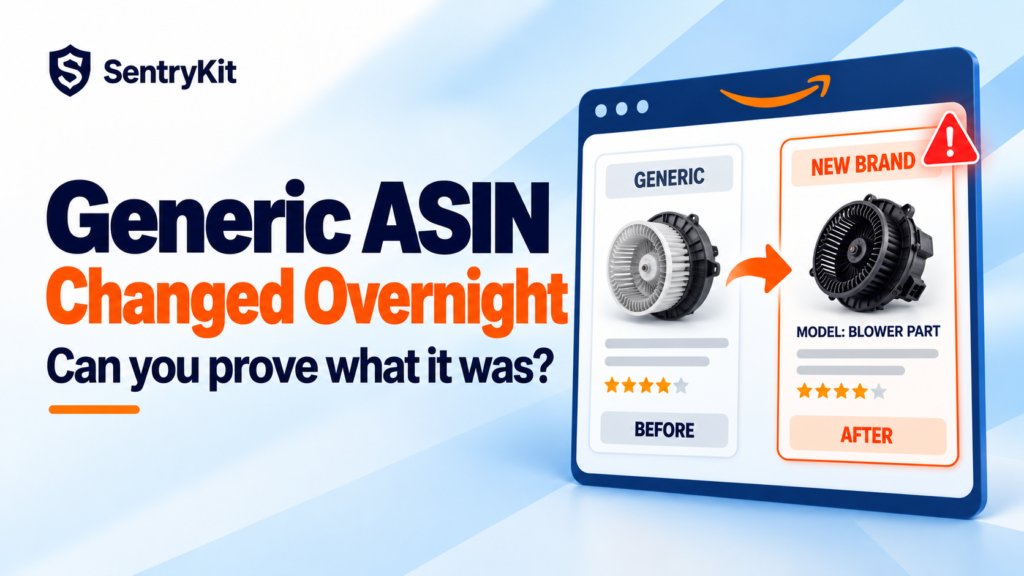
Sellers keep finding the brand on an established ASIN switched to one that has nothing to do with the product. It happens in both directions: branded listings turned into “Generic”, and generic listings given someone else’s brand. In the reports below, abuse complaints and support cases came back rejected, sometimes within minutes.
Here’s the short answer for anyone selling under an Amazon generic brand. On a generic ASIN there’s no brand owner to overrule the change, and Amazon’s first review is automated, so a brand value that looks valid passes. What gets it fixed is a catalog case backed by proof of what the listing used to say. Most sellers don’t have that proof, because nobody keeps a record of a listing they think is stable.
| Branded ASIN (Brand Registry) | Generic ASIN | |
|---|---|---|
| Who can correct the brand | The brand owner | Nobody has priority |
| Catalog lock available | Yes, Brand Catalog Lock | No |
| First report path | Brand Registry tools | Report Abuse, then a catalog case |
| What you have to prove | That you own the brand | What the ASIN was before |
Generic listings are where this is hardest to undo, because there’s no brand owner to correct the record.
A detail page is built from what every seller on it contributes, plus Amazon’s own catalog data. On a branded ASIN, the brand owner’s contribution wins. On a generic one, no contribution outranks another, so a wrong brand from a supplier feed, a catalog merge or a bad actor can stick.
This isn’t new. Amazon staff have published a reporting process for unauthorized brand-name changes on the Seller Forums, and repeated it a year later (Amazon Seller Forums). What’s changed is that generic listings, which many wholesale and private label sellers rely on, sit outside the protections brand owners got in 2026.
The first review is automated. If the new brand is a real brand in Amazon’s system, the check sees a valid value and closes the complaint. Seller threads show the pattern: “no violation found” within minutes, and in one case a rejection that cited the wrong violation type entirely (Amazon Seller Forums).
A rejection doesn’t mean Amazon reviewed it and disagreed. It usually means nobody has looked yet.
Step 2 is where cases die. The question Amazon is really asking is what the brand, model number and title were on a given date. A screenshot taken after the change can’t answer that. Price trackers record some fields but not the ones that decide a catalog case.
SentryKit's listing change alerts flag a brand, manufacturer or model number change on any ASIN you sell, with the old and new value side by side. Every change is saved to the product's timeline, which you can export as a dated record for the case.
That’s the gap SentryKit closes. Listing change alerts cover the identity fields that decide a catalog case (brand, manufacturer, model number, title), with before and after, on every ASIN you sell, and save each change to the product timeline so you have the history when Amazon asks for it. Hijacker alerts tell you when a new seller joins one of your ASINs, which is often how a wrong brand arrives. It tells you which ASIN needs you. Plans start at $19/month with a 14-day free trial. See pricing.
On a generic ASIN, the seller who can prove what the listing used to say is the one who gets it back.
Keep a dated record of every listing change
SentryKit watches 50+ signals on your ASINs, from brand and model number to images and new sellers, and emails you the before and after. Plans from $19/mo.
Start 14-day free trialRelated alerts
Any seller’s contribution or Amazon’s own catalog data can change it, because no brand owner has priority on a generic listing. Amazon also changes listings without notice.
The first review is automated. If the new brand looks valid, it closes the complaint. Escalate with a catalog case and evidence.
Not the way a brand owner can. Brand Catalog Lock applies to registered brands; see what Brand Registry doesn’t protect.
With packaging photos, supplier invoices and a dated record of the listing’s brand, model number and title before the change.
Only as a last resort. You lose the listing’s reviews and sales history, and the wrong brand stays on the old one.

Raghav Tiwari · Founder, SentryKit
Raghav is the founder of SentryKit. He spent years running his own Amazon storefronts before building it, and writes about Buy Box strategy, competitive intelligence, and the platform shifts sellers can’t afford to miss.