
Two things happened at once this quarter, and almost nobody connected them.
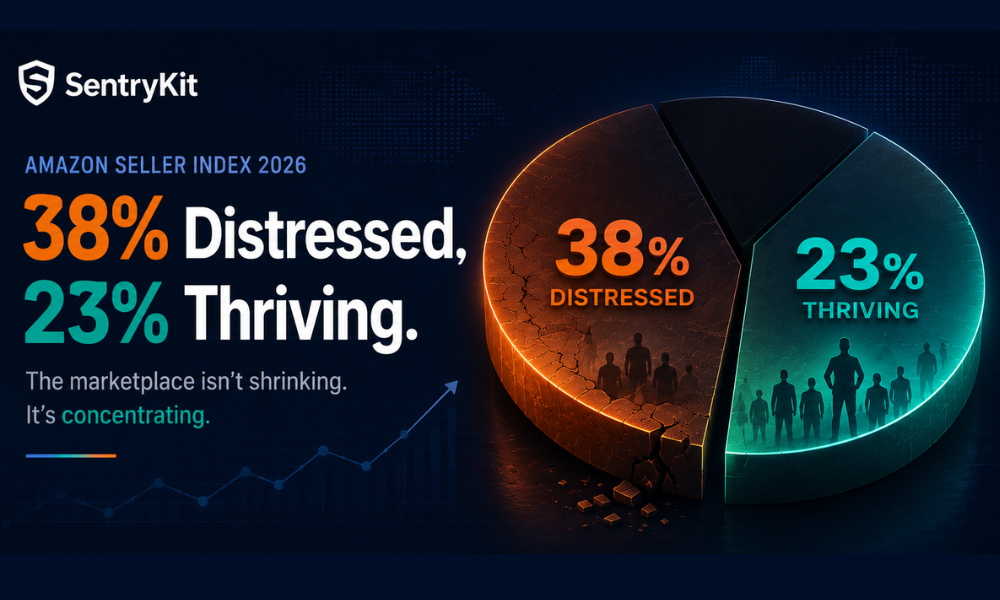
Marketplace Pulse released its 2026 Seller Index. It found that 38% of Amazon sellers are “distressed.” Only 23% are “thriving.” That leaves a wide middle cohort that’s neither — the report doesn’t name it, so I won’t invent a label for it either. But sit with the headline numbers for a second: more than a third of sellers are struggling, and fewer than a quarter are doing well. That’s not a rounding error. That’s a market splitting in two.
Separately — and I mean genuinely separately, this is a different dataset — third-party sellers’ share of Amazon’s paid units sold fell to 60% in Q1 2026. That’s down from 61% in Q4 2025, and 62% the quarter before that. Two consecutive quarterly declines. As Marketplace Pulse’s Juozas Kaziukenas reported, that’s the first time this has happened since Amazon started breaking out the number in 2004.
Read alone, each stat is a headline. Read together, they’re the same story told from two different vantage points.
The Seller Index is a sentiment and cohort survey — it asks sellers how they’re doing and sorts them into buckets. The unit-share number is a hard sales metric — it tells you what actually happened to the pie.
Neither one says the third-party seller category is shrinking. What they say, together, is that it’s concentrating. A shrinking share of sellers is capturing a stable or growing share of the outcomes. A widening base is falling behind. That’s not a contradiction between two reports. That’s one trend, described twice.
If you’ve read the unit-share drop and assumed “the market for sellers like me is dying,” that’s the wrong read. The market isn’t dying. It’s just narrowing who wins.
“Competition is tough” is the laziest possible explanation, and it’s not what the data says anyway. Marketplace Pulse’s Seller Index points at something more specific: 49% of sellers cite marketplace fees as their primary margin concern. 46% cite advertising spend.
Those two numbers together are basically the whole story. Fees eat the top of your P&L. Ad spend eats what’s left of the middle. Combine them and a seller doesn’t need a competitor to undercut them — they can bleed out on cost structure alone while sales stay flat or even grow.
Take a private-label seller running 30 SKUs in home goods. Top-line sales look fine on the dashboard all year. Landed margin, meanwhile, quietly slides from 22% to 14% across two quarters, and nobody catches it because nothing technically broke — no lost Buy Box, no suppressed listing, just fees and ad spend creeping up a little every month. If you pulled your own P&L this morning and margin looked thinner than last quarter with no obvious cause, this is probably why.
This is why “distressed” doesn’t necessarily mean “losing sales.” A lot of these sellers are moving units. They’re just watching the margin on those units shrink quarter over quarter until the business stops making sense. That’s a slower, quieter kind of failure than a Buy Box loss, and it’s arguably more dangerous because it doesn’t show up as an alert. It shows up three months later on a P&L statement.
I wrote about the concentration side of this back in Fewer Than 8,000 Sellers Own Half of Amazon’s $300B, which looked at GMV concentration among the top of the seller base. That post was about revenue — who owns the biggest slice of the dollar volume.
This is a different cut of the same underlying shift. The Seller Index and the unit-share decline aren’t about who owns the top — they’re about the split across the whole base. A shrinking top tier of sellers concentrating revenue, and a widening bottom tier of sellers losing margin, are two symptoms of the same disease.
I also covered the broader base contraction — active sellers, new seller registrations, brand growth — in The Amazon Marketplace in 2026: 165,000 New Sellers, 800k+ Brands, and What Consolidation Means for You. That post already has the 165k new-seller and 800k+ brand numbers, so I won’t re-derive them here. What’s new this time is the active seller count trend Marketplace Pulse has been tracking since: 584,000 active sellers on Amazon.com in January 2025, down to 500,000 by March 2026. That’s a real, ongoing contraction in the base — happening at the same time revenue and unit share keep consolidating toward fewer players.
Put the three data points next to each other and you get a clean picture: fewer sellers overall, a shrinking share of units going to third parties as a category, and within what’s left, a widening gap between a thriving minority and a distressed majority.
Most guides stop at the doom-and-gloom part. They shouldn’t. The data itself hints at what’s structurally different about the sellers landing in the “thriving” bucket versus the “distressed” one — and none of it requires a specific tool to pull off.
Tighter margin discipline. Distressed sellers cite fees and ad spend as concerns, which tells you those costs are treated as fixed overhead they react to after the fact. Thriving sellers treat margin as something to actively defend, line by line, before it erodes — not something to notice once it’s already gone.
Better visibility into what’s actually happening to their listings day to day. A Buy Box loss, a price change from a competitor, a new seller undercutting on the same ASIN — these are daily events, not quarterly ones. Sellers who only look at aggregate sales dashboards see the damage weeks late. Sellers who watch listing-level changes as they happen catch the problem while it’s still cheap to fix.
Faster reaction time to competitive and platform changes. This is the compounding one. If your competitor drops price and you don’t notice for four days, you’ve lost four days of Buy Box share you’re not getting back. Do that every month and it adds up to exactly the kind of erosion the Seller Index is measuring. The sellers in the thriving bucket aren’t necessarily smarter about strategy. They’re just faster to see what changed and faster to respond.
None of this is about having the fanciest tooling. It’s about treating margin and competitive position as things you check daily, not things you discover in a quarterly review. The sellers getting squeezed by fees and ad spend are, in a lot of cases, the same sellers who find out about a problem after it’s already cost them a month of sales.
The market isn’t collapsing for third-party sellers as a category — it’s sorting them. Two straight quarters of unit-share decline and a Seller Index showing more distressed sellers than thriving ones are two views of the same sorting mechanism.
You don’t control Amazon’s fee structure. You don’t control ad auction dynamics. You do control how fast you notice when something changes and how hard you defend margin before it’s gone. That’s not a consolation prize — based on this data, it’s the entire dividing line between the 23% and the 38%. Pick a side.
It’s a report from Marketplace Pulse that sorts Amazon third-party sellers into cohorts based on business health. The 2026 edition found 38% of sellers fall into a “distressed” category and only 23% are “thriving,” with the remainder falling into a middle tier the report doesn’t specifically label.
According to Marketplace Pulse’s 2026 Seller Index, only 23% of sellers are classified as thriving. That’s less than a quarter of the seller base, against 38% classified as distressed.
Third-party unit share fell from 62% to 61% to 60% across three consecutive quarters through Q1 2026 — the first two-quarter consecutive decline since Amazon began reporting the metric in 2004. It reflects sales consolidating toward fewer, better-positioned sellers rather than an overall contraction of the third-party category.
Not necessarily as a whole. The unit-share decline and the Seller Index results both point to concentration rather than shrinkage — a smaller group of sellers capturing a stable or growing share of outcomes, while a larger base loses ground.
Per Marketplace Pulse’s Seller Index, 49% of sellers cite marketplace fees as their primary margin concern, and 46% cite advertising spend — together, the two biggest drivers behind why so many sellers land in the distressed cohort.

Raghav Tiwari · Founder, SentryKit
Raghav is the founder of SentryKit. He spent years running his own Amazon storefronts before building it, and writes about Buy Box strategy, competitive intelligence, and the platform shifts sellers can’t afford to miss.