
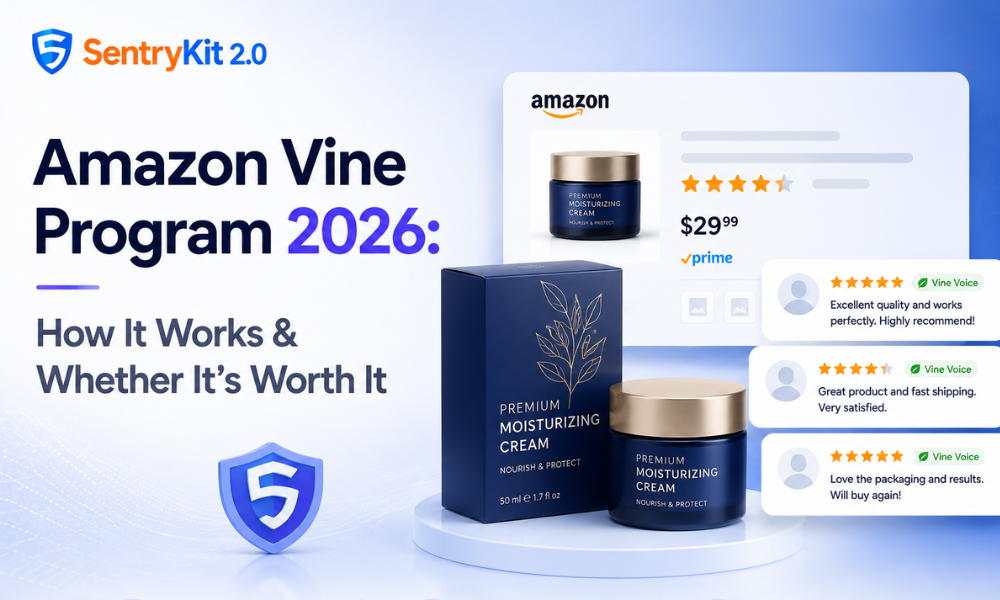
Amazon Vine is one of the few review programs Amazon runs directly. It lets eligible sellers and vendors submit products to be reviewed by a curated group of Amazon’s most trusted reviewers — called Vine Voices — before or after a product goes live. The reviews appear on the listing with a green “Vine Voice” badge, and sellers have no control over what reviewers say.
The program has changed significantly since its early days. It now has a tiered fee structure, broader eligibility through Seller Central, and limits on how many units you can enroll per ASIN. Whether it’s worth it depends on your product, your launch stage, and your risk tolerance. Here’s a clear breakdown of how it works in 2026 and how to decide if it makes sense for your catalog.
Amazon does not notify sellers when a review is published, so most sellers find out only by opening the listing. SentryKit is an Amazon listing monitoring tool that watches your ASINs and sends a real-time alert when a new review is posted, plus a separate alert when the top-rated reviews shown on the listing change. That means a Vine review that moves your star rating reaches you as a notification instead of something you discover later. SentryKit detects and reports review changes only — it does not contact reviewers, solicit reviews, or alter them.
Vine is an invitation-only reviewer program managed entirely by Amazon. Sellers don’t choose who reviews their products. Amazon selects Vine Voices from a pool of reviewers who have built a track record of helpful, verified reviews on Amazon. These reviewers receive your product free of charge and are expected to leave an honest review — positive or negative.
The “Vine Voice” badge that appears on their reviews is visible to all shoppers. It signals that the review came from Amazon’s trusted reviewer program, not from an organic purchase. Some shoppers treat these reviews with extra credibility because they know the reviewer was selected for their review history. Others are skeptical because the product was received for free — but that concern applies to any early review from a non-purchaser.
What Vine does not do: it doesn’t guarantee positive reviews, it doesn’t allow seller communication with reviewers, and it doesn’t let you screen who reviews your product. Once you enroll units, Amazon handles the distribution. If a reviewer doesn’t like the product, you’ll see that in the review.
The reviews generated through Vine count toward your ASIN’s overall review count and star rating just like any other verified review. They are indexed by Amazon’s algorithm and visible to shoppers immediately upon publication. Reviews from Vine tend to be detailed and often include photos or videos, which can help listing conversion rates — both for the content quality and because rich reviews tend to perform better in Amazon’s search algorithm.
Vine moved to a paid model in 2023, replacing what was previously a free (but harder to access) program. The current fee structure is based on how many units you enroll per ASIN:
The fee is charged per ASIN enrollment, not per review received. If you enroll 30 units and only 12 reviewers claim and review them, you still pay $200. The units that aren’t claimed by Vine Voices remain in your inventory — Amazon returns them or they can be removed from FBA.
The products themselves are provided by you at no charge to the reviewer, so the cost of goods needs to factor into your calculation. For a product that costs $15 to produce and you’re enrolling 30 units, the actual cost of the Vine campaign is $200 (program fee) + $450 (30 units × $15 COGS) = $650 before any FBA fees on those units. For a high-ticket product at $80 COGS enrolled at 10 units, the math looks very different: $75 (fee) + $800 (COGS) = $875 for up to 10 reviews.
The fee is applied as an advertising charge in your Seller Central account and is typically charged within 5 days of enrollment. Always verify current fee amounts in Seller Central before enrolling — Amazon can and does adjust program terms. You can find the current fee schedule in the Vine enrollment help page in Seller Central.
The maximum enrollment is 30 units per ASIN. You cannot enroll the same ASIN twice to get more reviews — each ASIN can only be enrolled in Vine once.
To enroll in Amazon Vine through Seller Central, you need to meet a set of eligibility requirements that Amazon checks at enrollment:
The review count threshold is the most common eligibility blocker. If your ASIN has crossed 30 reviews — even if they’re all low-star — it will no longer appear as eligible in the Vine enrollment interface. For new products or relaunches, the window to use Vine is early.
Some sellers time Vine enrollment to coincide with a product launch, enrolling before organic reviews start to accumulate. Others wait until the listing is optimized and the product is performing well in conversion, so that early Vine reviews reflect the product in its best state. Both approaches are valid — the key is making sure the product is actually ready for an honest reviewer to evaluate it before enrolling.
Vine is most useful in a specific situation: you have a new or recently relaunched product in a category where review count and star rating significantly affect conversion, and you need to build credible early reviews without running the risk of early organic reviews from buyers who had a subpar experience before you’d fully optimized the listing.
Vine tends to be worth it when:
Vine tends to not be worth it when:
One underappreciated risk: Vine reviews tend to be longer and more detailed than average. A negative Vine review with photos and a thorough breakdown of product flaws is more damaging than a brief negative review from an organic buyer. If your product has a known weakness — packaging, size discrepancy, a feature that underdelivers — expect Vine reviewers to document it.
The safest approach is to treat Vine as a product readiness test. If you wouldn’t be comfortable with 30 honest, detailed reviews from expert reviewers publishing today, the product isn’t ready for Vine. Fix the underlying issue first — whether that’s product quality, listing accuracy, or packaging — and then enroll.
Vine enrollment is managed through Seller Central under the Advertising menu. The path is: Advertising → Vine. From there, you’ll see a list of your eligible ASINs and can select how many units to enroll per ASIN.
The enrollment process takes a few minutes. You select the ASIN, choose your enrollment tier (which determines the fee), and confirm. Amazon then makes the product available to Vine Voices in the program, who can browse available products and request the ones they’re interested in reviewing.
After enrollment, the timeline looks roughly like this:
You won’t be notified when individual reviews post. Monitor the listing’s review count in Seller Central or through your regular listing monitoring setup — reviews appearing is an indication of Vine activity. The reviews themselves will show the green “Vine Voice” badge.
One thing sellers often miss: if a Vine-enrolled product has its listing suppressed or runs out of FBA stock during the enrollment period, it can affect reviewer availability. Make sure FBA inventory stays stocked throughout the review window — typically the 90 days following enrollment. A suppressed listing doesn’t prevent reviews from posting, but it can reduce the number of Vine Voices who are able to claim a unit before your stock runs out.
For products where your brand protection matters alongside review velocity, having a solid baseline of reviews also helps defend against hijacker attempts — it’s harder for an unauthorized seller to damage a listing’s star rating when there’s already a substantial review corpus in place. That’s a separate but related consideration for private label brands managing listing integrity.
No. Amazon Vine does not guarantee any particular review outcome. Vine Voices are expected to give honest reviews, and their reviews reflect their actual experience with the product. Sellers have no input into what reviewers say, and Amazon does not remove or alter Vine reviews on the seller’s behalf unless they violate standard community guidelines.
No. Amazon Vine is only available to sellers with an active Amazon Brand Registry enrollment. Without Brand Registry, the Vine option will not appear in your Seller Central advertising menu. Enrolling in Brand Registry requires a registered trademark.
There is no guaranteed number. You enroll a set number of units (up to 30), and Vine Voices claim those units based on interest. Not every enrolled unit will be claimed, and not every Vine Voice who claims a unit will leave a review. In practice, completion rates vary by category and product type — some enrollments generate reviews for all enrolled units, others generate fewer. The number of reviews posted is always less than or equal to the units enrolled.
No. Each ASIN can only be enrolled in Vine once. Once you’ve enrolled an ASIN, you cannot re-enroll it even if you use all 30 unit slots or the enrollment window passes without all units being claimed.
Units that are enrolled but not claimed by Vine Voices remain in your FBA inventory. You can create a removal order to get them back or continue selling them as regular FBA inventory. You are still charged the Vine program fee regardless of how many units are claimed.
Vine reviews post on their own schedule, and Amazon does not notify you when one goes live. SentryKit monitors your ASINs and sends a real-time alert when a new review is published, when the top-rated reviews on a listing change, and when a Best Seller badge is won or lost. It reports what changed on the listing; it does not contact reviewers or alter reviews.
Start a 14-day free trial of SentryKit and put your Vine launch on 50+ listing and account alerts.

Nisha Shetty · Marketing Manager, SentryKit
Nisha is a marketing manager and former Amazon seller who writes about e-commerce growth, consumer behavior, and digital retail trends.