Amazon offers two dedicated brand protection programs beyond Brand Registry itself: Transparency and Project Zero. Both exist to help legitimate sellers fight counterfeiting and listing abuse. They work in very different ways, they come with different costs and requirements, and they protect against different threats.
Neither is a complete solution on its own — and the right choice depends on your product type, your catalog size, and where your protection gaps are. This is a clear breakdown of what each program actually does, where each one stops, and how to decide which fits your situation.
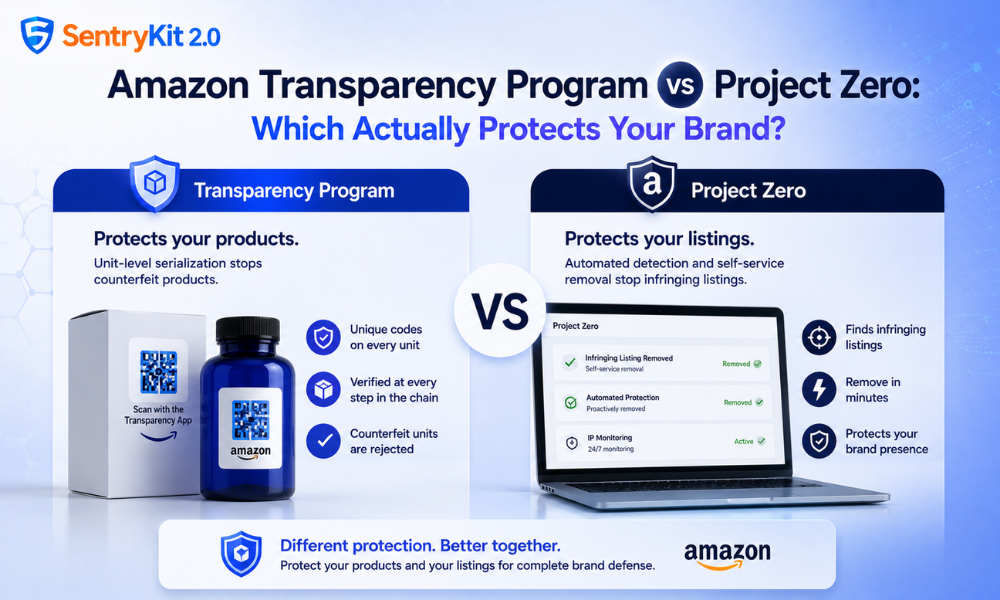
Transparency is a unit-level serialization program. When you enroll a product, Amazon generates a unique barcode — called a Transparency code — for each individual unit you produce. These codes are printed on product packaging at the manufacturing stage. When a unit enters the Amazon fulfillment network or is scanned at delivery, the code is verified. Units without a valid code are rejected.
The protection this provides is physical. A counterfeiter can copy your product and your packaging, but they cannot generate valid Transparency codes for units they didn’t manufacture through your enrollment. When a counterfeit unit without a valid code attempts to enter FBA or gets scanned on delivery, it gets flagged.
Customers can also verify their unit using the Amazon Shopping app or a dedicated Transparency app — giving them a way to confirm authenticity before or after purchase.
What Transparency requires:
Transparency works best for products manufactured in your own facility or with a manufacturer you have direct control over. If you’re sourcing from a third-party manufacturer who packages product before sending it to you, adding Transparency codes requires either a re-labeling step before FBA intake, or getting the manufacturer to apply codes at the factory — which adds lead time and coordination overhead.
Details on program enrollment and current per-unit pricing are available on the Transparency program page.
Project Zero operates at the listing level, not the unit level. It gives brand owners two tools that go beyond what standard Brand Registry offers: automated protections and self-service removal.
Automated protections run continuously in the background. Amazon’s systems scan the store for listings that appear to infringe on your brand — using your logos, images, and product information — and remove them proactively, without you needing to file a complaint. The system is trained on your brand’s intellectual property data, which you provide when enrolling.
Self-service removal lets you take down infringing listings yourself through the Project Zero dashboard, without going through Amazon’s standard complaint-and-review process. This is significantly faster — standard IP complaints can take anywhere from a few days to several weeks. With Project Zero’s self-service tool, you can remove an infringing listing in minutes.
What Project Zero requires:
Project Zero has no physical component. It doesn’t touch the units in the supply chain. It works against infringing listings — sellers who create unauthorized listings using your brand name, images, or product detail page content. You can learn more about Project Zero enrollment criteria via Amazon’s Project Zero help page.
The most important distinction between the two programs is what layer of the supply chain they protect.
Project Zero is a listing-level defense. It works when someone creates a listing that misrepresents your brand. If a bad actor opens a seller account and creates a new ASIN selling an infringing product — or joins your existing ASIN as an unauthorized seller — Project Zero gives you faster and more automated tools to remove them. But once counterfeit units are already in the fulfillment network or in customers’ hands, Project Zero has no mechanism to flag or intercept them.
Transparency is a unit-level defense. It works when legitimate-looking units enter the supply chain. If a counterfeiter sends units to FBA warehouses alongside your genuine units, Transparency catches the fake units at intake — they don’t have valid codes, so they get rejected. This happens before the customer even places an order.
The practical consequence: a seller facing counterfeit goods in FBA (commingled inventory being the most common exposure) will get more direct protection from Transparency than from Project Zero. A seller facing frequent rogue third-party sellers creating unauthorized listings or joining their ASIN will get more leverage from Project Zero’s self-service removal tool.
The other key difference is cost. Project Zero is free if you’re Brand Registry eligible and meet the trademark requirement. Transparency has per-unit costs that compound with volume. For a seller moving 10,000 units per month, Transparency can add a meaningful ongoing cost line. For a low-volume premium product, that cost is negligible relative to the protection it provides against single counterfeiting events that could permanently damage reviews and brand equity.
As Raghav noted in our post on Amazon’s enforcement loophole with bad actors relisting, even with these tools in place, determined bad actors can work around listing-level protections by creating new ASINs after removal. Transparency is the only program that closes the loop at the physical unit level — but it requires supply chain integration that isn’t always feasible.
These programs address different risks. In most cases, the right answer isn’t one or the other — it’s both, applied to the right products and situations.
Enroll in Project Zero if:
Enroll in Transparency if:
Consider both if:
One practical starting point: audit your complaint history. If most of your brand protection complaints have been against unauthorized sellers on your existing ASINs (hijackers, rogue resellers), Project Zero addresses that more directly. If you’ve had issues with counterfeit units in customer hands or FBA rejection notices, Transparency is the relevant layer.
Neither program replaces active monitoring of your listings. Both programs are reactive in different ways — Transparency rejects bad units and Project Zero removes bad listings, but someone still has to check that the protections are working and that new threats aren’t slipping through. That’s where continuous listing monitoring remains the baseline, regardless of which program you use.
Yes. Both programs require active Amazon Brand Registry enrollment. Transparency also requires a registered trademark. Project Zero additionally requires a registered trademark (not just a pending application) and a minimum complaint accuracy rate.
Amazon charges a per-unit fee based on volume, typically ranging from approximately $0.01 to $0.05 per unit. Higher volume enrollments receive lower per-unit rates. There is no flat monthly fee — the cost scales with how many units you produce under the program.
Yes, and they complement each other well. Transparency protects at the unit level (blocking counterfeit physical products), while Project Zero protects at the listing level (blocking unauthorized listings and infringing seller accounts). Using both together provides broader coverage than either program alone.
Project Zero is available to Brand Registry enrolled sellers with a registered trademark, across most product categories. Some categories with unique regulatory requirements may have limitations. The program’s automated protections are most effective in categories where your brand’s visual identity and IP are clearly distinguishable from generic alternatives.
Both programs have coverage gaps. Neither program prevents a bad actor from creating a new ASIN (under a different brand or slightly modified product description) that competes with or misleads buyers about your product. Neither program monitors your listing for changes made directly to your product detail page by other sellers who join your listing. And neither program provides real-time alerts about unauthorized activity — detecting new threats still requires active monitoring.

Nisha Shetty · Marketing Manager, SentryKit
Nisha is a marketing manager and former Amazon seller who writes about e-commerce growth, consumer behavior, and digital retail trends.