
Every article written about Amazon ending its FBA prep services was written before January 1, 2026. “Here’s what’s coming. Here’s how to prepare.” Six months later, those predictions have met reality. This is what actually happened.
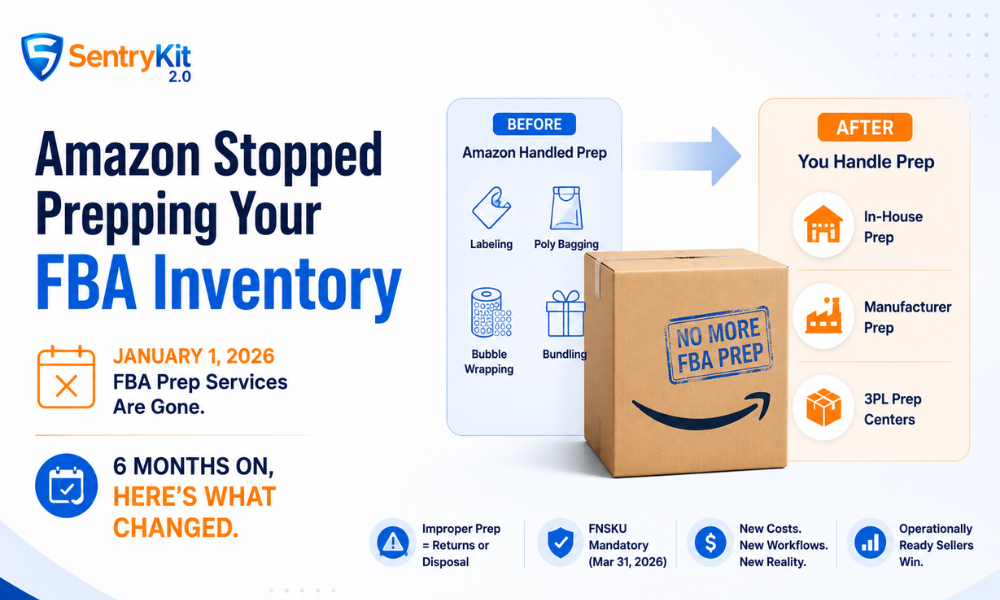
On January 1, 2026, Amazon discontinued its US FBA prep services entirely. No more FNSKU labeling, poly bagging, bubble wrapping, bundling, or compliance prep on Amazon’s end. The announcement, first reported by Supply Chain Dive, applied not just to standard FBA fulfillment centers but also to AWD (Amazon Warehousing and Distribution), AGL, and the SEND program.
If your units arrive at a fulfillment center improperly prepped, Amazon won’t fix them. They’ll be returned to you at your expense or disposed of — no reimbursement, no grace period, no pay-to-fix option at the door.
Amazon’s stated rationale: “the vast majority of sellers already handle their own prep.” That was likely accurate. The service ending was partly an acknowledgment of market reality, not a dramatic policy reversal. But for the subset of sellers who relied on Amazon as a fallback — especially smaller resellers shipping inconsistent volumes — the timing created a real operational gap. For full details, see Amazon's official FBA prep and packaging requirements.
The prep service shutdown didn’t land in isolation. It landed alongside the March 31 FNSKU mandate, which ended commingling as a default option for most resellers.
Before March 31, resellers could ship manufacturer-barcoded inventory and let it commingle in Amazon’s network. After March 31, resellers must FNSKU-label every unit — or risk defective item flags and suppressed listings. Brand Registry enrollees who use manufacturer barcodes retain a meaningful exemption here. That’s one of the real, underappreciated cost advantages of Brand Registry enrollment — one that doesn’t show up in most comparisons of enrolled vs. non-enrolled sellers.
For resellers outside Brand Registry, Q1 2026 meant two operational changes hitting simultaneously: no more Amazon prep, and mandatory FNSKU labeling on every unit. The sellers who felt it most weren’t large 3PL-enabled operations — they were mid-size resellers who had been relying on Amazon’s prep service as the path of least resistance.
Sellers didn’t have many choices. The market landed on three primary approaches. For a detailed comparison of prep options, Helium 10's breakdown of FBA prep options is worth bookmarking.
Bringing prep fully in-house — label printers, poly bag stock, and warehouse workflows — works well if you have consistent volume and staff who can build the process. The equipment investment is real but manageable. The ongoing cost is labor and time.
The catch: in-house prep errors still result in Amazon rejections. Wrong label placement, insufficient poly bagging for fragile items, missing suffocation warnings — you’ve done the work and still taken the hit.
For private label sellers with established manufacturer relationships, pushing prep upstream was the cleanest answer. If your manufacturer prints FNSKU labels and poly bags at origin, nothing changes at the warehouse level.
This isn’t an option for resellers buying wholesale from third parties. But for brands sourcing direct, it’s the most cost-efficient path — prep cost folds into production cost rather than appearing as a separate labor line. The transition for these sellers was largely invisible.
The third-party prep center market — which existed long before January 1 — absorbed significant volume in Q1. Services like MyFBAPrep and dozens of regional prep centers handle receiving, FNSKU labeling, poly bagging, bundling, and compliance prep before forwarding inventory to Amazon.
The cost is real: prep centers charge per unit, with rates varying by prep complexity, and that adds up at volume. But for resellers without warehouse space or consistent inbound flow, outsourcing prep is often the most practical answer. One underappreciated advantage: the prep center takes on the compliance risk. If they mislabel, the remediation is on them.
Sellers who had their prep infrastructure sorted before January 1 — in-house workflows, prep center contracts, or manufacturer-level labeling — moved through Q1 without significant disruption. Sellers who waited and then scrambled faced real pain: inventory backlogs, rejected shipments, and the cost of building new workflows under time pressure. Q1 was, for some, expensive.
The FNSKU collision made it harder than it needed to be. Resellers who weren’t already FNSKU-labeling had to implement that change at the same moment they were standing up new prep workflows. Some of that friction has settled. Some sellers are still recalibrating their cost structures six months later.
One downstream effect worth watching: improperly prepped inventory that makes it through can still generate defective item complaints — and those complaints can suppress listings. If you’ve had prep disruptions this year and you’re seeing unexplained suppression events, that connection is worth investigating before assuming the cause is something else. A suppressed listing tied to a defective item flag has a different fix path than a suppression from a policy violation or an image issue. And if you’re running a high-SKU catalog, the account health impact of repeated prep violations compounds faster than most sellers expect. SentryKit’s Listing Suppressed alert surfaces these events in real time — useful if you want to catch a bad shipment’s downstream effects before they become a prolonged listing problem.
The prep service end wasn’t the industry earthquake some predicted. But it did separate sellers with operational infrastructure from those who were leaning on Amazon as a fallback. Six months out, that gap is visible.
No. Amazon discontinued its US FBA prep services — including FNSKU labeling, poly bagging, bubble wrapping, bundling, and compliance prep — effective January 1, 2026. There is no fee-based option to have Amazon handle prep at the fulfillment center. Your inventory must arrive fully prepped and labeled to Amazon’s requirements.
Amazon will either return the units to you at your expense or dispose of them with no reimbursement. Repeated violations can also generate defective item complaints that affect listing health and account standing.
Yes. The service discontinuation applies to AWD, AGL, and the SEND program — not just standard FBA fulfillment centers. All Amazon-operated US programs are affected. You are responsible for full prep compliance before inventory enters any Amazon program.
Yes, but it's a different issue. Partnered carrier programs are separate from prep services. You can still use partnered carriers for inbound shipping — but your units must arrive at the fulfillment center already prepped and compliant regardless of which carrier you use. The two programs are independent.
It depends on your catalog and volume. For private label sellers sourcing direct, pushing prep upstream to origin is typically the lowest per-unit cost. For resellers, in-house prep has the lowest unit cost at scale but requires upfront investment. Third-party prep centers are the most accessible starting point but add a per-unit margin. The right answer depends on your SKU count, inbound volume, and warehouse capacity.
Yes, most established prep centers handle custom packaging — inserts, branded poly bags, multi-pack bundling, and specific labeling formats. Provide detailed specs, supply packaging materials where needed, and confirm their capability with your specific SKU type before signing a contract.

Nisha Shetty · Marketing Manager, SentryKit
Nisha is a marketing manager and former Amazon seller who writes about e-commerce growth, consumer behavior, and digital retail trends.