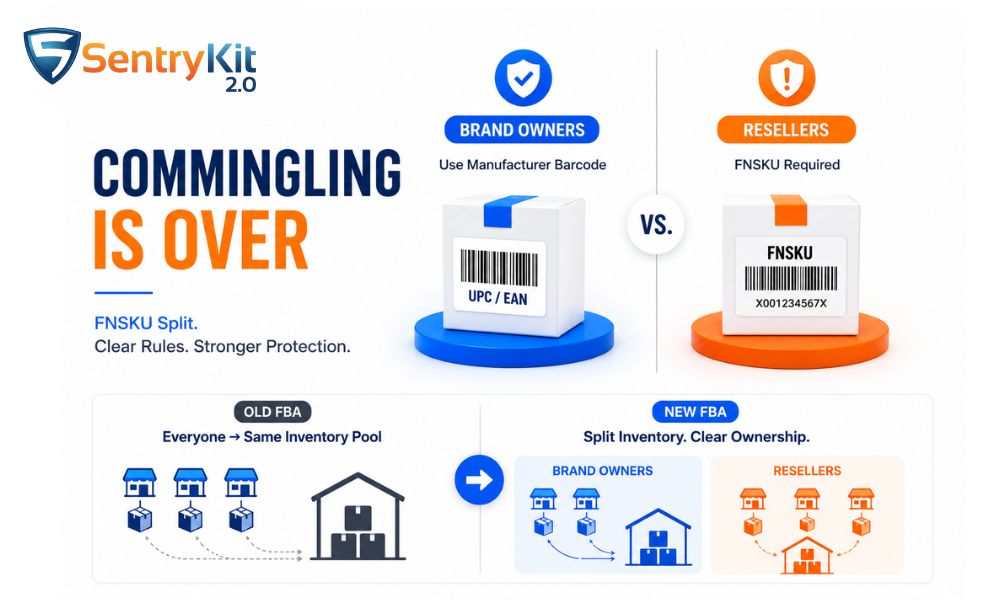
On March 31, 2026, Amazon split FBA’s inventory identification rules into two distinct tracks. Brand Registry members selling products they manufacture can continue using manufacturer barcodes — EAN, UPC, or ISBN — to identify their units in Amazon’s fulfillment network. Everyone else — resellers, distributors, third-party brand sellers, and private label sellers without Brand Registry enrollment — must use FNSKU labels on every unit, no exceptions.
The policy change resolved one of the most persistent inventory accuracy problems in FBA: commingled inventory. It did not eliminate commingling entirely, but it drew a clear line between the sellers who can still participate and those who cannot. If you are a reseller, that line just moved. If you are a brand owner enrolled in Brand Registry, things just got easier — provided you understand what changed and what the new compliance requirements actually are.
Here is what the March 31 change means in practice, depending on which side of the split you fall on.
Commingling allowed multiple sellers’ units of the same ASIN to be stored together in Amazon’s fulfillment network and drawn from a shared inventory pool. When a buyer ordered a product from your listing, Amazon would fulfill the order from whichever unit was closest to the buyer — regardless of which seller originally sent that unit. The seller who made the sale would receive the revenue; Amazon tracked which seller was owed fulfillment credit on the shared pool.
Amazon designed this system for efficiency. Consolidating inventory from multiple sellers reduced the number of unique product locations in its warehouses, simplified its routing algorithms, and allowed faster delivery by drawing from the nearest available unit. For high-volume commoditized products — generic batteries, basic cables, undifferentiated household items — the model worked reasonably well. The product was the product regardless of which unit you sent.
The problem was abuse. Commingling required Amazon to trust that every unit placed into a shared pool was authentic and in the condition claimed. That trust was routinely violated. Counterfeit sellers could insert fake units into commingled pools for popular ASINs, contaminating inventories that legitimate sellers had built carefully. A buyer who purchased from your listing might receive a counterfeit unit from another seller’s commingled inventory. Your listing received the negative review. Your account bore the consequence.
Amazon’s Brand Registry provided tools to report and remove counterfeit listings, but it could not prevent the upstream contamination problem as long as commingling remained open to anyone using manufacturer barcodes. The March 31 policy change directly addresses that vulnerability by restricting who can participate in manufacturer barcode fulfillment.
Amazon announced the expanded FNSKU requirement in January 2026 with a March 31 effective date for new shipments. The core rule change: the manufacturer barcode opt-in — which allowed eligible sellers to use EAN, UPC, or ISBN barcodes instead of Amazon-specific FNSKU labels — is now restricted to Brand Registry-verified brand owners selling products they manufacture.
The previous opt-in was available to a broader range of sellers including resellers who met Amazon’s eligibility criteria for specific ASINs. That broader eligibility is gone. The “eligible for merchant barcode” status that previously appeared in Seller Central for certain ASINs has been revoked for non-brand-owner accounts.
What the new rule permits: a Brand Registry-enrolled brand owner who manufactures their products can use the manufacturer barcode when (a) the ASIN has a valid UPC, EAN, or ISBN registered in Amazon’s catalog, (b) the brand has completed Brand Registry verification, and (c) Amazon has maintained merchant barcode opt-in eligibility for that ASIN for the brand’s account. All three conditions must be met — brand registry enrollment alone is not sufficient.
What the new rule requires from everyone else: FNSKU on every unit before it arrives at an Amazon fulfillment center. The FNSKU is Amazon’s unique identifier that ties a specific unit to a specific seller account. It eliminates commingling by making each unit traceable — Amazon knows which seller’s inventory it is drawing from at fulfillment time. There is no shared pool when every unit has a seller-specific identifier.
Transition terms: units already in Amazon’s fulfillment centers under the old manufacturer barcode opt-in were not recalled. Existing inventory continues to fulfill normally. But any new shipments created after March 31 require FNSKU for sellers who no longer qualify for merchant barcode opt-in. Sellers who send new units using manufacturer barcodes for ineligible ASINs risk having those units rejected at the receiving dock or placed on hold pending relabeling at the seller’s expense.
If you manufacture your products and are enrolled in Amazon Brand Registry, the practical impact on your operations is minimal. You can continue using your product’s standard UPC or EAN barcodes for FBA shipments as long as your ASIN maintains merchant barcode opt-in eligibility. There is no relabeling cost for your core product line, and your existing prep workflows do not need to change.
The more meaningful benefit is what this policy change does to the counterfeit contamination risk on your listings. Resellers who were previously able to commingle units alongside your manufacturer-barcoded inventory — including bad actors inserting counterfeit units — no longer have that access. If your ASIN’s manufacturer barcode opt-in is now restricted to your account, the shared pool that enabled contamination no longer exists for your listing. Your FBA inventory pool is yours.
There is an important caveat: the brand owner exemption applies only to products you manufacture. If you also carry third-party products — items you resell that are made by another company — those products still require FNSKU for your account. The exemption is tied to the brand owner relationship on each ASIN, not to your account status globally. Review your full ASIN inventory. Any ASIN where you are the reseller rather than the manufacturer now requires FNSKU, even if your brand owner ASINs remain on merchant barcode opt-in.
Brand owners should also verify that their Brand Registry enrollment is current. If your enrollment has lapsed, expired, or was granted under an old email or trademark registration that is no longer active, you may not qualify for the manufacturer barcode exemption even if you are the ASIN’s manufacturer. Check your Brand Registry dashboard and confirm the enrollment status is Active before assuming the exemption applies.
For resellers, the March 31 change is a direct operational cost increase. Every unit you send to FBA now requires an FNSKU label. If your current workflow involves purchasing inventory and shipping it directly to Amazon’s fulfillment centers using the product’s manufacturer barcode, that workflow is no longer compliant for your account.
The labeling options are: apply FNSKU labels yourself before shipping, use a third-party prep center to label units, or use Amazon’s FBA Label Service (currently charged at $0.55 per unit for standard-size items, $1.20 for oversized). The cost differential between these options depends on your volume and your current prep infrastructure. Sellers who operate their own warehouse can add FNSKU labeling to their existing prep flow with relatively low incremental cost. Sellers who were drop-shipping directly from suppliers to Amazon’s fulfillment centers — relying on the manufacturer barcode as the path of least resistance — face a more significant operational adjustment.
Check your existing Shipping Plans immediately. Any plan that shows “eligible for merchant barcode” may now be inaccurate. Amazon’s Seller Central has been updating the eligibility status in real time as the policy change propagated, but not all accounts updated simultaneously. If you create a new Shipping Plan for an ASIN that previously used merchant barcode opt-in and you do not have Brand Registry eligibility on that ASIN, the plan creation process will now require FNSKU. Verify before you send units.
For retail arbitrage and wholesale resellers who source from multiple suppliers across many ASINs, the FNSKU requirement creates a labeling checkpoint that did not previously exist at scale. This is not optional compliance — units sent without FNSKU for non-eligible ASINs will be flagged at intake. The damage is operational disruption and fulfillment delays while the issue is resolved, plus any relabeling fees Amazon charges for units received incorrectly. A listing suppression can also result if the compliance issue triggers a hold on your inbound shipment status. Build the labeling step into your intake process now, before a shipment gets rejected.
The fastest way to audit your compliance exposure is a Barcode Type check in Seller Central. Go to Inventory > Manage FBA Inventory and look for the “Barcode” column (you may need to customise your column view to surface it). Any ASIN showing “Manufacturer barcode” where you are not the Brand Registry-enrolled manufacturer is now a non-compliance risk for new shipments. Pull a list and prioritise by inbound shipment volume — the ASINs you ship most frequently carry the highest immediate risk.
The March 31 change is a permanent structural shift to FBA’s inventory identification architecture, not a temporary enforcement wave. Build the FNSKU step into your standard operating procedures for any ASIN where you are not the Brand Registry-enrolled manufacturer. That is the operating reality from April 2026 forward.
FNSKU stands for Fulfillment Network Stock Keeping Unit. It is Amazon’s own barcode that ties a specific unit of inventory to a specific seller account in Amazon’s fulfillment network. A UPC (Universal Product Code) is a manufacturer-assigned barcode that identifies a product regardless of who is selling it. Because a UPC is not seller-specific, multiple sellers’ units can be pooled together under the same UPC — which is how commingling works. An FNSKU prevents commingling because each unit is traceable to a single seller account, making it impossible for Amazon to substitute another seller’s unit when fulfilling your order.
No. Units already at Amazon fulfillment centers under the old manufacturer barcode opt-in are not affected by the March 31 change. They will continue to be fulfilled as normal until the inventory depletes. The new FNSKU requirement applies to new shipments created after March 31, 2026. Only units in new Shipping Plans created after the effective date are subject to the new requirement.
No, not as of March 31, 2026. The manufacturer barcode opt-in for FBA is now restricted to Brand Registry-enrolled brand owners selling products they manufacture. Resellers, regardless of how many ASINs they carry or their sales volume, must use FNSKU labels on all units sent to FBA. The cost of FNSKU labeling is either absorbed by your own prep operation or paid through Amazon’s FBA Label Service.
Amazon will flag the shipment at intake. In some cases, units will be rejected outright. In others, Amazon will place the units on hold and charge relabeling fees to apply FNSKU labels before the units are made available for fulfillment. Shipment holds can delay your inventory availability, which affects your in-stock status and can suppress your listing from the Buy Box if availability drops below Amazon’s threshold. Repeated non-compliance can also trigger account-level warnings.
Yes. The Brand Registry exemption applies only to products you manufacture and own the brand for. If you also carry third-party products — items where you are the reseller rather than the brand owner — those ASINs require FNSKU even though your account is Brand Registry-enrolled. The exemption is per-ASIN based on brand ownership, not a blanket pass for your entire account. Review your catalog and apply the FNSKU requirement to any ASIN where you are reselling rather than manufacturing.

Nisha Shetty · Marketing Manager, SentryKit
Nisha is a marketing manager and former Amazon seller who writes about e-commerce growth, consumer behavior, and digital retail trends.