
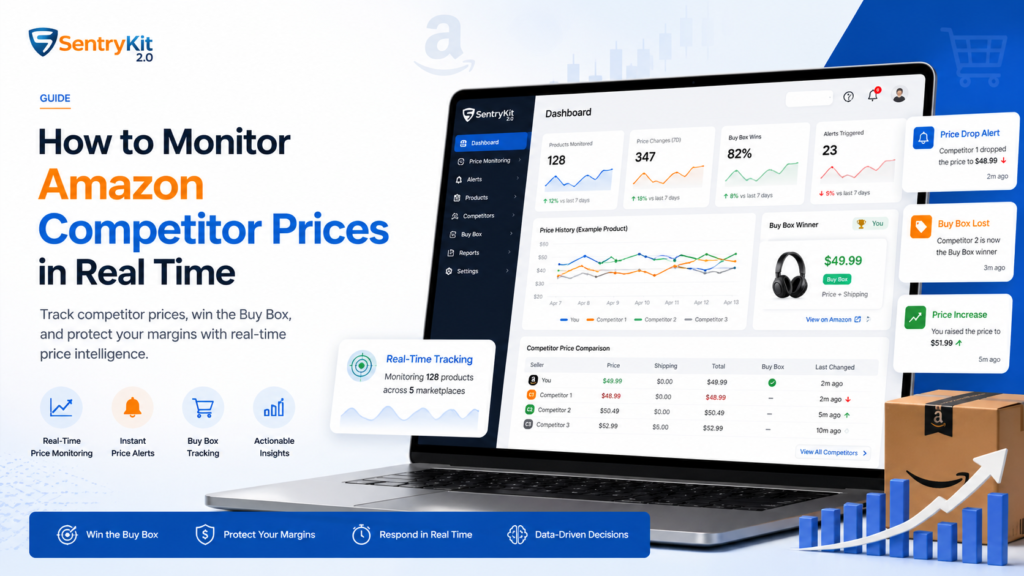
Amazon does not enforce MAP. This surprises a lot of brand owners, especially those who assume the Seller Agreement prohibits price undercutting. It doesn’t — not in the way MAP agreements work. Here’s what MAP actually is, why Amazon won’t enforce it, and what options brand owners have when a reseller ignores their pricing floor.
MAP stands for Minimum Advertised Price. It is a contractual agreement between a brand and its authorized resellers — not a rule Amazon creates, administers, or enforces. The agreement restricts the price at which a reseller can advertise the product: in search results, on their website, in email promotions, and in any other marketing channel. The critical legal distinction is that MAP governs the advertised price, not necessarily the actual checkout price.
Brands put MAP agreements in place to protect perceived product value and to prevent race-to-the-bottom dynamics across their distribution network. In traditional retail — brick-and-mortar stores, catalog retailers, independent boutiques — this distinction between advertised price and selling price is meaningful. A store might advertise a product at MAP while offering a discount at the register. That loophole exists because the advertisement and the transaction are separate events.
On Amazon, that distinction collapses entirely. The price a customer sees in search results is the price they pay at checkout. The add-to-cart price is the advertised price. There is no separate register negotiation. This means that on Amazon, MAP and minimum selling price are functionally the same thing — and yet Amazon treats them as legally distinct, because they are. That legal distinction is precisely what allows Amazon to sidestep MAP enforcement entirely. Understanding this gap is the starting point for any brand trying to protect its pricing integrity on the platform.
US antitrust law prohibits resale price maintenance — the practice of a manufacturer or brand dictating the price at which an independent business resells a product it has already purchased. Amazon enforcing MAP on behalf of brands would make Amazon a party to resale price maintenance, exposing it to significant antitrust liability. Amazon will not take that risk, and its legal teams have made this position clear in how the platform operates.
Amazon’s core algorithm is explicitly designed to surface the lowest available price to customers. That algorithm and MAP enforcement are fundamentally in conflict. Amazon does not want to suppress a lower-priced offer on behalf of a brand — doing so would run directly against the platform’s commercial interest in presenting buyers with the best deal.
Amazon has previously faced scrutiny over price parity clauses in its seller agreements — clauses that required sellers not to offer lower prices elsewhere. Regulators viewed those clauses as anticompetitive. Amazon removed them in several markets as a result. Enforcing MAP would invite similar scrutiny from a different angle.
Brands who try to route MAP violations through Amazon’s Brand Registry or IP complaint tools hit a wall quickly. Brand Registry is built for counterfeit detection, content control, and intellectual property protection — not pricing policy enforcement. Amazon will reject MAP violation reports filed through those channels because pricing contracts between brands and their resellers are outside Amazon’s scope. The enforcement responsibility sits entirely with the brand.
Say your MAP is $25 and one reseller drops to $22. Within 48 to 72 hours, a cascade typically begins. Here is what that sequence looks like in practice:
SentryKit’s Competitor Price Change alert is built to catch the first drop — because the first violation is the one that triggers the cascade. Early detection gives you the window to act contractually before the erosion spreads beyond Amazon.
Amazon will not enforce MAP for you, but that does not mean you are without options. Brand owners who manage MAP effectively use three categories of levers: contractual, operational, and monitoring.
SentryKit’s Competitor Price Change alert gives you the notification. The contractual and supply chain response is yours to execute — but you need the signal first.
The practical problem most brand owners face is not that they lack MAP policies or reseller agreements. It is that they do not know when violations are happening until the damage is already done.
The typical discovery path looks like this: a reseller undercuts your price on a Tuesday evening. By Wednesday morning, other resellers are matching the lower price. By Thursday, a retail partner contacts you asking why your product is cheaper on Amazon than the wholesale price they are paying you. You check your seller central dashboard, see the Buy Box is with a different seller, and begin investigating. The violation started 48 to 72 hours ago. The cascade is already in motion.
That 48 to 72 hour window is the monitoring gap. It is the distance between when a violation begins and when you have the information needed to act on it. Everything that happens in that window — the Buy Box shift, the competing resellers matching the lower price, the retail partner calls — is damage that accumulates because no alert fired when the first price change happened.
Real-time monitoring of the Buy Box price on your ASINs closes that gap. There is an important distinction worth making here: tracking who holds the Buy Box is not the same as tracking what the Buy Box winner is charging. A different seller winning your Buy Box at your MAP price is a distribution signal. A different seller winning your Buy Box at a price below MAP is a pricing violation. You need to monitor the price, not just the seller identity.
SentryKit’s Competitor Price Change alert, powered by Buy Box intelligence, monitors the Buy Box price on your ASINs and notifies you when it moves — so you know which ASIN, what the new price is, and when the change happened. MAP enforcement is your responsibility, not Amazon’s. But you can only execute that responsibility if the monitoring is in place before the violation starts, not after your retail partner calls to complain.
No. Amazon does not enforce MAP (Minimum Advertised Price) agreements. MAP agreements are contracts between a brand and its resellers — Amazon is not a party to those agreements. Enforcing MAP on behalf of brands would constitute resale price maintenance under US antitrust law, which Amazon will not risk. Amazon enforces its own policies (listing standards, seller performance, counterfeit claims) — not third-party pricing contracts.
MAP (Minimum Advertised Price) is the lowest price at which a reseller is allowed to advertise a product — in search results, on their website, or in promotional materials. In many interpretations, MAP does not restrict the actual transaction price at checkout. Brands use MAP to protect price integrity in advertising across distribution channels, but it is not the same as a minimum sale price, and Amazon does not treat it as one.
Not directly for MAP violations. Amazon does not have a MAP complaint process because it doesn’t enforce MAP. However, if the seller is unauthorized, you can report them through Amazon Brand Registry. If the listing involves counterfeit products, you can file an IP complaint. Your remedy for an authorized reseller violating MAP is through your distribution agreement — not through Amazon.
Report the unauthorized seller through Amazon Brand Registry. If they are selling counterfeit products, file an intellectual property complaint using Brand Registry’s report tools or through Amazon’s Project Zero program. For authorized resellers who are violating your MAP agreement, your options are contractual: terminate their authorization, stop supplying them, and pursue any remedies in your distribution agreement.
The most reliable way is real-time price monitoring. SentryKit’s Competitor Price Change alert notifies you when prices move on your listing, so you can identify who changed their price and when. Without active monitoring, most brand owners find out about pricing violations after the Buy Box has already shifted — hours or even days after the change happened. Catching violations early is the difference between a quick contractual response and a full pricing cascade across your reseller network.

Nisha Shetty · Marketing Manager, SentryKit
Nisha is a marketing manager and former Amazon seller who writes about e-commerce growth, consumer behavior, and digital retail trends.