
The Amazon Buy Box determines who gets the sale. Not just most of the time — on most listings, it determines nearly all of it. Shoppers who add a product to cart overwhelmingly buy from whoever is in the Buy Box, and Amazon’s own guidance confirms that the Buy Box is awarded algorithmically based on a set of seller and listing criteria.
Understanding what those criteria are — and which ones you can actually move — is the difference between stable Buy Box ownership and watching your win rate drift without knowing why.
Before the algorithm can consider you, you have to meet the eligibility floor. Sellers must hold a Professional selling plan, have been selling on Amazon for at least 90 days (for most categories), maintain an Order Defect Rate below 1%, and have a sufficient volume of recent sales activity.
New sellers often hit the 90-day clock without realising it. Until you cross that threshold, the Buy Box simply won’t rotate to you regardless of your price or metrics.
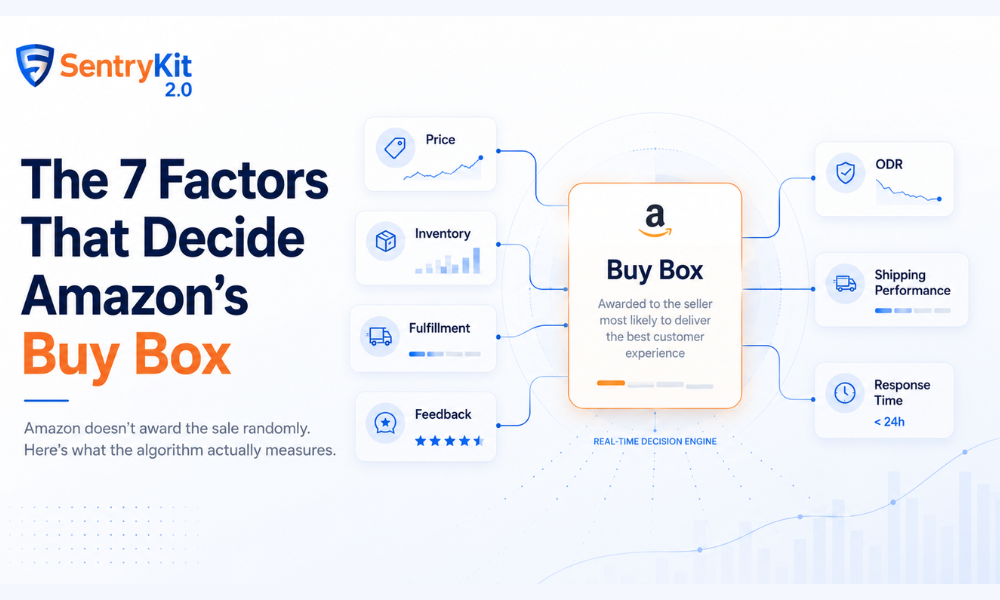
Once you’re eligible, Amazon’s algorithm evaluates these factors in real time. No single factor is an absolute override — it’s a weighted combination — but some carry significantly more weight than others.
1. Fulfilment method. FBA sellers have a structural advantage. Amazon’s algorithm weights fulfilment reliability heavily, and FBA listings carry Prime eligibility by default. Seller Fulfilled Prime (SFP) sellers can achieve similar standing, but the performance bar is high — Amazon’s 2026 SFP requirements include a 99% on-time delivery rate and a sub-0.5% cancellation rate. FBM sellers can win the Buy Box, but they need to outperform on price or metrics to overcome the FBA baseline.
2. Price (landed price). The algorithm compares landed price — item price plus shipping. A seller offering $18 + $5 shipping is competing against $22 with free Prime shipping, and free Prime almost always wins despite the higher headline price. Price is the factor sellers most commonly over-optimise: dropping price to chase the Buy Box works until it doesn’t.
3. Order Defect Rate (ODR). ODR covers negative feedback rate, A-to-Z Guarantee claims, and credit card chargebacks. Amazon’s threshold is 1% — above it, you risk losing Buy Box eligibility entirely. Check your Account Health dashboard any time your Buy Box share drops unexpectedly.
4. Shipping performance. For FBM sellers, Late Shipment Rate and Pre-Fulfillment Cancellation Rate matter significantly. For FBA sellers, Amazon handles shipping, so this factor is largely neutralised in your favour.
5. Seller feedback rating. Your overall feedback score is a steady background signal. The weight increases as seller count on an ASIN rises. A seller with 94% positive feedback is at a real disadvantage against a seller at 98%+ on the same ASIN, even if prices are equal.
6. Inventory availability. Out-of-stock listings don’t hold the Buy Box. Beyond the obvious, the algorithm factors in your historical in-stock consistency. Sellers who regularly go out of stock may recover the Buy Box slower than competitors after restocking. For more on FBA inventory signals that feed into Buy Box continuity, see our guide on Amazon FBA inventory management.
7. Response time and customer service metrics. For FBM sellers, response time to customer messages (Amazon expects under 24 hours) is a tracked metric. It contributes to the overall seller quality score Amazon uses to compare sellers on shared ASINs.
On competitive ASINs with multiple eligible sellers, Amazon doesn’t give one seller permanent Buy Box ownership. It rotates — allocating a share of sessions to each seller proportional to their Buy Box score.
This means your Buy Box win rate in Business Reports reflects how much of the rotation you’re capturing, not whether you “won” or “lost” in a binary sense. A healthy competitive ASIN might show a 60% win rate for the top seller and 40% for a close competitor — both sellers are getting sales, just in different proportions.
What disrupts this system: a new seller entering the listing below your price, a competitor suddenly gaining Prime eligibility, or an unauthorised seller (hijacker) undercutting aggressively. For a detailed breakdown of why Buy Box rotation happens and how to diagnose sudden share shifts, see our post on why your Amazon Buy Box keeps rotating.
The diagnostic sequence is straightforward.
Check Other Sellers on Amazon. Has a new seller appeared? If an unauthorised seller has entered your listing and is undercutting, that’s a Hijacker Detected situation — the fix is a cease-and-desist or test buy, not a price drop.
Compare landed prices. If a legitimate competitor is now below your landed price and FBA-fulfilled, you have a pricing decision to make — at least it’s a deliberate one.
Check your Account Health metrics. A dip in ODR, Late Shipment Rate, or Pre-Fulfillment Cancellation Rate will gradually erode your Buy Box share before it shows up as a formal warning.
Verify your listing status. A suppressed listing loses the Buy Box entirely — no seller holds it. This is different from Buy Box Lost, and requires a listing fix rather than a price or metrics adjustment.
SentryKit’s Buy Box Lost alert fires in real time when a competitor takes the Buy Box on your listing — so you start this diagnostic sequence immediately rather than discovering it hours later in Business Reports.
The factors above are not equally controllable. Some are structural — switching from FBM to FBA is a significant operational decision. Others are maintenance — checking your stranded inventory takes 10 minutes a week. Here’s where to focus by impact and effort:
High impact, low effort:
High impact, higher effort:
Common mistakes that don’t work:
The right Buy Box strategy depends on your selling model. The factors don’t change, but the constraints and leverage points do.
Private label sellers should, by default, be the only seller on their listing. If your Buy Box win rate drops below 90% on a private label ASIN, the first assumption isn’t competition — it’s a hijacker or listing issue. Your Buy Box strategy here is more about protection than competition: monitoring for unauthorised sellers, keeping your listing healthy, and ensuring FBA stock levels never hit zero on high-velocity ASINs. Marketplace Pulse regularly documents how quickly unauthorised sellers appear on successful private label listings.
Wholesale and OA sellers are operating in genuine multi-seller competition. Your Buy Box strategy is about improving your relative score vs. other sellers on the same ASIN: landed price (factoring in FBA vs. FBM), feedback percentage, and in-stock consistency. On wholesale ASINs with 3+ eligible sellers, the Buy Box rotates in real time — the goal is to hold the largest share of that rotation, not to eliminate competitors.
Agency and multi-brand sellers managing hundreds of ASINs need monitoring infrastructure rather than per-ASIN manual checks. The Buy Box dynamics across 500 ASINs can’t be reviewed manually — the only workable approach is alert-driven, where you respond to changes as they happen rather than auditing retrospectively.
Winning the Amazon Buy Box in 2026 comes down to understanding the algorithm’s weighted inputs — and optimising the ones you can actually control.
Amazon’s algorithm weighs fulfilment method (FBA has a structural advantage), landed price, Order Defect Rate, shipping performance, seller feedback rating, inventory availability, and customer service response time. No single factor is an absolute rule — it is a weighted combination.
FBA gives sellers a significant structural advantage because Amazon controls fulfilment reliability and Prime eligibility. But FBA sellers can still lose the Buy Box to competitors with better pricing or metrics, or lose it entirely if their listing becomes suppressed.
Yes. On competitive ASINs, Amazon rotates the Buy Box between eligible sellers, allocating sessions proportionally based on their Buy Box score. Your Buy Box Win rate in Business Reports reflects your share of that rotation, not a binary win or loss.
Amazon does not publish a hard floor, but sellers below 95% positive feedback are meaningfully disadvantaged against sellers at 98% or above when competing on the same ASIN. The impact increases as the number of competing sellers grows.
Check the Other Sellers on Amazon section on your listing. If a seller appears who was not there before — especially one with few reviews, low feedback, or a suspiciously low price — that is the signal. A Hijacker Detected alert from SentryKit fires as soon as this happens so you do not need to check manually.
Open your product listing in a browser while logged out of Seller Central. If you see an Add to Cart button with your seller name, you hold the Buy Box. If another seller name appears, they hold it. For systematic monitoring across multiple ASINs, use Business Reports in Seller Central or a real-time alert tool.
FBA provides a significant structural advantage because Amazon controls fulfilment reliability and Prime eligibility is built in. However, FBA sellers can still lose the Buy Box to other FBA sellers with better pricing or metrics, or lose it entirely to a suppressed listing. FBA improves your competitive position; it doesn’t guarantee a win.

Nisha Shetty · Marketing Manager, SentryKit
Nisha is a marketing manager and former Amazon seller who writes about e-commerce growth, consumer behavior, and digital retail trends.