
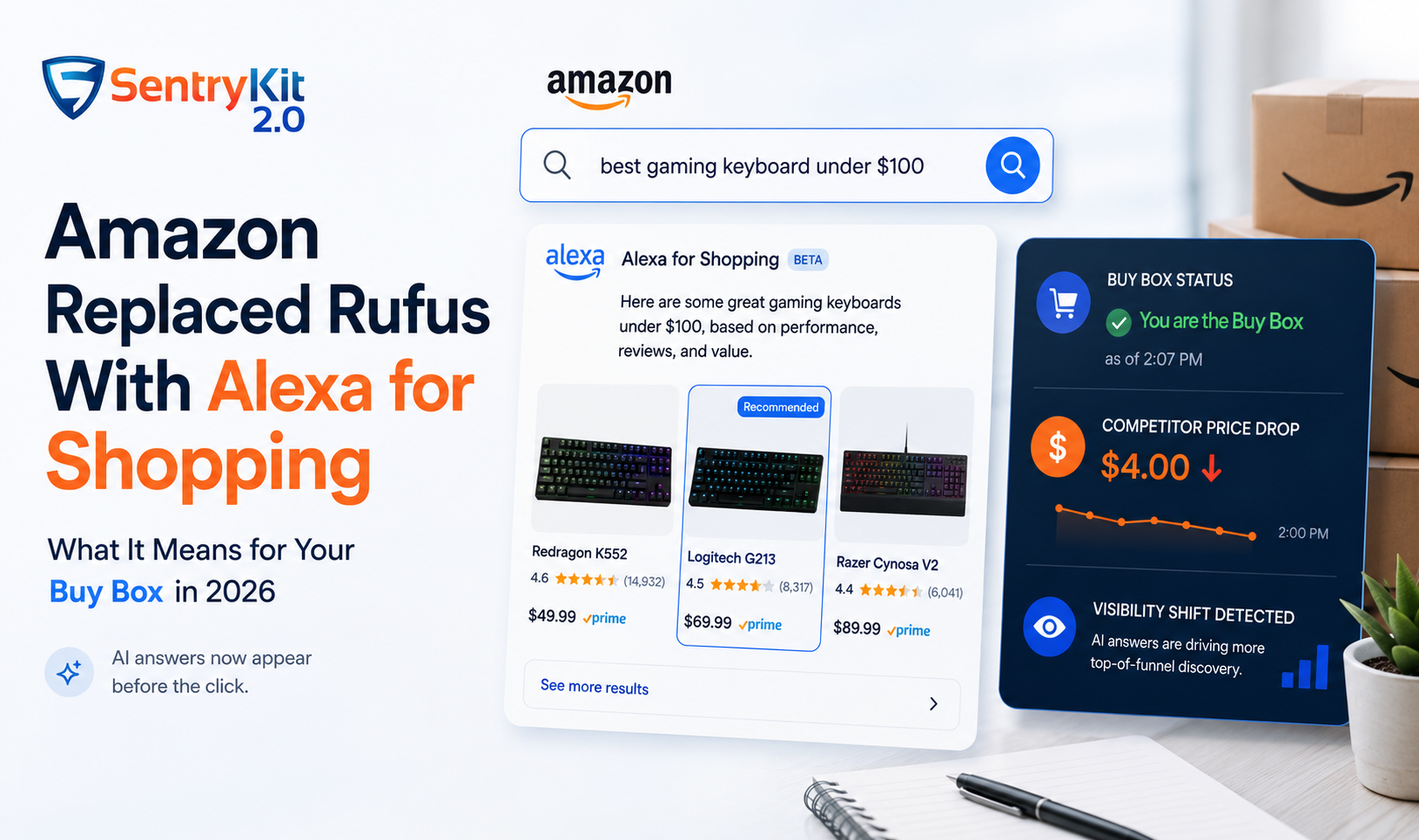
On May 13, 2026, Amazon retired Rufus and folded it into a new agent called Alexa for Shopping. It lives inside the search bar on Amazon.com and the Amazon Shopping app. It’s free to any US shopper signed into an Amazon account — no Echo, no Prime, no Alexa app required. The same agent now runs across the Shopping app, Echo Show, the Alexa app, and alexa.com, with one continuous shopper profile.
That’s the headline. The seller story is different.
The change most coverage missed: the assistant has moved from a side panel on the product detail page to the search bar at the top of the funnel. The answer is now generated before the click. That doesn’t make the Buy Box less important. It makes it the gatekeeper between an AI recommendation and a transaction.
Amazon announced Alexa for Shopping as a unified agent that merges what Rufus did (product expertise, on-page Q&A) with what Alexa+ does (personalized cross-surface continuity). It replaces Rufus across the search experience. CNBC covered it the day of launch, and About Amazon followed with the official seller-facing positioning.
For context on scale: Andy Jassy told investors on the most recent earnings call that monthly active Rufus users were up over 115% year over year, and engagement was up nearly 400%. Amazon is not pulling back on agentic discovery — it’s doubling down and moving it closer to the buyer’s first query.
Type a question into the Amazon search bar — “what’s a good skincare routine for men” or “when did I last order AA batteries” — and Alexa for Shopping returns a conversational answer plus product comparisons, up to a year of price history, and personalized guidance. Standard search listings still appear alongside it.
The continuity piece matters too. The same agent profile follows the shopper from amazon.com to the Shopping app to an Echo Show in the kitchen. The funnel is no longer just a single PDP — it’s a persistent thread the shopper picks up wherever they are. That changes where attention compounds, and it changes where attention leaks.
The answer slot moved upstream of the click. A shopper who used to land on the PDP and read your A+ content can now get a comparison and a recommendation in the search bar. Weak listing data costs you the answer slot before it costs you the click.
Ads coexist with AI-generated answers. Amazon’s framing is that ads appear “where relevant,” not to narrow what the agent shows. If you were already running Sponsored Brands or Sponsored Products, those positions now share real estate with conversational responses generated above them.
Discovery now spans surfaces, not pages. One shopper, many entry points, one persistent profile. The window during which a buyer is “in” your product’s consideration set is longer, but the moment of decision is shorter and earlier.
The Buy Box still decides who fulfills the order on the listing the agent surfaces. If Alexa for Shopping recommends an ASIN and you’re not on the Buy Box at that moment, the seller who is takes the sale. That mechanic is identical to what it was last week.
Listing health still determines whether you’re a candidate at all. A suppressed listing, a hijacker scenario, or an out-of-stock state takes you out of the running before the agent ever evaluates you. Nothing about Alexa for Shopping changes that — but the cost of being invisible is higher because more discovery now flows through that single answer slot.
Here’s the mechanic that should keep sellers focused. I’ve watched wholesale sellers in particular get burned by exactly this timing gap, and it just got tighter.
A competitor cuts their price by $4 at 2:00pm on a Tuesday. The agent fields a relevant query at 2:07pm. It surfaces the listing. The Buy Box belongs to the competitor at that moment. They take the cart. You don’t even see the demand in your dashboard — it never appears as a lost sale on your side because you weren’t in the conversation. That kind of Buy Box rotation is already biting sellers hard, and Alexa for Shopping concentrates more of the day’s discovery into fewer, faster decisions.
This is also why distinctions matter. Buy Box Lost means a competitor currently holds the Buy Box on your listing — your revenue is at risk on that listing. Listing Suppressed means Amazon has removed the Buy Box entirely from the listing, usually because of a listing condition issue. The fix is different. The revenue calculation is different. Conflating them is how sellers misread their own data, and the cost of misreading just went up.
Marketplace Pulse data adds another layer to this. Third-party seller share fell to 60% in Q1 2026 — the first two-quarter consecutive decline since Amazon began reporting the metric in 2004. The active seller count dropped from 584,000 in January 2025 to roughly 500,000 by March 2026. Supply is consolidating. Fewer sellers are competing for more concentrated discovery. The sellers who hold the Buy Box at the right moments take a larger share of a smaller pie.
Most of what you should be doing is what you should already be doing. Three things deserve fresh attention.
If you weren’t already getting Buy Box Lost alerts the moment they fire, this is the week to fix that. The same applies to Hijacker Detected and Competitor Price Change — pricing shifts that used to take a day to surface in your numbers now have a tighter feedback loop because the agent is fielding queries against your live state. SentryKit was built for this exact gap: real-time Buy Box and competitor price intelligence, not delayed dashboard reads.
Suppressed listings are out of the conversation entirely. Beyond that, AI-generated listing edits — Amazon’s own and third-party “enhancers” — have a real history of backfiring on sellers. The agent now reads whatever ends up on the page. Auto-edits that compress your bullet points or rewrite your A+ content are not edits to a static asset — they’re edits to a knowledge source the agent quotes from.
Treat the product detail page like a knowledge source the agent will quote. Sparse, generic copy reads poorly to a language model. Specific, declarative sentences read well. If your PDP doesn’t clearly answer “what is this,” “who is it for,” “what makes it different,” and “what are the trade-offs,” you’ll lose answer slots to listings that do — even when your product is objectively better. This is the same lesson Amazon’s 2026 algorithm signals have been pointing toward for months, applied to a new surface.
If you read nothing else: the five things to do this week.
The agent moved upstream. The Buy Box didn’t. Your job is to be holding it when the agent looks.
No. Rufus was a chat panel on the product detail page. Alexa for Shopping is an agent in the search bar that handles the query before the shopper reaches the PDP. The underlying capability inherits from both Rufus and Alexa+, but the surface and the timing are different.
No. The Buy Box mechanics are the same — price, fulfillment, seller metrics, inventory. What changes is how often the Buy Box is the deciding factor on a transaction, because the agent now routes more discovery into it.
Yes. The agent surfaces organic listings alongside ads. Amazon has said ads appear “where relevant” and aren’t designed to narrow what’s shown. Strong organic listings with healthy Buy Box state remain eligible.
Write declarative, specific sentences in titles, bullets, and A+ content. Keep listings clean and free of suppression issues. Hold the Buy Box consistently. Monitor competitor pricing in real time so a Tuesday-afternoon undercut doesn’t silently move sales off your ASIN.
May 13, 2026. Amazon announced the transition the same day, with US rollout effective immediately for shoppers signed into Amazon accounts.

Raghav Tiwari · Founder, SentryKit
Raghav is the founder of SentryKit. He writes about Amazon Buy Box dynamics, marketplace intelligence, and the operational reality of running a private label or wholesale business at scale.