
If your sales dropped this week and you can’t explain why, a black hat attack may already be in progress. Most sellers know these tactics exist. What they miss is the window — the hours or days between when an attack starts and when they find out.
That gap is the real cost. Not the terminology — sellers have read those guides. The problem is the distance between “I know these attacks exist” and “I can see one happening to my listing right now.” In 2026, that gap is more expensive than ever. AI has lowered the cost of launching attacks. Review campaigns, fake IP complaints, PPC click fraud — all of it runs faster and cheaper than two years ago. The attacks haven’t changed in kind. They’ve changed in scale.
This guide covers the eight attacks most likely to hit your listing, what each one looks like in your Seller Central data, and how fast you need to respond before the damage compounds.
Black hat tactics on Amazon are deliberate, policy-violating actions taken by competitors — or hired services — to harm your listing, tank your ranking, or get your account suspended. They’re not Amazon algorithm changes or bad luck. Someone made a decision to do this.
The phrase gets used loosely. Sellers sometimes call a legitimate competitor undercutting their price a “black hat attack.” That’s not it. A competitor pricing below you and winning the Buy Box fairly is competition. What this post covers is something different: a competitor filing a fake trademark complaint against your ASIN. Or paying a service to flood your listing with 1-star reviews over 48 hours. Or placing bulk orders on your inventory then returning every unit to trigger a stockout.
Those are attacks. Here’s what changed in 2026.
Two years ago, a fake review campaign required a team of paid reviewers, product shipments, and coordination across Facebook groups — time-consuming and expensive enough that smaller sellers were rarely targeted.
That friction is mostly gone now.
AI-generated review content has made it possible to produce hundreds of plausible 1-star reviews with varied phrasing, purchase-realistic detail, and different writing styles — at near-zero marginal cost. Review farms that once needed humans now run on automation. Amazon’s detection has improved too, but the attack volume has outpaced it.
IP complaint filing has seen the same shift. Services that automate the submission of trademark or copyright complaints exist specifically to suspend competitor listings. They don’t need a valid claim — they need to trigger Amazon’s automated enforcement long enough to cost you sales. The filing itself takes seconds.
PPC click fraud has always been a problem. In 2026, it’s running via bot networks sophisticated enough to simulate human browsing behaviour. A serious budget bleed can unfold in a single campaign day before you’ve noticed the ACoS spike.
Sellers in competitive categories — any category with meaningful margin — should treat these attacks as an operational risk rather than a worst-case scenario. The question is no longer whether someone might target you. It’s whether you’d know in time.
For each attack: what it is, what you’d actually see in your account, and how fast it damages you if you miss it.
An unauthorised seller adds themselves to your ASIN — usually selling a counterfeit, a grey-market product, or nothing at all — and competes for your Buy Box. On a private label listing where you should be the only seller, any new competitor appearing is a red flag.
What you see in your account: A second (or third) seller appears in the Buy Box rotation. Your Buy Box win rate drops. If the hijacker is pricing below you, they take the Buy Box entirely. Customers start receiving wrong products — and leaving reviews on your listing.
Time to damage: Hours. A hijacker who undercuts your price by $2 can hold your Buy Box through the evening session and the next morning before you notice. For context on removing them and preventing repeat attacks, see our guide on Amazon listing hijackers.
A coordinated campaign of 1-star reviews, placed by unverified purchaser accounts, arriving in a short window. The goal is to drop your rating fast enough to trigger Amazon’s algorithm to deprioritise the listing — and to scare off buyers who scroll down to recent reviews.
What you see in your account: A cluster of low-star reviews arriving within 24–72 hours, often from accounts with no purchase history on your ASIN. Common language patterns repeated across reviews with slight variation (“this product is total garbage,” “waste of money”) are a signature of coordinated campaigns.
Time to damage: 24–48 hours. Amazon’s algorithm factors review recency and velocity. A sudden spike in 1-star reviews will suppress your listing in search results before Amazon’s own moderation catches the fraudulent accounts.
A competitor files a bogus copyright or trademark complaint against your listing. Amazon’s enforcement is automated — the listing gets deactivated while the complaint is reviewed, which can take days.
What you see in your account: An email from Amazon flagging a policy violation. Your ASIN status changes to “inactive” or “deactivated” in Manage Inventory. There is no warning before deactivation — the first signal is the email, often hours after the listing has already gone dark.
Time to damage: Immediate. Every day the listing is deactivated is a day of zero sales, ranking decay, and inventory sitting idle. A listing that was ranking on page one can lose its position entirely by the time the complaint is resolved.
Competitors — or services they hire — repeatedly click your Sponsored Product ads with no intent to buy. The goal is to drain your daily ad budget early, removing your visibility for the rest of the day.
What you see in your account: ACoS spikes sharply with no corresponding increase in conversions. Budget exhausted significantly earlier than usual. When you check campaign reports: high click volume, near-zero purchases, often concentrated in the same geographic region or time window.
Time to damage: Within one campaign day. If your daily budget is depleted by 10am, you’ve lost afternoon and evening ad coverage — typically the highest-conversion windows.
A competitor (or service) places large orders on your FBA inventory, then returns every unit. The goal is to trigger a stockout — which causes Amazon to suppress your listing — or to inflate your return rate, which signals product quality issues to the algorithm.
What you see in your account: A sudden spike in units sold followed by a spike in returns within the return window. FBA stranded inventory. Your in-stock rate drops. In some cases: a Listing Suppressed status triggered by stockout.
Time to damage: 3–7 days. Slower than hijacking, but the ranking damage from a stockout event can persist for weeks after you’re back in stock.
Someone changes your listing’s title, images, or bullet points without your permission. This happens through Amazon’s open catalog contribution system, which allows any seller to suggest edits. In competitive categories, it’s exploited deliberately.
What you see in your account: Your title has changed. An image has been swapped. A bullet point now contains inaccurate product claims — and you didn’t make this edit. In some cases, the change triggers Amazon’s own listing suppression if the new content violates policy.
Time to damage: Immediate. A changed title or image tanks conversion rate from the moment it goes live. If it introduces a policy violation, your listing can be suppressed before you’ve noticed the edit.
This one doesn’t touch your listing directly — it inflates a competitor’s review count to widen the social proof gap between their listing and yours. A competitor sitting at 4.2 stars with 200 reviews who jumps to 4.6 stars with 800 reviews in three weeks hasn’t earned those numbers.
What you see: Not in your account — you have to watch your competitors’ listings. A sudden jump in their review count, particularly from unverified purchases in a short window, is the signal. This is a competitive attack rather than a direct listing attack, but it affects your relative position in search.
Time to damage: Weeks. The gap compounds over time as the inflated listing ranks higher and converts better.
A competitor merges their ASIN into your variation family — inheriting your reviews, your ranking history, and your visibility. Amazon’s variation system is designed for legitimate parent-child relationships (same product, different sizes or colours). When exploited, an unrelated product appears in your listing’s variation dropdown and rides your social proof.
What you see in your account: Products appearing in your variation dropdown that you didn’t add. Review count anomalies that don’t match your actual sales history. Customer confusion in Q&A about products that aren’t yours.
Time to damage: Slow but persistent. Variation abuse is hard to detect and harder to unwind. By the time most sellers catch it, the variation has been in place long enough to dilute the listing’s integrity.
Listing hijacking and content manipulation are the two attacks that tend to cause the most damage in practice — not because they’re the most sophisticated, but because sellers check their listings every few days at best.
A hijacker who appears on Monday morning has an enormous window. If you check listings Thursday, they’ve had three days. At 40 conversions a day, that’s 120 sales lost, customer reviews from a counterfeit product accumulating on your listing, and a Buy Box that may take a week to recover even after the hijacker is removed.
Content manipulation is often discovered later still. Most sellers find out because a customer emails them confused about a product feature. By then, the changed content has been live for days — and if it triggered a suppression, that suppression is already baked into your ranking history.
The window between when an attack starts and when you find out is the entire cost of the attack. Shrink the window and you shrink the damage.
Most sellers check their dashboard for revenue. These are the signals worth checking specifically for attacks — and what each one points to.
Sudden Buy Box share drop with no price change: You’re FBA, priced competitively, nothing’s changed — and your Buy Box win rate dropped this week. Check for new sellers on your ASIN. A hijacker typically prices slightly below you, and even if they’re not FBA-eligible at the same level, they’ll rotate in during the window before you remove them.
Review velocity spike: Pull your reviews filtered by date. If you received more reviews in the last 48 hours than in the prior two weeks, check the account profiles. Unverified purchases, limited review history, and clustered submission times are all signatures of a coordinated campaign.
ACoS spike without conversion change: If your ACoS jumped significantly and your conversion rate didn’t move, the problem isn’t your advertising — someone is clicking your ads. Pull the campaign report by time of day. Click fraud typically shows high volume concentrated in a narrow window.
Listing content that changed without your edit: If a field in your listing has changed that you didn’t update, treat it as an attack until proven otherwise. Catalog errors do happen, but unexplained content changes in competitive categories are more likely intentional.
Returns spike: A sudden jump in FBA returns from a specific ASIN, especially with no corresponding customer complaints, is the early signal of an inventory depletion attempt. Watch your stranded inventory closely in the 14–21 days after a returns spike.
The problem with manual checking is that you’re always running behind. By the time you log in and notice the signal, the attack has been running for hours or days. Real-time alerts on Buy Box share and listing changes are the operational difference between catching a hijacker in hour two versus day three — and in a competitive category, that’s the difference between a $200 incident and a $3,000 one.
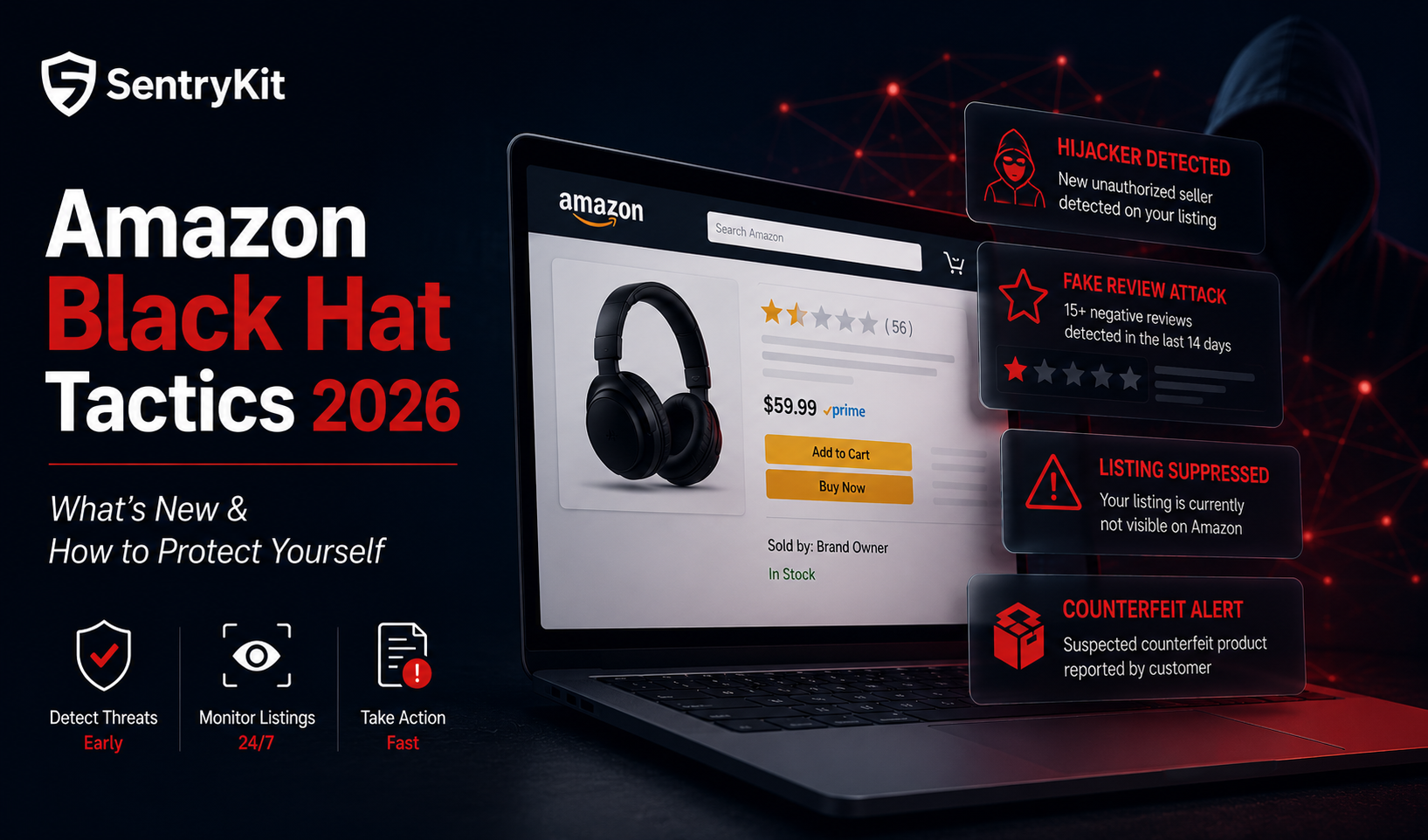
SentryKit fires a Hijacker Detected alert the moment an unauthorised seller appears on your listing. The Content Changed alert fires when your listing’s title, images, or bullet points change — whether you made the edit or someone else did. Both are real-time and available on every plan.
Amazon’s brand protection programs — Brand Registry, Project Zero, Transparency — are real and worth having. Brand Registry gives you the tools to report violations. Project Zero’s self-service counterfeit removal is faster than the standard reporting channel. Transparency’s serialisation is the strongest protection against physical counterfeits.
But all three are removal tools. They work after you’ve identified the attack. This is the part most guides don’t say clearly enough.
The limitation isn’t the program — it’s that you have to know something is wrong before you can escalate. Brand Registry doesn’t alert you when a hijacker appears. Project Zero doesn’t notify you when your content changes. These programs assume you’re already watching.
As Seller Labs documented in their black hat tactics terminology guide, the Amazon ecosystem has its own shadow economy of bad actors — and it moves faster than any policy response. The answer isn’t to rely on Amazon to catch attacks for you. The answer is to see them yourself, fast enough that the damage is minimal before escalation begins.
When you do need to escalate: use Seller Central’s “Report a Violation” tool for IP and hijacker complaints. Be specific — include ASINs, order IDs where available, and screenshots of the unauthorised seller or fraudulent reviews. Vague reports get slow responses. The more evidence you attach on the first submission, the faster the resolution.
For serious cases — coordinated fake review bombing, repeated false IP claims from the same competitor — document the pattern across multiple incidents before escalating to Amazon Executive Seller Relations. A single incident looks like a dispute. A documented pattern looks like systematic abuse.
You can’t control whether a competitor decides to target your listing. You can control how quickly you find out.
A hijacker who holds your Buy Box for 72 hours costs real money — lost sales, potential ranking drop, customer reviews from a counterfeit product sitting on your listing. The same hijacker caught in two hours costs almost nothing. That’s not a small difference. In a competitive category, it’s often the difference between a minor incident and a week of recovery work.
SentryKit alerts you the moment an unauthorised seller appears on your listing, the moment your content changes, and the moment your Buy Box share drops — so you can respond before the damage compounds, not after.
A black hat seller on Amazon is any seller who uses practices that violate Amazon’s Terms of Service to gain an unfair advantage — or to deliberately harm a competitor’s business. This includes buying fake reviews, filing false IP complaints, hijacking competitor listings, and using bots to drain competitor ad budgets. The defining characteristic is intentional policy violation, not just aggressive competition.
The clearest signal is a new seller appearing on your ASIN — especially on a private label listing where you should be the only seller. Look for a drop in your Buy Box win rate without any change in your price or metrics, an increase in customer complaints about receiving wrong or low-quality products, and new sellers appearing in your “Other Sellers on Amazon” section. A real-time alert tool that fires when a new seller appears gives you the fastest possible notification — without it, you’re reliant on manual checks.
Amazon can and does suspend accounts caught using black hat tactics, but enforcement is reactive and inconsistent. The main reporting tools — IP violation reports, fake review flagging, Brand Registry violations — all depend on you identifying the attack first and providing evidence. Amazon does not proactively monitor individual listings for unauthorised sellers or suspicious review patterns in a way that consistently catches attacks before they cause damage.
A competitor is a legitimate seller offering a comparable product and competing fairly for the Buy Box. A hijacker is a seller who has added themselves to your specific ASIN — particularly a private label ASIN — without authorisation, often selling a counterfeit or inferior version of your product under your listing. The distinction matters because the response is different: a competitor requires a pricing or positioning response; a hijacker requires an Amazon report and potential legal action.
Yes — not because the tactics are new, but because AI has significantly lowered the cost of executing them at scale. Fake review generation, automated IP complaint filing, and click-fraud bots are all cheaper and faster to deploy than two years ago. Sellers in competitive, high-margin categories should treat these attacks as a routine operational risk rather than a rare worst-case scenario.

Nisha Shetty · Marketing Manager, SentryKit
Nisha is a marketing manager and former Amazon seller who writes about e-commerce growth, consumer behaviour, and digital retail trends.