
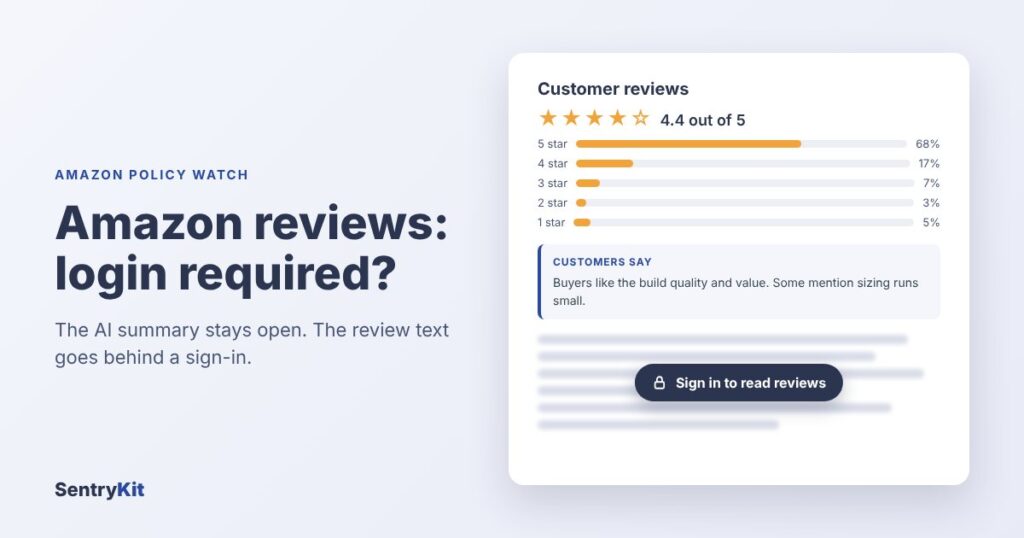
Some Amazon shoppers have been hitting a wall since July. Not a paywall — a login wall. Visit a product page while logged out, scroll to reviews, and instead of the reviews themselves you get a line: “Customer reviews require account verification. Sign in.” The star breakdown is still there. The AI-generated “Customers say” summary is still there. The actual review text isn’t.
I don’t think this is about reviews. I think it’s a small, visible piece of a much bigger bet Amazon is making on who controls access to its data — and reviews are just the test case that happened to surface first.
Here’s the setup, stated plainly: some unauthenticated sessions are being blocked from reading review text. Logged-in shoppers appear unaffected. The block is inconsistent — it shows up on some products and some sessions, not others, which is the signature of an A/B test, not a policy rollout. There’s no official Amazon statement confirming this as permanent. Treat it as an observed, early signal, not confirmed policy.
But the pattern inside the pattern is what matters.
When the wall appears, the AI-written summary stays visible to everyone, logged in or not. Only the raw review text — the thing a human wrote, in their own words, with specifics — gets gated behind an account.
That’s not a random design choice. It tells you something about what Amazon is willing to keep open (its own AI output) versus what it’s willing to restrict (raw, scrapeable data). Any tool or script that pulls review text without an authenticated session runs into this wall. The summary keeps flowing either way. It also isn’t an isolated data point — reporting on Amazon’s review-visibility cap and its new Agent Policy describes the same restriction pattern playing out at the contractual level, not just the UI.
Amazon decides what shoppers see on your listing, and it changes things without telling you. SentryKit alerts you when a new review lands, your top reviews shift, or your listing content is edited.
Most guides would stop at “here’s a login wall, watch out.” They shouldn’t. The interesting question isn’t whether this specific test survives — early A/B tests often don’t, or they come back in a different form six months later. The interesting question is what it tells you about Amazon’s incentives right now.
Amazon has spent the last two years pushing an AI layer into the middle of every shopping interaction it owns. Rufus answers product questions before you ever open a listing. “Customers say” replaces hundreds of individual reviews with one paragraph. Sellers already live this reality on the catalog side — I wrote about how Amazon is increasingly generating your title, your bullets, and your image callouts, which raises the question of what’s actually still yours. Read more in Amazon Is Writing Your Title, Your Bullets, and Your Images. The review login wall is the same instinct applied to a different surface: Amazon’s AI summary stands in front of the raw data, and the raw data itself gets harder to reach directly.
That’s the frame worth holding onto. A company doesn’t gate access to public-facing content on a whim. It gates access when the content has become valuable enough — as training data, as competitive signal, as fuel for a shopping agent — that open access starts to look like a cost rather than a feature.
That’s also the scale worth knowing: Amazon raised at least $25 billion in a bond sale to fund its AI infrastructure buildout — chips, data centers, energy capacity, and model development, spread across AWS, the core ecommerce business, advertising, Rufus, Alexa, and logistics. Financing that scale through debt, instead of its own cash flow, is what tells you the strategy is real and not aspirational. The login wall and the bond raise aren’t two separate stories. The bond raise buys the compute and the data centers; the login wall is one small experiment in controlling what flows through them.
You don’t need to panic about this test specifically. It may not stick. So what do you actually do about it today? Nothing dramatic — you watch the direction, not the test. Amazon is moving from “open enough to be scraped” toward “gated, with an AI summary standing in for the raw data.” That shift doesn’t target sellers directly — it targets anyone building on top of publicly accessible Amazon data without going through an authenticated, Amazon-controlled channel. Third-party tools that read review sentiment for competitive research, for product development, or for customer insight are the ones who feel this first.
The honest read: this isn’t Amazon coming after sellers. It’s Amazon building a moat around its own AI-mediated shopping experience, and the review page is one brick in that moat. Any tool that depends on reading raw review text off a public page — logged out, at scale — is going to face more friction over time, not less.
That’s the same pattern behind The Amazon Ads MCP Is Real. Here’s What It Can’t See — Amazon opens exactly as much of its AI stack as it needs to look transparent, and gates the rest.
Amazon is now also selling a way to collect more of those reviews, faster. We broke down what Amazon Review Requests actually buys you.
Watch what gets gated next. That tells you more than any press release will.
See every change on your Amazon listings
SentryKit watches 50+ signals on your ASINs and alerts you with the before and after, in your language and currency. Plans from $19/mo.
Start 14-day free trialRelated alerts
It’s inconsistent. Some logged-out sessions are hitting a message asking for account verification before showing review text, while others aren’t. That pattern points to an A/B test, not a confirmed, permanent policy. There’s no official Amazon announcement confirming a full rollout.
Based on current reports, it’s specifically unauthenticated sessions that hit the wall. Logged-in shoppers appear to see reviews normally. The star rating breakdown and the AI-generated “Customers say” summary remain visible either way.
Because the summary is Amazon’s own output, and the raw review text is the underlying data other tools and services might otherwise read directly. Restricting the raw text while keeping the summary open pushes shoppers — and any AI shopping agent — toward Amazon’s version of the data rather than the original source.
They’re connected by strategy, not by mechanism. The bond raise funds Amazon’s AI infrastructure — chips, data centers, model development — at a scale large enough that Amazon is financing it with debt. The login wall is a small, low-cost experiment in controlling access to the data that infrastructure runs on. One is the capital investment; the other is an early access-control test built on top of it.
Not urgently. The test is early and inconsistent. The practical takeaway is directional: expect Amazon to keep tightening access to raw, scrapeable data over time in favor of its own AI-generated summaries. If you or a tool you use depends on reading review text at scale without an authenticated account, that access is likely to get harder, not easier.

Raghav Tiwari · Founder, SentryKit
Raghav is the founder of SentryKit. He spent years running his own Amazon storefronts before building it, and writes about Buy Box strategy, competitive intelligence, and the platform shifts sellers can’t afford to miss.