
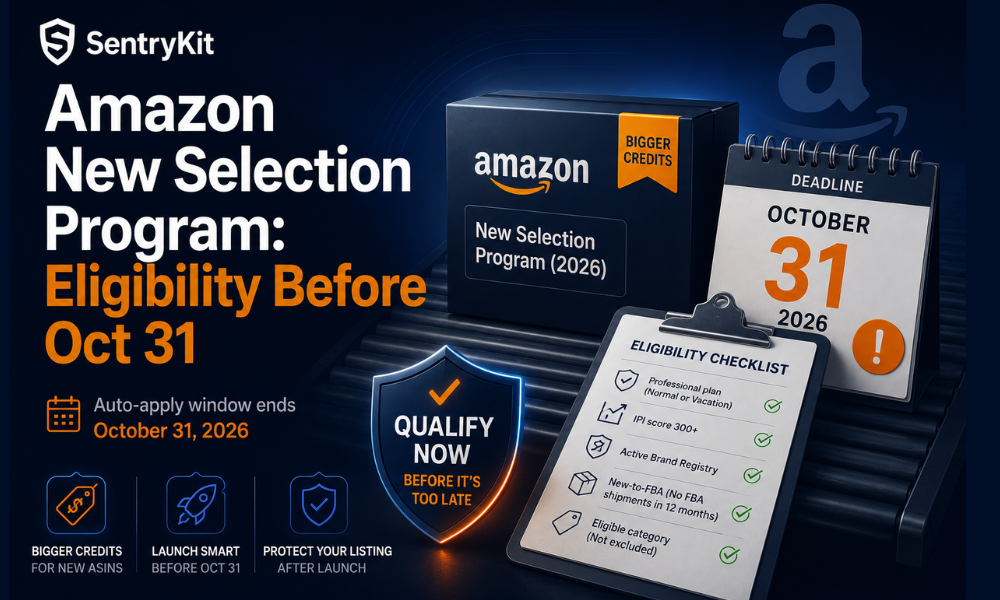
Amazon’s New Selection Program (2026) relaunched on July 30 with bigger fee credits for new-to-catalog branded ASINs. That launch itself — what changed, and the post-launch monitoring gap it doesn’t solve — is covered in Amazon’s New Selection Program (2026) Launches July 30 — Bigger Credits, Same Old Blind Spot. This post picks up where that one left off, with a narrower question that matters more right now if you’re actively launching new ASINs this quarter: does your specific ASIN actually qualify, and how much time do you have left to find out.
If you’re already enrolled in the program, Amazon automatically applies the benefit to eligible new branded FBA ASINs — no separate application, no opt-in click. That automatic window runs through October 31, 2026, as PPC Land reported when Amazon confirmed the lock-in date. After that, the promotional terms tighten, and credits tied to this specific enrollment period stop applying to new launches. That’s the deadline. Here’s the part that trips sellers up.
Auto-apply doesn’t mean guaranteed — that’s the exact distinction sellers skip past. The phrase describes how the credit attaches to a qualifying ASIN, not whether every ASIN you launch qualifies. Enrollment in the program is automatic. Eligibility is still evaluated per ASIN, against a fixed set of criteria Amazon checks in the background.
Here’s what that looks like in practice. Say you’re a private label seller launching three new branded ASINs in August. Two are genuinely new-to-catalog and meet every criterion — the credit attaches automatically, no action needed. The third has some prior listing history you’d forgotten about, or sits in a category Amazon has carved out of the program. That third ASIN doesn’t get the credit, and nothing on the surface tells you that at launch. You find out weeks later, when the invoice doesn’t match what you expected.
That covers the what. Here’s the why it matters for your timeline specifically: the closer you get to October 31, the less runway you have to catch an eligibility miss and adjust your launch plan before the window closes.
Got a launch penciled in for September or October? The criteria split into two levels — your account and the specific ASIN — and both have to clear before a launch qualifies, as a detailed breakdown of the program’s eligibility rules confirms:
Account-level requirements:
ASIN-level requirements:
Run this against every ASIN you plan to launch before October 31, not just the ones you assume are new — and confirm the full current criteria in Seller Central directly, since Amazon can adjust program terms without much notice.
Three patterns show up most often when sellers reconcile invoices and find a credit missing:
The action signal here is simple: if any of these three apply to a launch you’re planning before October 31, check eligibility with Amazon Seller Central directly before you commit the launch date, not after the invoice arrives.
A new ASIN launch this quarter carries two distinct risks, and they don’t overlap. A private label seller launching a dozen new branded ASINs this quarter is carrying both risks at once — whether they’ve priced that in or not. The first is the one this post covers — missing the fee credit because the ASIN falls outside eligibility criteria. The second is what happens to the listing itself once it’s live, with no sales history, no established Buy Box position, and no track record to fall back on if something goes wrong.
That’s the gap SentryKit fills — not the credit question, which sits inside Amazon’s billing system and stays outside SentryKit’s visibility. Once the new ASIN is live, SentryKit can monitor that listing for Buy Box Lost, Hijacker Detected, and Listing Suppressed the moment any of them happen, so a rocky launch doesn’t go unnoticed on top of a missed credit. A brand-new ASIN with zero history is exactly the kind of listing a hijacker targets first, precisely because there’s no established seller reputation protecting it yet.
Two risks, two fixes. Confirm eligibility with Amazon before the ASIN goes live. Watch the listing itself once it does.
October 31, 2026 is the deadline that matters this quarter, not July 30. If you’re launching new branded ASINs before then, run the eligibility checklist — Brand Registry status, genuine new-to-catalog status, category scope, no prior listing history — against each one before launch, not after the invoice lands. And once the ASIN is live, keep an eye on the listing itself: fee credit and Buy Box health are two separate problems, and only one of them shows up in your invoice.
No. If you’re already enrolled in the program, the credit auto-applies in the background to ASINs that meet the eligibility criteria. There’s no separate per-ASIN application — but auto-apply only happens for ASINs that actually qualify, not automatically for every launch.
October 31, 2026. That’s when the automatic benefit window for this enrollment period closes. New branded ASINs launched after that date under this specific program terms won’t receive the auto-applied credit.
No. Enrollment is one criterion among several. Your account also needs a professional selling plan in normal status and, if you have an assigned IPI score, that score needs to be 300 or higher. The ASIN itself needs to be genuinely new-to-FBA (no shipment by any seller in the past 12 months) and outside the excluded categories. A brand can be fully enrolled and still have an individual ASIN — or the account itself — fall outside eligibility.
Most sellers find out during invoice reconciliation, which can happen weeks after launch — well into or past the October 31 window. Checking eligibility criteria before you launch, rather than waiting to reconcile the invoice, is the only way to catch a miss while you still have time to act.
No. SentryKit is a Buy Box intelligence platform and doesn’t have visibility into Amazon’s billing or invoice data. What it does monitor is the new listing itself — firing Buy Box Lost, Hijacker Detected, and Listing Suppressed alerts the moment the new ASIN goes live, which is a separate but equally costly risk for a freshly launched listing.

Nisha Shetty · Marketing Manager, SentryKit
Nisha is a marketing manager and former Amazon seller who writes about e-commerce growth, consumer behavior, and digital retail trends.