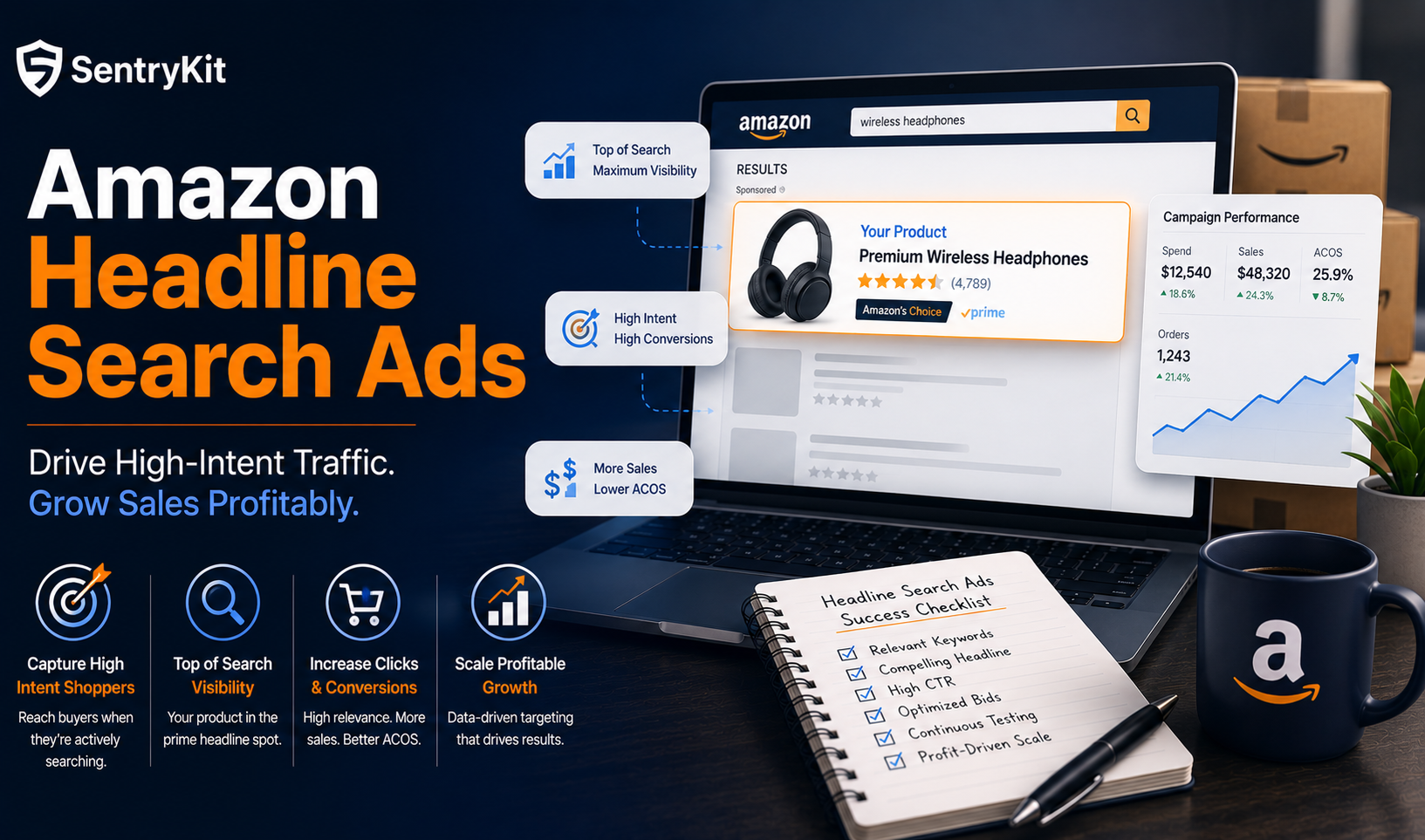
Amazon Headline Search Ads — now officially called Sponsored Brands — are banner-style ads that appear at the top of Amazon search results, above all organic listings. They feature your brand logo, a custom headline, and up to three products. When clicked, shoppers land on your Amazon Storefront or a custom product landing page.
Sponsored Brands are available exclusively to Brand Registered sellers and are one of the highest-visibility ad formats Amazon offers. In 2026, Amazon has significantly expanded the format with AI-powered creative tools and new audience targeting options that make Sponsored Brands more effective — and more automated — than ever before.
Here’s why sellers invest in Sponsored Brands in 2026:
2026 introduced several significant changes to Sponsored Brands that sellers need to know about:
AI-powered product collections (January 2026): Amazon replaced manually curated product collections with an AI-powered format. You now provide 3–10 products and Amazon’s algorithm selects the optimal combination for each shopper. The result: beta tests showed 2.5x more unique products purchased compared to manually curated collections. Custom headlines, lifestyle images, and branded assets are no longer required for this format.
Sponsored Brands prompts (March 2026, GA): AI-powered prompts automatically engage shoppers with relevant product information during their browsing session. These are charged at CPC and integrated into existing campaigns — no separate setup required.
Reserve Share of Voice: Advertisers can now reserve top-of-search Sponsored Brands placements for branded keywords at a fixed, upfront price. This guarantees visibility when shoppers search your brand name, regardless of auction competition.
New audience targeting: Two new retargeting audiences were added — “Purchased brand’s product” and “Clicked or Added to cart” — enabling more precise re-engagement of high-value shoppers and supporting repeat purchase campaigns.
Pro tip: If you haven’t tested Sponsored Brands Video yet, start with a 15–20 second product demonstration. SBV consistently outperforms static headline on both CTR and CVR in 2026, and video inventory is still less competitive than static placements.
In 2026, the best-performing Sponsored Brands headlines are short (under 50 characters), benefit-led, and don’t duplicate the product title. “Premium Wellness for Daily Energy” outperforms “Buy Our Best-Selling Supplement.” Lead with what the buyer gains, not what the product is.
Amazon’s AI-powered collections in 2026 make A/B testing product selection less critical — the algorithm does the optimization. But still test your headlines and video creatives. Run at least two headline variations per campaign and let each run for 7–10 days before drawing conclusions.
Pull insights from Amazon’s Search Term Report to identify keywords that drive profitable traffic. In 2026, adding the new retargeting audiences — “Purchased brand’s product” and “Clicked or Added to cart” — to your Sponsored Brands campaigns can meaningfully reduce wasted spend while targeting shoppers who’ve already shown purchase intent.
Your Sponsored Brands ad must match the page shoppers land on. If your headline says “Premium Pet Care,” your Store landing page should lead with pet care products — not the full catalogue. Misalignment between ad and landing page is one of the most common causes of high bounce rates and poor ROAS in Sponsored Brands campaigns.
Track ACoS, CTR, ROAS, and impressions weekly. For video campaigns, also monitor completion rate — if viewers are dropping off early, the video hook needs work. In 2026, also check your New-to-Brand percentage by SKU: if your SB campaigns aren’t acquiring new customers, they’re competing with your own organic sales rather than expanding your customer base.
While powerful, Sponsored Brands do have real constraints in 2026:
Sponsored Brands drive traffic — but the quality of what shoppers land on determines whether that traffic converts. SentryKit monitors the listing-level factors that affect your ad ROI in real time:
SentryKit plans start at $19/month for Starter, with a free 30-day trial to get started.
Amazon Headline Search Ads — now Sponsored Brands — are one of the most effective ways to secure premium visibility, build brand recognition, and drive top-of-funnel awareness on Amazon. In 2026, the format has become significantly more powerful with AI-powered collections, Sponsored Brands Video growth, and new audience targeting options.
The most effective approach pairs strong Sponsored Brands campaigns with real-time listing monitoring. Traffic you pay for should land on listings in perfect health — correct content, correct pricing, Buy Box held. Start your free 30-day trial with SentryKit and make sure your ad spend is working as hard as possible.
They are the same product. Amazon rebranded Headline Search Ads to Sponsored Brands in 2019. The name ‘Headline Search Ads’ is no longer used in Amazon Advertising Console. All features, eligibility requirements, and campaign setup are now under the Sponsored Brands label.
Only sellers enrolled in Amazon Brand Registry can run Sponsored Brands. This requires a registered trademark that matches your brand name on Amazon. Resellers, arbitrage sellers, and non-branded sellers cannot access Sponsored Brands campaigns.
Product Collection (AI-curated from your selected products as of January 2026), Store Spotlight (showcases your Amazon Storefront pages), and Sponsored Brands Video (6–45 second video ads that autoplay in search results). Video now accounts for roughly 58% of total Sponsored Brands spend and delivers higher CTR and CVR than static formats.
Sponsored Brands use a cost-per-click (CPC) model — you only pay when a shopper clicks your ad. CPCs vary by category, competition, and keyword but are typically higher than Sponsored Products because of premium placement. Video ads often have lower CPCs than static Sponsored Brands while delivering comparable or better conversion rates.
Amazon reviews Sponsored Brands creatives before campaigns go live. Approval typically takes 24–72 hours. AI-powered Product Collections introduced in 2026 do not require custom creative and therefore move through approval faster.