
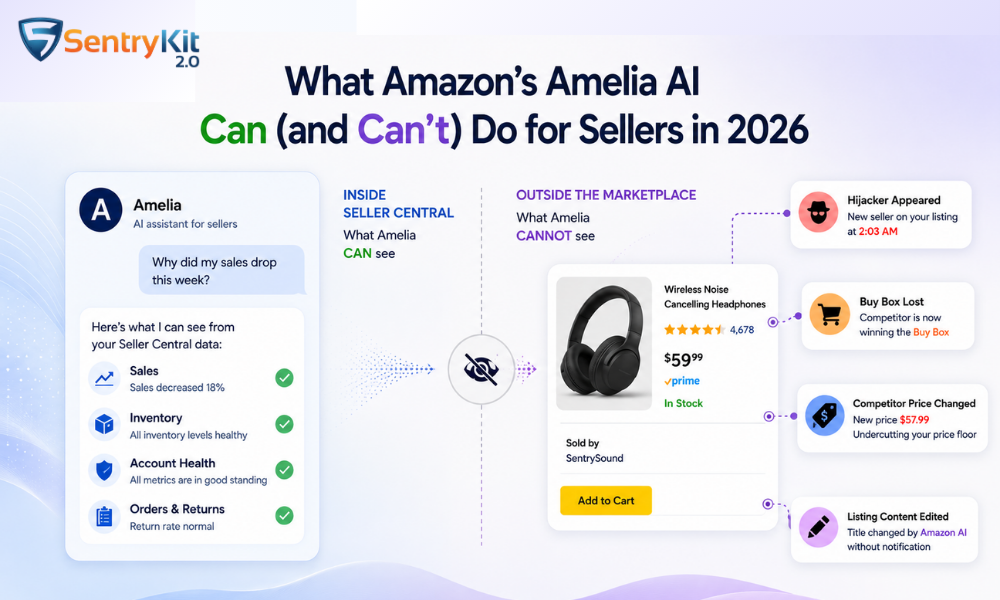
Amazon Amelia can answer almost any question about your seller account. What it can’t tell you is what’s happening on your listing right now, from the outside.
That gap matters more than most sellers realise — because the scenarios that cause the most damage (a hijacker at 2am, a suppression mid-day, a competitor undercutting your price floor) are all happening outside the Seller Central data boundary that Amelia sees.
Here’s exactly where Amelia’s visibility ends — and what that means for how you protect your listings.
Amazon describes Amelia as an AI assistant for sellers, embedded across Seller Central. It answers natural-language questions about your business — your sales trends, your account health, your inventory status, Seller Central policy questions — and it guides you through issue resolution workflows.
Amelia is the evolution of what Amazon internally referred to as Project Nile: a comprehensive AI layer for seller operations. As of 2026, it’s available in Seller Central in the US.
Amelia surfaces in Seller Central as a conversational interface. You can ask it things like “Why did my sales drop this week?” or “What’s my current account health status?” and get answers drawn from your account data. It also guides you through resolution workflows — if you have a listing issue, Amelia can point you to the right steps.
This is the critical distinction: Amelia draws on your Seller Central data. Your data. Sales figures, inventory levels, account health metrics, fulfilment status, return rates, policy case history — Amelia can see all of that.
What it cannot see is anything that originates outside your account: competitor behaviour, marketplace-level pricing data, who holds the Buy Box on your ASINs, whether an unauthorised seller appeared on your listing, whether Amazon’s own AI changed your listing content. That data lives outside the Seller Central data boundary, and Amelia doesn’t cross it.
To use Amelia effectively — and to know what it can’t replace — it helps to understand what it actually has access to.
Amelia can surface your own sales metrics: unit volume, revenue, session counts, unit session percentage (conversion rate), and trend comparisons against prior periods. If you’re trying to understand why your sales dropped this week, Amelia can help you frame the question and pull the relevant data from your own account.
Amelia has visibility into your FBA inventory levels, restock recommendations, and account health metrics — your Order Defect Rate, Late Shipment Rate, Policy Compliance status. If your account health score drops, Amelia can explain what changed and what Amazon’s resolution path looks like.
Amelia functions as a policy interpreter as well. You can ask it questions about Amazon’s programmes, fee structures, compliance requirements, and get answers grounded in Amazon’s current documentation — without digging through Seller Central Help yourself.
These are the specific gaps in Amelia’s visibility — and why each one matters.
Amelia can tell you your Buy Box percentage over time. It cannot tell you who holds your Buy Box at this moment, what price they’re offering, or whether a competitor just took it from you in the last 10 minutes.
Buy Box status changes within minutes of a price change. A competitor who prices below you by $0.01 can displace you and capture your sales while Amelia shows you yesterday’s Buy Box percentage with no indication anything changed.
Amelia has no access to what other sellers are charging on your ASINs. Competitor pricing is external marketplace data — it lives on the Amazon product page and in offer listings that Amelia doesn’t have a feed into.
This means Amelia can’t alert you when a competitor drops below your price floor, can’t show you the current offer distribution on your listing, and can’t tell you whether you’re the lowest-priced FBA seller at this moment.
Listing suppression can happen without a visible notification if the trigger is a quality flag from an automated Amazon system. Amelia doesn’t proactively surface suppression events — you’d need to check Manage Inventory or wait for Amelia to surface account health changes.
If your listing was suppressed at midnight and your sales went to zero, Amelia won’t tell you that something happened. You’ll see it in your sales data — hours later.
Hijacker detection requires monitoring the offer listings on your ASIN in real time — watching for new sellers who shouldn’t be there. That’s external marketplace data. Amelia has no visibility into who is selling on your listing at any given moment.
A hijacker who appears on your listing at 3am and starts undercutting your price won’t surface in Amelia unless you ask the right question — and by then, they’ve already been there for hours.
Amazon’s own AI tools — including the Enhance My Listing features rolled out to sellers in 2025 — can modify your listing content based on buyer engagement signals. As covered in how Amazon listing changes happen without seller action, your title, bullets, or images can change without a notification. Amelia doesn’t monitor for these changes.
Understanding the limits in the abstract is one thing. Here’s what they look like in practice.
A seller lists on your ASIN at 2am and prices $2 below you. They’re not an authorised seller. They take your Buy Box. You sleep through it. Your morning sales report shows a gap you can’t explain. You check Amelia — it shows your recent Buy Box percentage but nothing about what happened last night. You only find the unauthorised seller when you manually check your listing. By then, they’ve had 6 hours on your Buy Box.
A content change gets flagged by Amazon’s quality filters and your listing is suppressed at noon on a Wednesday — a high-traffic window. Amelia doesn’t alert you. Your sales drop to zero. You notice at 4pm when you check your account. You’ve lost 4 hours of sales on a day when your listing was getting significant traffic.
A reseller carrying your product drops their price below your price floor without warning. They take your Buy Box. Amelia shows you a declining conversion rate but no explanation of why the Buy Box moved. You don’t know a price breach happened until you check the offer listings manually — the next morning.
Amelia is effective for what it’s designed to do: answering questions about your own account data, guiding you through Seller Central processes, and helping you understand your performance metrics. Use it for that.
What it doesn’t replace is an external monitoring layer that watches your listings from the marketplace side — tracking who holds your Buy Box, what competitors are charging, when an unauthorised seller appears, and when your listing content changes.
That’s the gap SentryKit fills. A Hijacker Detected alert fires the moment an unauthorised seller appears on your listing. A Buy Box Lost alert fires when a competitor takes your Buy Box. A Competitor Price Change alert fires when another seller on your ASIN changes their price. A Listing Suppressed alert fires when your listing loses its featured placement.
Amelia tells you how your business performed. SentryKit tells you what’s happening on your listings right now — including the things Amazon’s own AI can’t see.
Start a free 30-day trial and see what’s been happening on your listings that Amelia can’t tell you.
Amazon Amelia is an AI assistant embedded in Seller Central. It answers natural-language questions about your seller account data — sales trends, inventory, account health, and Seller Central policy questions. It draws exclusively on data within your own Seller Central account and has no visibility into external marketplace activity.
No. Hijacker detection requires monitoring the offer listings on your ASIN in real time — external marketplace data that Amelia does not have access to. Amelia can only see data from within your own Seller Central account.
No. Amelia covers your internal account data: your own sales, inventory, account health, and Seller Central processes. It has no visibility into competitor pricing, Buy Box ownership, unauthorised sellers, or listing content changes. Sellers who need real-time monitoring of those signals need an external tool.
Amelia is a seller-facing assistant that helps sellers manage their accounts and understand their performance data. Alexa for Shopping is a buyer-facing assistant that helps consumers discover and purchase products. They are separate products with separate purposes and separate data access.
Amelia has access to your Seller Central account data: sales metrics, traffic, conversion, inventory levels, account health, fulfilment status, return rates, and policy case history. It does not have access to competitor offer data, real-time Buy Box status, or external marketplace activity on your ASINs.
Nisha Shetty · Marketing Manager, SentryKit
Nisha is a marketing manager and former Amazon seller who writes about e-commerce growth, consumer behavior, and digital retail trends.