
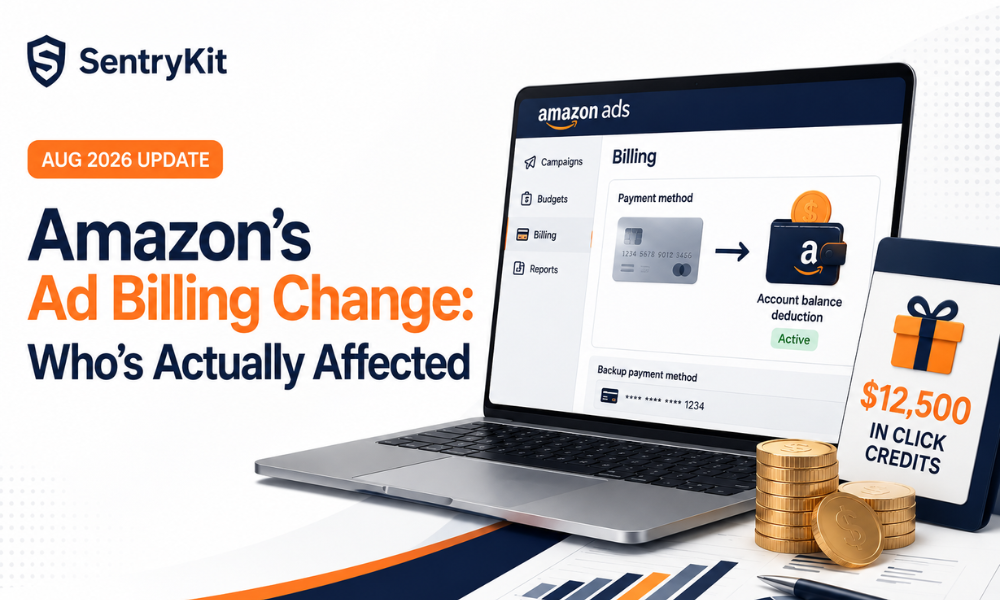
If you spent the past few months hearing conflicting things about Amazon pulling ad spend directly from seller balances, here’s the update: the change took effect this week, on August 1, 2026. But it doesn’t apply to every advertiser — and the details that got lost in the April panic cycle are worth revisiting now that the deadline has actually arrived.
Amazon Ads first notified a subset of advertisers in early April that their payment method for advertising costs would shift from credit card billing to automatic account balance deduction, effective April 15. That notice went out as individual Seller Central letters, with no public press release — which is exactly why it spread through LinkedIn and Reddit as a platform-wide policy before Amazon clarified otherwise.
On April 14, Amazon Ads deferred the change to August 1, 2026, giving the affected group roughly three and a half extra months to prepare. That deferred date is what took effect this week.
This is the part that got lost in translation the first time around. Amazon’s own announcement is direct about it: “This update applies only to the small group of advertisers who have been contacted directly.” If you weren’t sent an individual notice, this change doesn’t touch your account. Amazon has also said the majority of its advertisers already run on account balance deduction as their default payment method — the shift mainly affects a specific pool of advertisers still paying by credit card.
Affected advertisers have two choices, both selectable in the Billing section of the Ads Console:
Account balance deduction debits and credits ad costs automatically against your available seller or vendor balance. Amazon says this is already how most of its advertiser base operates.
Pay by Invoice has Amazon issue an invoice at the end of each month, with payment due 30 days from issuance — closer to how card billing used to work, timing-wise.
If you don’t pick one before the deadline, you’re automatically defaulted into account balance deduction. Your existing card stays on file, but only as a backup — it gets charged if your account balance can’t cover the spend.
The mechanics matter more than the headline. Under the old card-billing setup, a seller could run ad spend on a credit card, collect Amazon proceeds on a roughly 30-day disbursement cycle, and get another ~30 days before the card bill came due. Stack those together and you had close to 60 days of working capital that didn’t cost anything.
Account balance deduction closes that gap. Ad spend now comes straight out of your available balance inside Amazon’s own settlement cycle — before any proceeds reach your bank account. There’s also the card rewards loss to account for: a seller spending $50,000 a month on ads at a 2% rewards rate loses $1,000 a month, or $12,000 a year, once that spend moves off the card. At $250,000 a month in spend, that annual loss reaches $60,000. If ad spend is a meaningful chunk of how ad spend affects your margin, this is worth modeling before the change hits your account, not after.
Amazon is offering affected advertisers $2,500 a month in click credits for five consecutive months, starting August 1 and running through December 2026 — $12,500 total per advertiser. It’s a real cushion, but its value scales inversely with how much you spend: for an advertiser running $10,000 a month in ads, $2,500 in monthly credits covers a quarter of typical spend. For an advertiser at $100,000 a month, it covers about 2.5%.
There’s also a second-order effect worth watching. Alexander Swade, an ad consultant who has publicly discussed managing over $1 billion in ad spend, argued on LinkedIn that distributing credits broadly could temporarily inflate CPCs — advertisers bidding more aggressively with “house money” through August and September, then finding those elevated bids become the new normal once credits expire in early 2027. That’s industry speculation, not something Amazon has confirmed, but it’s a reasonable thing to watch in your own auction data over the next two months.
This billing change doesn’t sit in isolation either. It’s the third significant billing-precision update Amazon has rolled out to sellers this year, following the FBA fee changes that took effect earlier this year and the elimination of commingled inventory in March. Amazon’s Bid+ multiplier changes are part of that same broader tightening of how advertising mechanics work under the hood — worth reading if you haven’t already adjusted for it.
If you received a direct notice from Amazon about this change, log into the Billing section of your Ads Console and confirm which payment method you’re on. If you didn’t receive a notice, this change simply isn’t live on your account yet — but given the pattern of billing updates rolling out through 2026, it’s worth checking back periodically rather than assuming it never will be.
No. Amazon’s own announcement states it applies only to the specific group of advertisers who were contacted directly — not a platform-wide requirement.
You’re automatically migrated to account balance deduction on August 1. Your existing card remains on file as a backup only, used when your account balance is insufficient.
Partially, on timing. Net-30 invoicing from month-end gives you 30–60 days between spend and payment, depending on when in the month the spend occurred — similar timing to card billing. It doesn’t restore card rewards income, though.
Amazon said the deferral came directly from feedback from the affected advertiser group, who needed more time to model the cash flow impact and choose between the two options.

Nisha Shetty · Marketing Manager, SentryKit
Nisha is a marketing manager and former Amazon seller who writes about e-commerce growth, consumer behavior, and digital retail trends.