
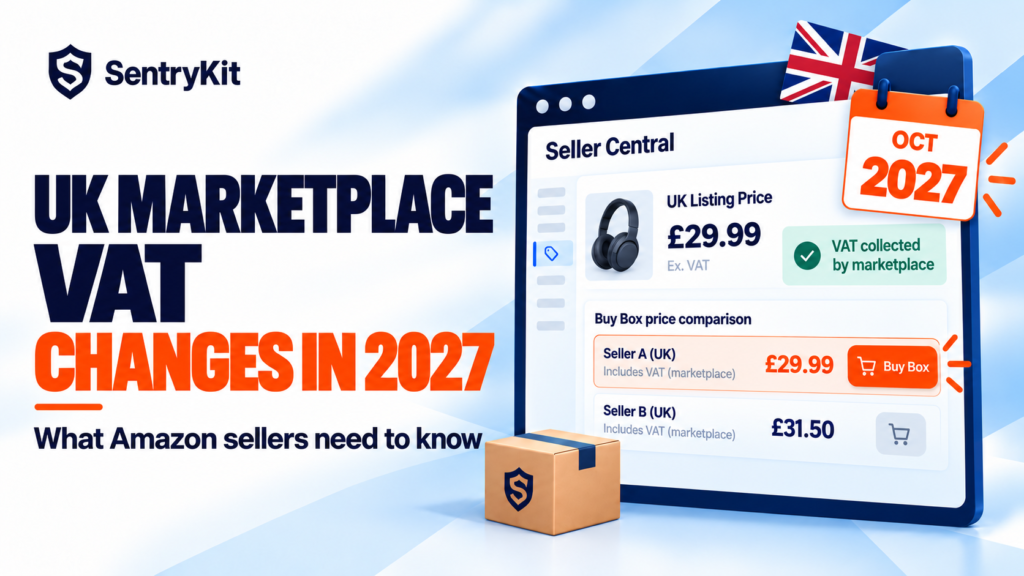
The Chancellor confirmed in the 28 October Budget that online marketplaces such as Amazon and eBay will collect the VAT on sales by UK sellers, starting in October 2027 (Reuters). If you sell on Amazon UK through a UK business, Amazon will charge the VAT on your sales to consumers and pay it to HMRC, and you stop charging output VAT on those sales yourself.
For a VAT-registered seller the tax bill barely changes. What changes is your cash flow, your VAT return and, for many listings, who you are competing with on price. Sellers who were never charging VAT feel it most.
Since 2021, Amazon already accounts for VAT when an overseas seller sells goods that are in the UK at the point of sale. The Budget extends that to UK-established businesses selling to consumers through online marketplaces (HMRC consultation).
| Seller | Today | From October 2027 |
|---|---|---|
| Overseas seller, stock in the UK | Amazon charges and pays the VAT | No change |
| UK seller, VAT-registered | You charge VAT and pay it on your return | Amazon charges and pays it; your sale to Amazon is treated as zero-rated; you still reclaim input VAT |
| UK seller, not VAT-registered, under £90,000 on that marketplace | No VAT charged | Out of scope |
| UK seller, not VAT-registered, over £90,000 on one marketplace | Should already be registered | The marketplace charges VAT on your sales |
| Private individual, not a business | No VAT | No change |
Business-to-business sales stay outside the change, and so do your own website and shop sales. VAT rates don’t change either.
According to Reuters’ report of the Budget, the rules cover UK businesses that are VAT-registered, or that sell more than £90,000 on an individual marketplace (Reuters via Global Banking & Finance). That matches the lead option in HMRC’s consultation: a £90,000 threshold measured per platform. If you are VAT-registered, you are in, whatever you sell on each marketplace.
Per platform matters for sellers who aren’t registered. A seller doing £70,000 on Amazon UK and £40,000 on eBay is under the line on each marketplace, but over £90,000 in total, so they still have to register for VAT, and registering brings them into scope. The full rules come with HMRC’s formal response and draft legislation, so check your own split with your accountant.
Three things change for a VAT-registered Amazon seller once the rules start:
Selling second-hand goods? The consultation is also deciding whether those sales are excluded or whether the margin scheme can work through a marketplace. Watch that one if you trade in used stock.
This is the part most coverage skips. The measure exists because some sellers on UK marketplaces don’t charge VAT they owe. On a shared listing, a seller who skips 20% VAT can sit far below a compliant seller’s price and still make money. Retail Insight Network reported the measure could raise up to £1 billion a year (Retail Insight Network).
When Amazon collects the VAT itself, that gap closes. Expect some offers to reprice upwards, some to disappear and some listings to change hands on the Buy Box once it starts. If you have lost the Buy Box on a listing to an offer you couldn’t explain, this is worth watching.
The counterintuitive bit: for honest UK sellers this is one of the few tax changes that could raise margins, not cut them.
When competing offers reprice, the first sign is usually the Buy Box. SentryKit emails you when another seller takes the Buy Box on your Amazon UK listings, and when your price moves above Amazon’s competitive price, with both prices on the alert.
October 2027, according to Reuters’ report of the Budget. That gives VAT-registered sellers about a year to plan for the cash flow change and update their bookkeeping. In his speech, the Chancellor said: “I will strengthen the requirements for online marketplaces so that sellers cannot avoid paying VAT when they sell online.”
Before then, HMRC still has to publish its formal response to the consultation and draft legislation. Amazon will tell sellers how it will apply the change in Seller Central. Nothing changes on your account today.
Step 5 is where SentryKit helps. It watches 50+ signals on your Amazon UK and EU listings and emails you when you lose the Buy Box, when your price changes, and when your price goes above Amazon’s competitive price. It doesn’t change your prices. It tells you which ASIN needs you. Plans start at $19/month with a 14-day free trial. See pricing, or see how it works for UK and EU sellers.
Other UK changes are already landing on listings this quarter, from GPSR blocks that keep coming back to fee category changes.
VAT used to be a cost of doing business properly. Soon it may be the line that separates who can still sell on your listing.
See who takes the Buy Box on your UK listings
SentryKit watches 50+ signals on your ASINs across Amazon UK and Europe and emails you when one changes. Plans from $19/mo.
Start 14-day free trialRelated
Yes. The 28 October 2026 Budget confirmed that online marketplaces such as Amazon will collect VAT on sales by UK sellers, starting in October 2027. Today only overseas sellers are covered.
If you are not VAT-registered and sell less than £90,000 on a marketplace, the new rules do not apply to your sales there. VAT-registered sellers are covered whatever they sell on each marketplace, according to reports of the 28 October 2026 Budget.
Yes. Your sales to Amazon are treated as zero-rated, and you keep reclaiming input VAT on stock and costs.
No. The change covers business-to-consumer sales of goods that are in the UK at the point of sale.
October 2027, according to reports of the 28 October 2026 Budget. HMRC still has to publish its formal response and draft legislation, and Amazon will set out how it applies in Seller Central.

Raghav Tiwari · Founder, SentryKit
Raghav is the founder of SentryKit. He spent years running his own Amazon storefronts before building it, and writes about Buy Box strategy, competitive intelligence, and the platform shifts sellers can’t afford to miss.