
Two things happened a few weeks apart, and almost nobody connected them.
First, Amazon quietly blocked ChatGPT’s crawlers — ChatGPT-User and OAI-SearchBot — from pulling live prices, listings, and reviews off its own site. If you asked ChatGPT to help you shop, it could no longer look at Amazon to answer you.
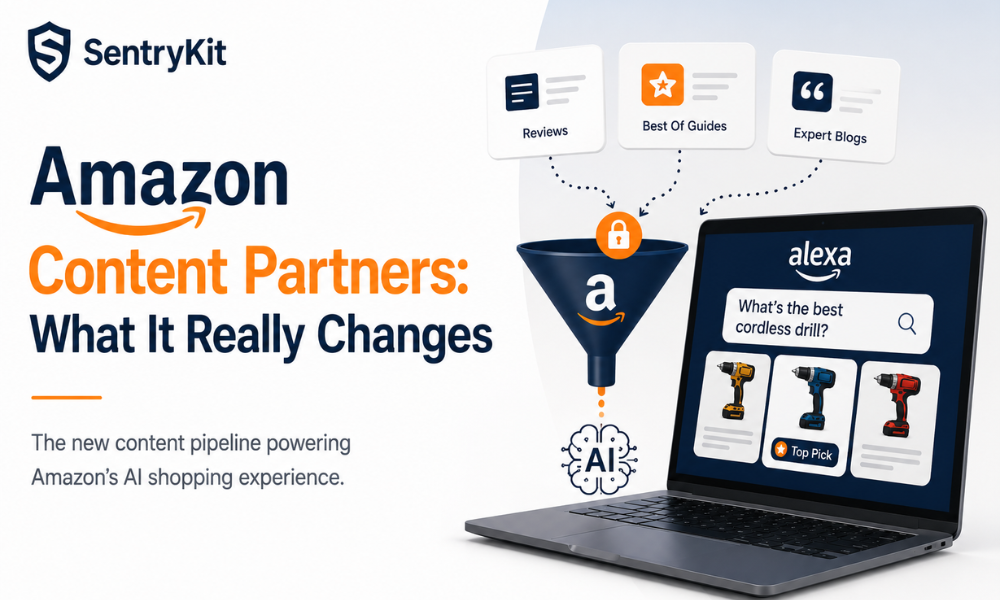
Then Amazon opened up a program called Amazon Content Partners, and gave independent creators the same power ChatGPT had just lost — the ability to block, rate-limit, or monetize AI crawlers hitting their own sites. Except this time, Amazon isn’t the one getting blocked. It’s the one paying creators to do the blocking, in exchange for feeding that content into its own AI shopping surfaces.
That’s not a coincidence. That’s a strategy, and it’s worth understanding before it shows up in your traffic numbers and you don’t know why.
Amazon opened a gated preview of Content Partners in mid-June 2026 and widened access toward the end of July. The mechanics, straight from Amazon: independent creators and publishers get access to AWS WAF — a tool that shows them exactly which AI crawlers are hitting their site, and lets them block, rate-limit, allow, or monetize that traffic. No fee to join. No minimum traffic bar. Creators can leave whenever they want.
In return, Amazon gets something it didn’t have before: a rights-managed pipeline of blog and article content it can feed into its own AI systems — the same systems now answering shopping questions where ChatGPT used to.
Here’s the part that matters more than the mechanics. Amazon has spent the past year blocking outside AI crawlers from scraping its own product pages. Modern Retail reported Amazon shutting down ChatGPT’s Shopping Research feature and blocking the crawlers that power it, specifically to stop rival AI tools from building shopping answers off Amazon’s data. Content Partners is the same move, run in the other direction. Instead of just keeping other AI systems out of its own turf, Amazon is now buying exclusive access to the turf around it — the reviews, roundups, and “best X for Y” posts that shoppers read before they ever open the Amazon app.
For most of the last decade, your visibility on Amazon was decided almost entirely on the product detail page. Title, bullets, images, reviews, A+ content. Rewrite the page, move the needle.
That’s no longer the whole story. Alexa for Shopping — the assistant that replaced the standalone Rufus chatbot in May — generates AI answers and side-by-side comparisons directly in search, and those answers increasingly pull on outside editorial content, not just your listing. If a competitor’s product shows up in a dozen well-regarded “best cordless drill” roundups and yours shows up in two, that gap now shapes what the AI recommends — separately from anything on your PDP.
Content Partners raises the stakes on that gap. If the publishers writing those roundups have joined Amazon’s pipeline — traded ChatGPT access for Amazon’s referral commission and hosting credits — their content becomes more available to Amazon’s own AI and less available to everyone else’s. A brand with denser, better third-party coverage across enrolled sites gets a structural edge in how it gets recommended. A brand that’s only ever invested in its own PDP doesn’t.
I’ve seen brand teams spend months getting an A+ content refresh exactly right, then get blindsided by something that never touched their listing at all. This is that pattern again, just one layer further out. You can’t fix a third-party editorial gap by rewriting your own bullet points, and by the time it shows up as a traffic or ranking shift, the gap has already been open for a while.
The instinct is to treat this as a publisher story — something happening between Amazon and content creators, three steps removed from your P&L. It isn’t. It’s the same mistake sellers make when they treat any single alert type as the whole monitoring problem, right up until the actual threat has already moved somewhere else. Amazon changes something upstream, doesn’t announce it as a seller-facing change, and the sellers who notice first are the ones who were already watching the wrong thing.
Nobody sends you a notification when a competitor’s brand starts showing up across five Content-Partners-enrolled sites and yours doesn’t. You just notice, eventually, that your share of AI-driven recommendations has quietly slipped — and by then you’re trying to reverse-engineer a change that happened weeks earlier.
Start by finding out who’s already writing about your category. Pull up the comparison posts, the gift guides, the “best X” roundups your product should be showing up in — competitors’ too — and note which sites keep appearing. Those are the publishers worth a real relationship, not a one-off outreach email. If Content Partners keeps expanding, the sites your category already trusts are the ones you want on your side of the pipeline, not a competitor’s.
Then treat third-party editorial the way you’d treat backlinks in classic SEO — as a signal you actively build, not one you hope accumulates. A quarterly check on who’s covering your category, and where those publishers stand on AI content licensing, is a smaller lift than it sounds, and it’s the only way you catch this shift before it’s already cost you a season of visibility.
Amazon didn’t announce this as something sellers need to act on. That’s exactly why it is.
A program Amazon opened in 2026 that gives independent creators and publishers access to AWS WAF tools to monitor, block, rate-limit, or monetize AI crawlers hitting their sites — in exchange for feeding that content into Amazon’s own AI shopping systems.
Amazon blocked ChatGPT from scraping its own product pages to stop a rival AI assistant from building shopping answers off Amazon’s data. Content Partners applies the same blocking logic to the content around Amazon — reviews, roundups, and comparison posts — but with Amazon as the beneficiary of the exclusivity instead of the target.
It affects sellers indirectly but materially. As AI shopping surfaces pull recommendations from third-party editorial content, which sites cover your product — and whether those sites are in Amazon’s content pipeline — increasingly shapes your AI visibility, separate from your product listing.
Amazon retired the standalone Rufus chatbot in May 2026 in favor of Alexa for Shopping, which is more embedded in search and leans more heavily on outside content for its comparisons and recommendations — which is exactly the content Content Partners is designed to route toward Amazon.
Map out which third-party sites already cover your category — comparison posts, gift guides, “best X” roundups — and treat those relationships as a deliberate part of your visibility strategy, the same way you’d build backlinks for SEO.

Raghav Tiwari · Founder, SentryKit
Raghav is the founder of SentryKit. He spent years running his own Amazon storefronts before building it, and writes about Buy Box strategy, competitive intelligence, and the platform shifts sellers can’t afford to miss.