
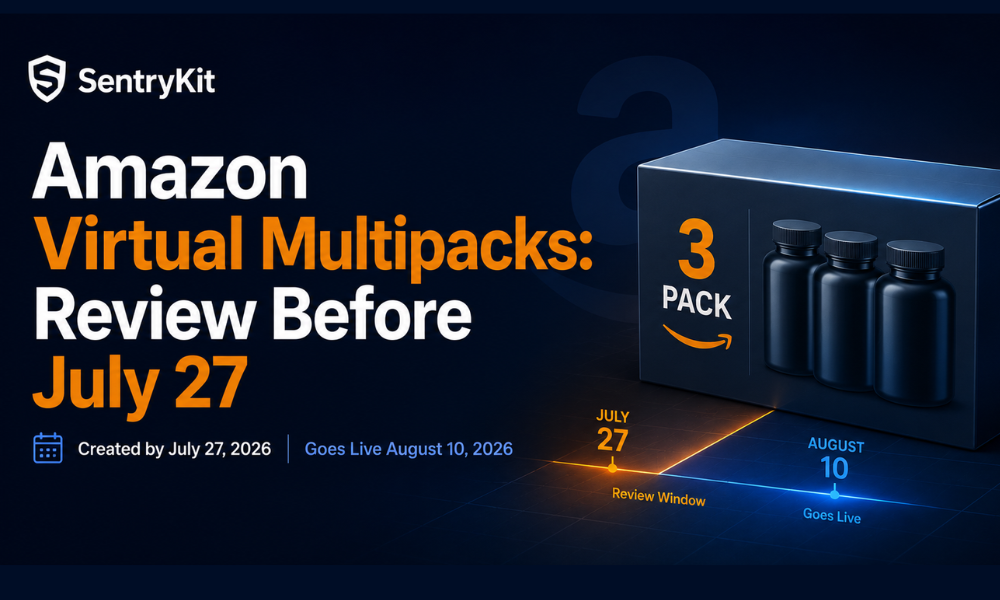
Amazon has started notifying eligible sellers directly inside Seller Central about a new pilot: Virtual Multipack (VMP) listings. If you sell single-pack products, Amazon may already be creating multipack variations on your ASINs — without you asking for them, and without you doing anything to trigger it.
Here’s the timeline that matters. Amazon is scheduled to finish creating these VMP listings by July 27, 2026. They go live to customers on August 10, 2026. In between, you have a review window inside Manage All Inventory where you can edit or delete a VMP before shoppers ever see it. Miss that window, and the listing goes live as-is.
A Virtual Multipack is a new listing Amazon generates from an existing single-pack ASIN, packaged as a “buy more, get a bundle” variation — think a 3-pack or 5-pack version of a product you already sell as a single unit. Amazon creates it as a variation linked to your original ASIN, not a separate product you build yourself — the mechanics are laid out in Amazon’s own Virtual Multipacks help page.
The pilot targets single-pack ASINs Amazon judges eligible for this treatment. If your catalog includes products customers commonly buy in bulk — supplements, cleaning supplies, consumables, small parts — there’s a real chance Amazon has already flagged some of your listings. Take a private label seller running 40 single-pack SKUs in the supplement category — the kind of catalog where multipacks are a normal purchase pattern already. That’s exactly the profile Amazon is targeting first.
Here’s the mechanism in plain terms: Amazon isn’t asking permission first. It’s creating the listing, then giving you a window to react to it. That’s the part sellers need to internalize.
Takeaway: if you sell single-pack ASINs in categories where multipacks make commercial sense, assume you’re in scope until you’ve checked otherwise.
Amazon began notifying eligible sellers about this pilot directly inside Seller Central — there’s no public blog post walking through this specific wave’s dates, which is exactly why most sellers will miss it. It’s sitting in a notification, not a headline. This isn’t Amazon’s first VMP wave, either: an earlier round of the pilot finished creating listings in late September 2025 with a go-live about two weeks later — the same creation-then-go-live pattern showing up again now, just on a new batch of ASINs and a new set of dates. Sellers who’ve already spotted a VMP on their catalog report the same reaction: they had no idea Amazon could attach a new listing to one of their ASINs without so much as a heads-up email.
The mechanics are straightforward once you know them:
That’s a review window measured in days, not weeks, once a listing is created — and it closes on a fixed date regardless of whether you noticed it. This is a silent-catalog-change problem with an unusually generous exception: Amazon actually gave sellers a door to walk through. The catch is that most sellers won’t know the door exists. So the question worth asking right now isn’t whether Amazon will do this to your catalog — it’s whether it already has, and whether anyone on your team has checked.
Bottom line: the fix here isn’t complicated — it’s timing. Check Manage All Inventory before July 27, and again before August 10, or you inherit whatever Amazon built.
The review happens in one place: Manage All Inventory in Seller Central. Here’s the situation you’ll be dealing with, and the options once you find a VMP attached to one of your ASINs:
The checklist is short on purpose. The action that matters is opening Manage All Inventory and looking, before July 27 closes the creation window and before August 10 makes the decision for you.
One page, one deadline, three outcomes — keep it, fix it, or delete it. Do this before the date does it for you.
This isn’t an isolated event. It’s the latest instance of the broader pattern of Amazon changing your listings without notice — title rewrites, AI-driven content edits, and now auto-generated variations, all landing on seller catalogs without a request from the seller. It’s also arriving at the same time Amazon has been tightening scrutiny on how ASINs get created and maintained across the catalog. Sellers are being asked to monitor more surface area, in more places inside Seller Central, with less lead time than ever.
Checking Manage All Inventory manually before two separate deadlines is exactly the kind of task that falls through the cracks — it’s not urgent until it suddenly is. That’s the gap SentryKit’s Content Changed alert closes. It’s a digest-tier alert on SentryKit’s Buy Box intelligence platform, and it flags when something changes on your listing — including a new variation showing up on your catalog — so a VMP lands in your digest instead of surprising you on August 10. You still make the call on whether to keep it, edit it, or delete it. You just find out with enough runway to actually do something about it.
A Virtual Multipack is a listing Amazon automatically creates from an eligible single-pack ASIN, structured as a variation (like a 3-pack or 5-pack) linked to your original listing — created by Amazon, not built by the seller.
Amazon is scheduled to finish creating VMP listings on eligible ASINs by July 27, 2026, and they go live to customers on August 10, 2026, unless the seller edits or deletes them before then.
Go to Manage All Inventory in Seller Central, locate any VMP variations linked to your ASINs, and edit or delete them before the August 10, 2026 go-live date.
No — this is currently a pilot affecting eligible single-pack ASINs, not a full marketplace-wide rollout. Sellers were notified directly inside Seller Central rather than through a public announcement.
SentryKit’s Content Changed alert, delivered as a digest-tier alert, flags catalog changes — including new variations appearing on your listings — so a change like a Virtual Multipack shows up in your digest instead of you finding out only after it’s already live to customers.

Nisha Shetty · Marketing Manager, SentryKit
Nisha is a marketing manager and former Amazon seller who writes about e-commerce growth, consumer behavior, and digital retail trends.