
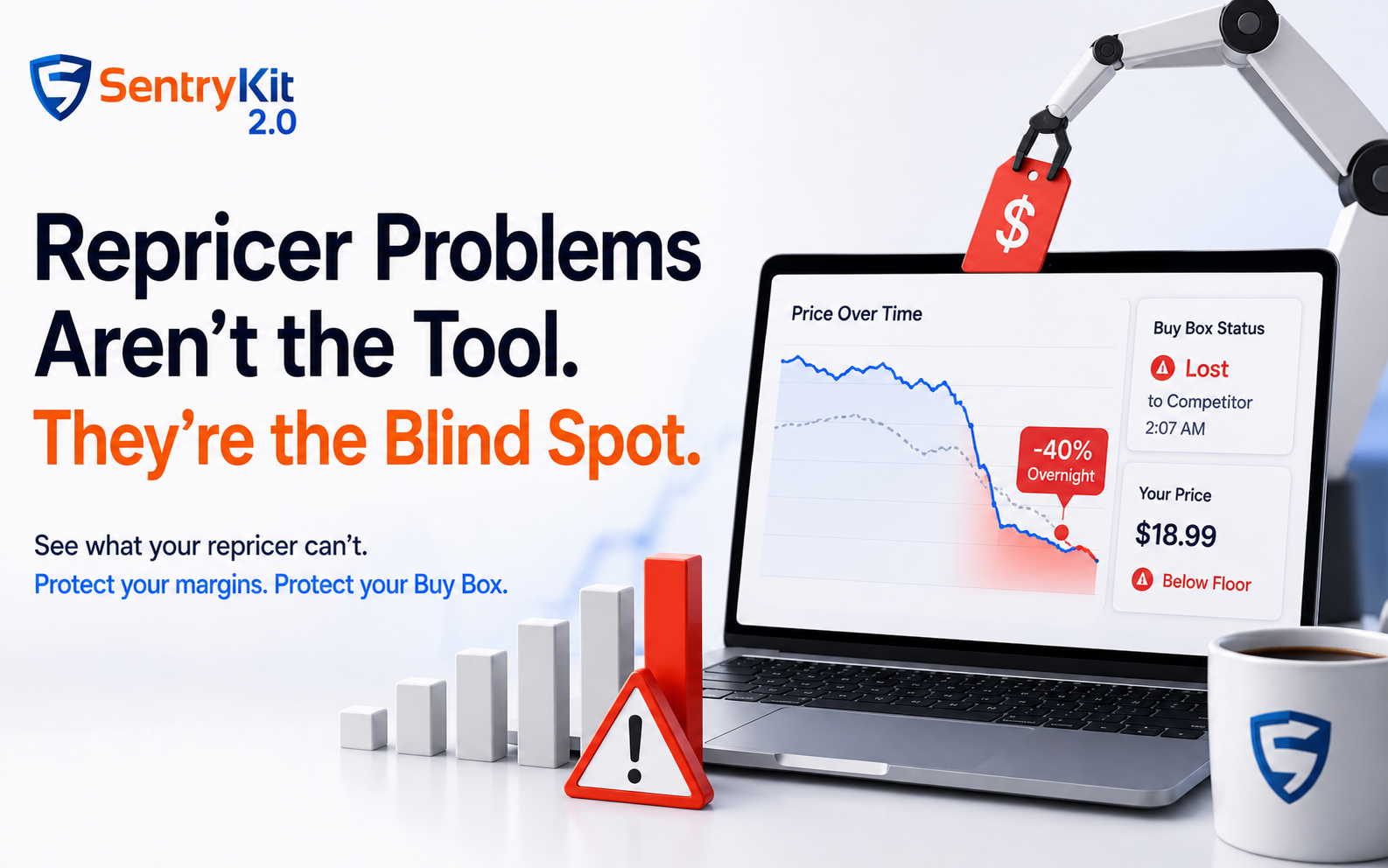
The pattern plays out the same way every time.
A wholesale seller managing a few hundred SKUs wakes up to find their margins destroyed. Prices dropped 40% overnight. The repricer did it. They’re furious — cancel BQool, search for an alternative, sign up for Aura or Seller Snap or Repricer.com. Three months later, different tool, same problem.
That’s not bad luck. That’s a structural issue that no repricer switch can fix.
The frustration is real. Sellers report prices tanking below minimum thresholds, repricing delays that cost Buy Box wins, and an interface that hasn’t kept pace with how they run their businesses. I’m not here to defend any specific tool.
But most of the complaints trace back to one thing: the repricer was making moves, and the seller didn’t know what it was responding to until the damage appeared in revenue. That’s not a BQool-specific problem. It’s what happens when Amazon automation goes wrong — it’s invisible until a crisis forces you to look.
Here’s the constraint every repricing tool operates under. The Amazon data feed they all run on limits a repricer to comparing your price against three signals: the lowest overall price, the lowest FBA price, and the Buy Box price. That’s it. The tool can’t see what happened in the last two hours. It can’t tell whether the seller who undercut you is a hijacker running a counterfeit, a legitimate competitor clearing inventory, or a new account that misconfigured their own rules. It responds to the current signal and moves your price accordingly.
The repricer didn’t go rogue. It did exactly what it was designed to do. You just didn’t have visibility into the market conditions it was reacting to.
Here’s where it gets more urgent.
On March 4, 2026, Amazon updated its Business Solutions Agreement to include a standalone Agent Policy governing all automated seller software — including repricing tools. The key requirement for pricing: automated price changes exceeding 20% within 24 hours must have documented human authorization. PPC Land covered the policy when it dropped — the 90-day transition window ends in early June 2026. Enforcement starts then.
This applies to every repricing tool, not just BQool. If your repricer can swing prices by more than 20% in a single day without prompting you for confirmation, it’s not compliant with Amazon’s current rules. The official BSA update thread on Seller Central has the details — worth reading if you haven’t.
The tools recommending themselves as alternatives haven’t prominently flagged this. Switching tools doesn’t solve the compliance exposure. You need to know whether any repricer you’re considering can enforce the 20% rule and produce a documented audit trail of who authorized what.
I’ve watched sellers cycle through three repricing tools in a year. The complaints differ slightly at each stop. The outcome doesn’t.
A repricer executes within rules you set. It moves fast, it covers every SKU, and it handles the volume a human can’t. What it doesn’t do is tell you whether those rules are still appropriate given what’s happening in the market right now — or whether the signal it’s reacting to is what you think it is.
A Seller Labs analysis of AI repricing tools for Amazon FBA makes a point worth sitting with: the biggest repricing mistakes aren’t tool failures — they’re information failures. Sellers set minimum prices based on their cost structure at setup and forget to update them when fees change. They configure competitive rules against the wrong baseline. They don’t know a hijacker has entered their listing until the repricer has already chased prices down to compete with them.
That’s also why automated repricing quietly erodes margins at a pace most sellers don’t catch until they run a proper margin audit. It’s not dramatic. It’s 3% here, 5% there, over weeks. A faster repricer doesn’t fix any of that. It executes the wrong response faster.
True story · SentryKit support case
An Amazon seller contacted SentryKit support after two of their listings became inactive without any notification from Amazon. Their repricer had made a small downward price adjustment — exactly what it was designed to do in response to competitor pricing. Amazon compared the revised price against its own benchmark and flagged it as a potential pricing error, deactivating both listings.
The seller only discovered this when they checked Seller Central. By then the listings had been inactive long enough to affect ranking and sales velocity.
The SentryKit support review identified the core issue: the repricer was executing without margin context. No COGS data had been entered, so there was no floor below which pricing would stop. The repricer’s job is to compete for the Buy Box — it has no way of knowing whether a given price covers your costs or whether it will trip an Amazon compliance threshold.
Two things surfaced in that conversation worth understanding:
The fix wasn’t switching repricers. It was adding the margin context the repricer was never designed to carry. Once COGS were in, alerts fired on moves that actually mattered — with enough lead time to act.
The listings didn’t go inactive because the repricer malfunctioned. They went inactive because the repricer had no context about what prices were acceptable, and there was no visibility layer in place to catch it before Amazon did.
Before you switch repricers — or keep the one you have — these are the questions that actually matter.
Do you know when a competitor drops price before your repricer responds? If the first signal you get is your own price changing, you’re always reacting. The decision has already been made for you.
Do you know why you lost the Buy Box? Losing it to a competitor who undercut you, losing it to a hijacker, and losing it because your repricer pushed below your own floor are three different problems with three different fixes. Your repricer won’t tell you which one happened.
Can you see your Buy Box share over time and spot when it drops? A single Buy Box Lost event is a data point. A pattern across a week is a problem that needs diagnosing. Most sellers can’t see the pattern until they’re deep into the damage.
Do you have a documented record of what triggered each significant price change? Under the new BSA Agent Policy, that documentation isn’t optional anymore.
The tool that answers these questions isn’t a repricer. It’s a market intelligence layer — real-time competitor price monitoring that closes the gap between when something moves in the market and when you find out about it.
This is the model that works.
A repricer executes within rules you set. Fast, comprehensive, handles the volume. That’s a genuine advantage and I’m not suggesting you drop it.
What’s missing is a layer that tells you when the rules need updating — when a competitor enters, when you lose the Buy Box, when your price breaks through your own floor. Without that, you’re flying on assumptions you set weeks ago.
SentryKit works alongside your existing repricer — it gives you the context your repricer doesn’t. A Competitor Price Change alert fires within 90 seconds of a move in the market, before your repricer has acted. A Buy Box Lost alert tells you immediately when you’ve lost position. A Price Floor Breach alert catches the exact moment your repricer violates your own minimum — so you’re not finding out the next morning.
That’s the gap. Not which repricer you’re running — whether you can see what’s happening before any tool makes a move.
If you want to see how SentryKit and BQool compare directly, the full breakdown is here.
Before you cancel your subscription and sign up for the next repricer, spend 30 minutes with your Buy Box data. Find out who’s beating you and why. Is it a competitor legitimately undercutting you? A hijacker? Your own tool running below your floor? The answer tells you whether the problem is the tool or the information — and which one to fix first.
With Prime Day weeks away, this is not the time to be running blind on any of your ASINs. Get your Buy Box position right before the window opens, and make sure whatever’s automated is working with you — not ahead of you.
Start the 30-day free trial. See what your repricer has been responding to.
The policy applies to every repricing tool that makes automated price changes — not any one tool specifically. The requirement is that automated price changes exceeding 20% within 24 hours must have documented human authorization. Check with your current provider on how they’re handling this. If they haven’t published guidance, ask them directly before June enforcement begins.
Pause the repricer first. Then check your Buy Box data — find out whether the drop was triggered by a legitimate competitor, a hijacker, or a rule misconfiguration on your end. Restore your price manually. Then set up a Price Floor Breach alert so you catch it in real time next time rather than the morning after.
No. SentryKit is a Buy Box intelligence platform, not a repricer. It monitors market conditions and alerts you in real time when something changes. Your repricer handles execution. They serve different functions — and used together, you get the visibility the repricer doesn’t provide on its own.
Repricing is automated price adjustment to compete for the Buy Box. Buy Box intelligence is knowing who holds the Buy Box, why you lost it, what competitors are actually doing, and whether price is even the problem. A repricer without intelligence is executing blind. That’s how you end up in a price war with a hijacker.
Yes, if it makes automated price changes through Amazon’s seller API — which all repricing tools do. The policy requires automated tools to identify themselves as agents and requires documented human authorization for price changes above 20% in 24 hours. The 90-day transition window ends in early June 2026.
Yes. If a repricer drops your price to a level Amazon classifies as a potential pricing error, Amazon can suppress or deactivate the listing — often without sending a notification. This happens because the repricer has no visibility into Amazon’s internal pricing benchmarks, and no margin floor to stop it. The fix is entering your COGS so SentryKit can correlate price moves with your actual cost structure and alert you before a price breach triggers a listing suspension. A Listing Suppressed alert will also fire the moment a listing goes down, so you’re not finding out hours later.

Raghav Tiwari · Founder, SentryKit
Raghav is the founder of SentryKit. He writes about Amazon Buy Box dynamics, marketplace intelligence, and the operational reality of running a private label or wholesale business at scale.