
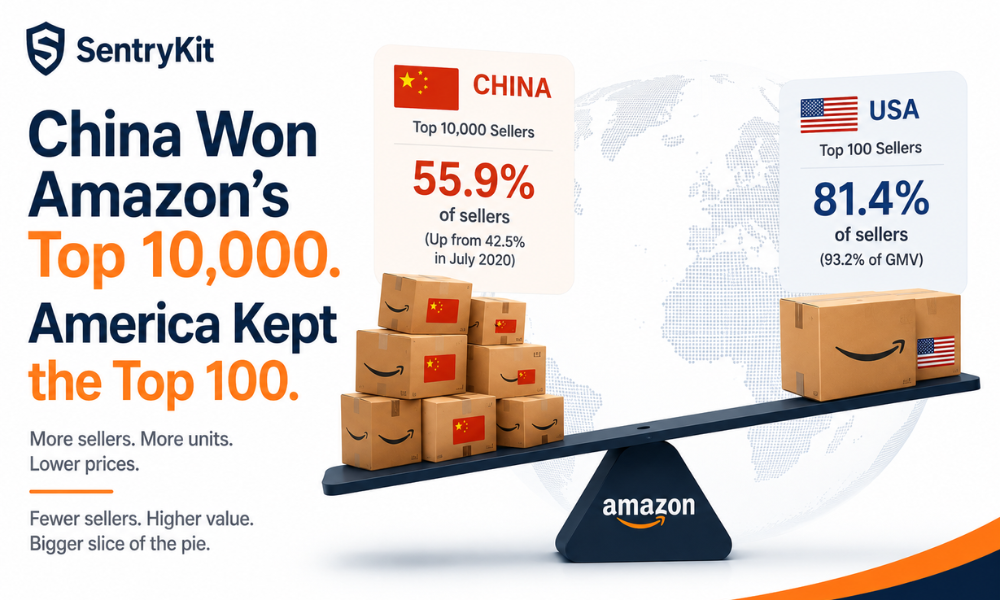
Here’s a stat that’s been making the rounds: Chinese sellers now make up 55.9% of Amazon’s top 10,000 sellers, up from 42.5% in July 2020. US sellers dropped from 53.7% to 40.5% over the same stretch. Every repost of that number treats it as proof China has taken over Amazon. It hasn’t. The data — from Marketplace Pulse’s July 9, 2026 analysis — tells a much more specific story once you look past the headline.
The headcount shift is real. Six years ago, US sellers were the clear majority in Amazon’s top 10,000. Now Chinese sellers are. That’s a genuine structural change in who’s operating at scale on the platform, and it’s worth taking seriously — 165,000 new sellers joined the marketplace this year alone, and a growing share of the ones reaching real scale are Chinese-based.
But “top 10,000” is a big group. It spans everything from sellers doing a few million a year up to the handful doing hundreds of millions. Treating that whole range as one competitive bloc is where the headline goes wrong.
Here’s the number that should have been in every repost and wasn’t: within that same top-10,000 cohort, US sellers hold 65.3% of total GMV. Chinese sellers hold 28.6%. Headcount and revenue share are moving in opposite directions — more Chinese sellers are reaching the top 10,000, but the revenue inside that group is still concentrated with US sellers.
That’s not a contradiction. It’s the whole story. Chinese sellers are winning volume — more sellers, more listings, more SKUs at scale. US sellers are still winning value.
Zoom into the very top of Amazon’s seller pyramid and the picture flips even harder. US sellers are 81.4% of the top 100 by headcount and 93.2% of its GMV. At the highest tier — the sellers doing the most volume on the platform — this isn’t close. America didn’t just hold onto the top 100. It owns it, on both counts that matter.
If you’re trying to figure out what separates the sellers at the very top from everyone else fighting for scraps in a crowded middle tier, nationality of origin isn’t the differentiator. Operating at that top-100 level is still, overwhelmingly, a US-seller game.
Here’s the mechanism behind all of it: average selling price. In the top 100, US sellers average $47.62 per unit. Chinese sellers average $22.03. That’s more than double.
This is the actual explanation for why headcount growth hasn’t translated into GMV growth for Chinese sellers. They’re not displacing US sellers from higher-value categories — they’re winning volume in lower-ASP categories where unit economics favor scale over margin. More sellers, more units, lower price points. It’s a different game than the one being played at the top of the pyramid, not a more successful version of the same one.
If you’re a US-based seller in a lower-ASP, commoditized category, this data says your competitive pressure is real and growing — that’s exactly the price tier where Chinese seller headcount growth is concentrated. If you’re operating in a higher-ASP category or you’re already near the top of your category’s seller pyramid, the pressure looks different, and the data doesn’t support “China is coming for you specifically.”
Either way, 38% of sellers reporting distress in this same market isn’t a coincidence tied to one nationality of competitor — it’s a market getting more crowded at every tier, with different pressure points depending on where you sit.
Two things are true at once: China owns the long tail of Amazon’s largest sellers by count, and America still owns the very top by both count and revenue. Anyone repeating just the first half of that isn’t wrong, exactly — they’re just telling you a third of the story.
By headcount in the top 10,000, they’re now the majority — 55.9% versus 40.5% for US sellers. By revenue in that same group, US sellers still hold nearly two-thirds. “Dominate” depends entirely on which number you’re looking at.
Average selling price. Chinese sellers in the top 100 average $22.03 per unit versus $47.62 for US sellers — they’re winning on volume in lower-price categories, not on margin in higher-price ones.
The headcount trend has moved steadily since 2020, from 42.5% to 55.9% for Chinese sellers. Nothing in the data suggests that’s reversing. Whether it eventually reaches into the GMV split at the top is the open question — right now, it hasn’t.

Raghav Tiwari · Founder, SentryKit
Raghav is the founder of SentryKit. He spent years running his own Amazon storefronts before building it, and writes about Buy Box strategy, competitive intelligence, and the platform shifts sellers can’t afford to miss.