
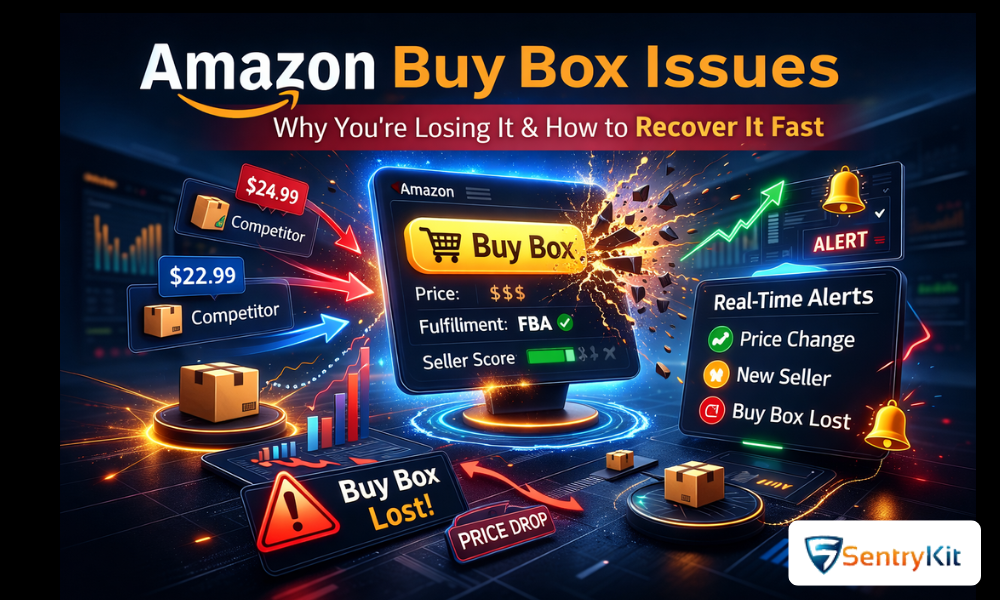
Losing the Amazon Buy Box can immediately impact your sales, visibility, and conversions. Since the majority of purchases happen directly through the Buy Box, even a short disruption can lead to lost revenue and declining listing performance. For sellers competing in crowded categories, Buy Box stability is critical to maintaining consistent growth.
In this guide, we break down what causes Amazon Buy Box issues, the most common problems sellers face, and how to quickly recover and prevent future losses using smarter monitoring and automation.
The Amazon Buy Box is the section on a product detail page where customers can directly click “Add to Cart” or “Buy Now.” It’s the default purchase option, and most shoppers never scroll down to view other sellers.
For many listings:
Over 80% of sales come through the Buy Box
Mobile users almost exclusively purchase via the Buy Box
Listings without a Buy Box see drastic conversion drops
When you lose the Buy Box, your product doesn’t disappear—but your visibility and ability to convert customers drop significantly. Competitors who win the Buy Box gain immediate advantage in both sales and ranking.
Understanding the types of Buy Box issues is the first step toward fixing them effectively.
In some cases, Amazon removes the Buy Box entirely. This typically happens when pricing is deemed uncompetitive or when there are issues with the listing. Instead of showing a primary seller, Amazon may display multiple offers without a clear winner.
One of the most common issues is losing the Buy Box to a competitor. This can happen due to better pricing, faster fulfillment, or stronger seller metrics.
When multiple sellers qualify, Amazon rotates the Buy Box between them. While this may seem fair, it creates inconsistent sales patterns and makes forecasting difficult.
Many sellers assume the lowest price guarantees the Buy Box. However, Amazon considers several factors beyond pricing, including fulfillment speed and account health.
Some sellers experience situations where the Buy Box appears and disappears throughout the day. This is often caused by fluctuating inventory, pricing changes, or competitor activity.
Several factors influence Buy Box eligibility, and even small changes can lead to loss or suppression.
Amazon prioritizes competitive pricing, but this doesn’t mean the lowest price always wins. Pricing too high can disqualify you, while pricing too low can trigger suppression if Amazon suspects it may harm customer trust.
External price mismatches (e.g., your product being cheaper on another website) can also result in Buy Box loss.
Fulfillment plays a major role in Buy Box eligibility. Sellers using Fulfilled by Amazon (FBA) often have an advantage due to:
Faster shipping
Reliable delivery
Better customer experience
FBM sellers can still win the Buy Box, but they must maintain exceptional shipping performance.
Amazon evaluates seller health using key metrics such as:
Order defect rate
Late shipment rate
Cancellation rate
Customer feedback
Even slight dips in these metrics can reduce your chances of winning or retaining the Buy Box.
Stock levels directly impact Buy Box ownership. Running low on inventory or going out of stock can immediately cause you to lose the Buy Box.
Once lost, it may take time to regain even after restocking.
Incomplete or inconsistent listings can negatively affect Buy Box eligibility. This includes:
Missing product details
Incorrect categories
Variations not properly structured
Amazon favors listings that provide a clear and reliable customer experience.
New sellers entering your listing can disrupt Buy Box stability. Unauthorized sellers or hijackers often compete aggressively on price, making it harder to maintain control.
One of the biggest challenges sellers face is delayed detection. Many rely on manual checks, which can result in hours—or even days—of unnoticed Buy Box loss.
By the time the issue is identified:
Sales have already dropped
Competitors have gained traction
Rankings may have declined
Buy Box ownership changes
Sudden price fluctuations
New sellers appearing on listings
Buy Box suppression
Manual monitoring is not scalable, especially for sellers managing multiple SKUs.
This is where automation becomes critical. Real-time alerts allow you to instantly detect Buy Box changes and respond before performance is affected.
Once you identify a Buy Box issue, taking immediate action is key.
Review competitor pricing and ensure your offer remains competitive. Avoid drastic underpricing, as it can harm margins and trigger suppression.
If possible, switch to FBA to increase your chances. If using FBM, focus on:
Faster shipping times
Reliable delivery
Lower handling times
Monitor your account health and resolve issues proactively. Focus on:
Reducing defects
Improving feedback
Ensure your product listings are complete, accurate, and optimized. Small inconsistencies can impact Buy Box eligibility more than expected.
If hijackers are present, take immediate action to remove them. This helps stabilize pricing and regain Buy Box control.
Avoid stockouts by forecasting demand and replenishing inventory on time. Consistent availability improves Buy Box retention.
Fixing issues is important—but prevention is what drives long-term success.
Monitor listings continuously
Use automated repricing strategies
Maintain strong seller metrics
Keep inventory levels stable
Track competitor activity
Most importantly, sellers need visibility into changes as they happen—not after the damage is done.
Buy Box conditions can change at any moment. Without automation, sellers are always reacting late.
Real-time alerts provide:
Instant notification of Buy Box loss
Visibility into competitor actions
Tracking of pricing changes
24/7 monitoring without manual effort
This allows sellers to respond immediately and minimize revenue impact.
Amazon Buy Box issues are one of the most critical challenges sellers face. Losing the Buy Box—even temporarily—can significantly impact sales, rankings, and overall performance.
By understanding the causes, monitoring listings proactively, and taking fast corrective action, sellers can recover quickly and maintain consistent growth.
The key is shifting from reactive fixes to proactive monitoring—ensuring you always stay one step ahead of potential issues.
You can lose the Amazon Buy Box due to several factors, including uncompetitive pricing, poor seller performance metrics, slower fulfillment methods, or low inventory levels. Increased competition from other sellers or unauthorized sellers on your listing can also impact Buy Box ownership. Monitoring these factors consistently is key to identifying the exact cause.
Buy Box suppression usually happens when Amazon determines that the listing does not offer a competitive or reliable customer experience. This can be due to high pricing, inconsistent listings, low seller ratings, or external price mismatches. When suppressed, Amazon removes the Buy Box entirely instead of awarding it to a seller.
To recover the Buy Box quickly, you should adjust your pricing to stay competitive, improve your fulfillment method (preferably FBA), maintain strong seller metrics, and ensure your inventory is in stock. Identifying the root cause early using real-time alerts can significantly reduce recovery time.
No, the lowest price does not guarantee the Buy Box. Amazon considers multiple factors, including fulfillment speed, seller performance, shipping time, and overall customer experience. A slightly higher price with better fulfillment and metrics can still win the Buy Box.
Yes, Amazon may rotate the Buy Box among multiple eligible sellers. This is known as Buy Box rotation. However, this can lead to inconsistent sales and reduced predictability, especially in highly competitive listings.
The time required to regain the Buy Box depends on the issue. Pricing adjustments may show results within hours, while improvements in seller metrics or inventory restocking can take longer. Faster detection typically leads to quicker recovery.
Using Fulfilled by Amazon (FBA) increases your chances of winning the Buy Box, but it does not guarantee it. Sellers must still maintain competitive pricing, strong performance metrics, and consistent inventory levels.
Manual monitoring is time-consuming and often delayed. Most sellers use automated tools or real-time alerts to track Buy Box ownership, pricing changes, and new sellers on their listings. This helps detect issues instantly and take action before sales are impacted.
Yes, unauthorized sellers or hijackers can compete for the Buy Box, often undercutting prices or affecting listing stability. Detecting and removing them quickly is essential to maintaining Buy Box control and protecting your revenue.
The best way to prevent Buy Box issues is through continuous monitoring, competitive pricing strategies, strong seller performance, and maintaining healthy inventory levels. Using real-time alerts ensures you can respond immediately to any changes.