
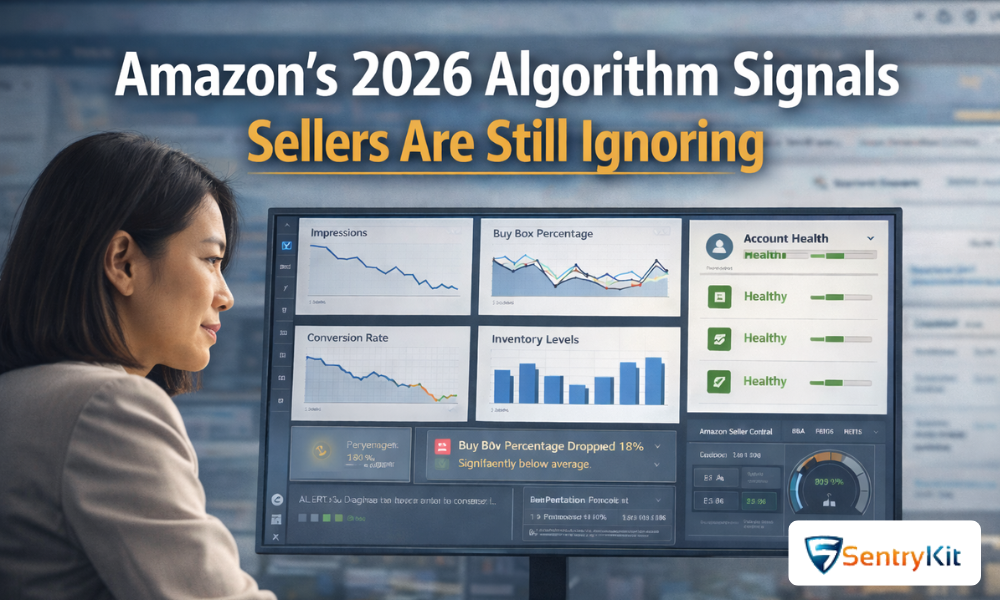
Amazon’s marketplace in 2026 looks familiar on the surface—but underneath, the Amazon algorithm 2026 operates very differently from what most sellers still assume. Listings don’t lose visibility overnight because of one mistake. They decline slowly due to signals sellers fail to see, track, or understand.
In this guide, we break down the Amazon ranking factors 2026 that actually matter today, why sellers miss them, and how a lack of visibility quietly erodes performance even when nothing “seems wrong.” This is both a technical and strategic playbook designed to help sellers protect rankings before damage compounds. Sellers relying on a proactive amazon seller monitoring tool are far more likely to detect these signals before rankings and revenue are affected.
The Amazon algorithm 2026 is no longer reactive. It is predictive. Instead of rewarding sudden optimization, it evaluates patterns over time—looking for sellers who consistently deliver low-risk, high-confidence buying experiences.
Unlike earlier years, Amazon ranking factors 2026 emphasize:
Stability over spikes
Consistency over velocity
Trust over tactics
This shift is why many sellers experience declining impressions or Buy Box rotation without changing price, ads, or listings—especially when they are not using an amazon seller monitoring tool to track real-time performance changes.
Behavioral data is now one of the most powerful inputs in the Amazon algorithm 2026. Amazon watches how buyers interact, not just whether they buy.
Key behavioral ranking factors include:
Amazon tracks how reliably a listing converts across time—not just during promotions. Drops in conversion consistency reduce algorithmic confidence.
Scroll depth, image interaction, A+ engagement, and time-on-page all influence visibility under Amazon ranking factors 2026.
Increased returns, refunds, or customer contacts weaken trust signals—even when reviews remain positive.
In 2026, Buy Box ownership is no longer binary. The Amazon algorithm 2026 evaluates Buy Box stability over time, not just eligibility.
Frequent Buy Box rotation—even without price changes—signals:
Fulfillment inconsistency
Inventory risk
Service performance volatility
This directly impacts organic ranking strength.
One of the most underestimated Amazon ranking factors 2026 is inventory continuity.
Even short stockouts now cause long-tail visibility damage.
Why?
The algorithm recalibrates demand trust
Recovery requires renewed conversion confidence
Sponsored data no longer fully offsets organic loss
This is why sellers often report rankings not recovering weeks after restocking.
Amazon algorithm 2026 heavily weights delivery reliability. This includes:
Late shipment rate trends
Regional delivery variance
Prime promise consistency
Even when metrics stay within “acceptable” thresholds, negative trends are still detected.
While Amazon claims account health does not directly affect rankings, Amazon ranking factors 2026 clearly show correlation.
Suppressed listings, unresolved warnings, or repeated minor violations reduce:
Buy Box exposure
Search placement confidence
Algorithmic tolerance for performance dips
Most sellers still rely on:
Periodic manual checks
Delayed reports
Surface-level dashboards
But the Amazon algorithm 2026 responds to real-time signal drift, not static snapshots.
This creates silent losses when sellers:
Miss listing suppressions
Don’t notice Buy Box rotation
React after impressions decline
One of the most misunderstood concepts in the Amazon algorithm 2026 is algorithmic trust recalibration. Sellers often see the term used vaguely, but rarely explained clearly.
Algorithmic trust recalibration is Amazon’s process of continuously re-evaluating how much visibility, traffic, and Buy Box exposure a seller deserves based on recent performance patterns—not isolated events.
In simple terms, Amazon is constantly asking:
Can this seller be trusted to deliver a predictable buyer experience?
Are recent signals improving, stable, or declining?
How much risk does this listing introduce compared to alternatives?
This recalibration happens automatically and quietly, often without alerts.
Under modern Amazon ranking factors 2026, trust is influenced by:
Consistency of conversion rates over time
Inventory reliability (avoiding stockouts and restock volatility)
Buy Box stability rather than short-term wins
Fulfillment performance trends, not just pass/fail metrics
Post-purchase behavior, including returns and customer contacts
A single issue rarely causes damage. Instead, small negative signals compound, triggering recalibration.
Sellers often miss this process because:
There is no Seller Central alert for “trust loss”
Metrics remain technically within acceptable limits
Sales decline gradually, not suddenly
Without an amazon seller monitoring tool, sellers only notice recalibration after impressions, rankings, or Buy Box share have already dropped.
Real-world symptoms include:
Reduced impressions despite unchanged listings
Slower Buy Box rotation recovery
Sponsored ads converting worse than before
Rankings failing to rebound after restock or fixes
These are not random. They are outcomes of algorithmic trust recalibration.
Sellers often say:
“We didn’t change anything—so why did sales drop?”
Under Amazon algorithm 2026, something always changed. It just wasn’t visible without proper monitoring.
Invisible changes include:
Fulfillment SLA shifts
Buyer behavior drift
Algorithmic trust recalibration
To stay competitive, sellers must shift from optimization to risk prevention.
Monitor signals daily, not weekly
Track trends, not thresholds
Protect consistency over growth bursts
This is how modern sellers align with Amazon ranking factors 2026.
The Amazon algorithm 2026 no longer rewards sellers who react late. It rewards those who see problems early, maintain consistency, and eliminate blind spots. Sellers who understand modern Amazon ranking factors 2026 don’t chase visibility—they protect it.
The Amazon algorithm 2026 prioritizes long-term buyer trust signals, behavioral consistency, fulfillment reliability, and inventory stability.
Yes. Amazon ranking factors 2026 focus less on keyword manipulation and more on sustained performance patterns.
Indirectly. Account health issues reduce algorithmic confidence and Buy Box exposure.
Because Amazon algorithm 2026 reacts to external signals like behavior, inventory, and fulfillment—not just listing edits.
Through continuous monitoring and alerts instead of manual checks.