
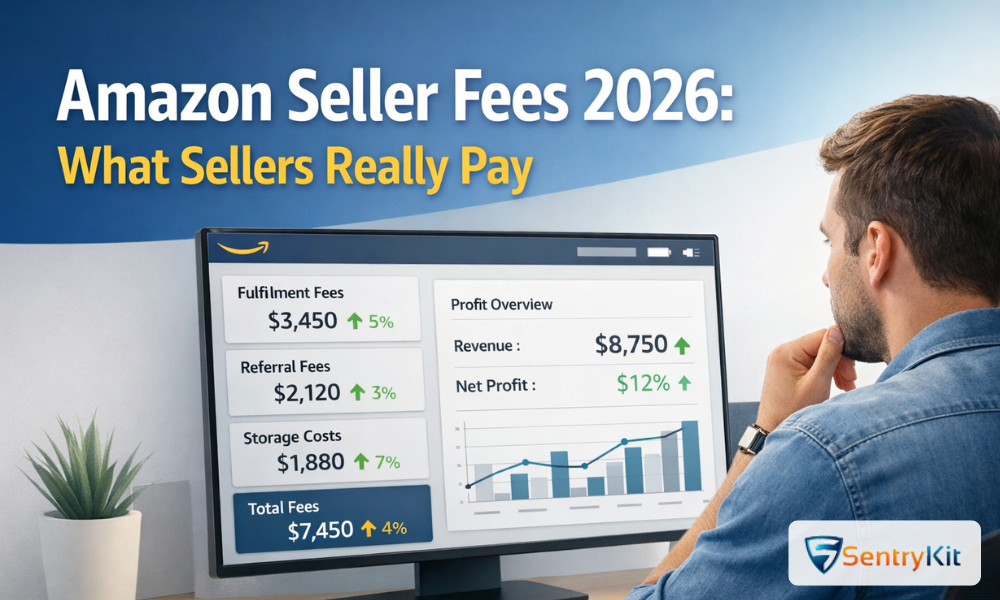
If you’re selling on Amazon in 2026, understanding Amazon seller fees 2026 isn’t optional — it’s essential.
Between incremental fee increases in the U.S. and major structural shifts globally, 2026 will see more sellers reevaluate profitability, pricing models, and inventory strategies. In some regions, Amazon is even reducing referral and fulfillment costs for specific categories while elsewhere fees are nudging up slightly.
Understanding Amazon seller fees in 2026 also requires visibility into how those fees affect listings, inventory, and fulfillment performance in real time, which is why many sellers rely on an Amazon monitoring tool to track silent cost and performance changes.
By the end of this guide you’ll understand:
What fees have changed (and why)
How different fee types impact your bottom line
Fee strategies for profitability in 2026
How to plan pricing and cost management better
Let’s dive in.
Referral fees are the commission Amazon takes on every sale. Unlike prices or promotions, referral fees are a cut of the final transaction.
In the U.S., Amazon will not introduce new referral fee types in 2026. However, granular fee tiers may shift costs depending on fulfilment and product value.
In Europe, referral fee reductions are being rolled out in multiple categories — especially for clothing, accessories, home products, groceries, and pet items. Certain rates drop significantly for lower-priced products (e.g., 5% for smaller items).
💡 Tip: Always check your category’s referral fee in Seller Central because the minimum fee floor and percentage can vary widely by category and nation.
Amazon charges fulfillment fees per unit shipped through FBA, covering picking, packing, and delivery.
In the U.S., Amazon announced that:
Average fulfillment fees increased by approximately $0.08 per unit across all size tiers.
What this means in practice:
Small standard items ($10–$50) may see small increases (e.g., ~$0.25 per unit).
Large standard items may see modest increases too (e.g., ~$0.05 per unit).
Even small per-unit increases add up fast. For example, if you sell 10,000 units per month and your average fee rises just $0.08 per unit, that’s an extra $800/month or $9,600/year in fulfillment costs. If you’re comparing costs year over year, it helps to review how Amazon structured pricing previously — especially when analyzing Amazon FBA fees in 2025 and how those changes set the foundation for 2026.
📌 Remember: Amazon uses the greater of actual weight or dimensional weight (L × W × H ÷ 139) to calculate fulfillment fees — and 2026 tightened dimensional weight rules. Always measure your fully packed box, not just the product.
There’s good news for sellers of inexpensive products.
Amazon introduced expanded low-price discounts in place of older Small & Light programs.
In Europe, certain low-price fulfillment fees are being lowered significantly (e.g., by ~£0.40/€0.45 on items priced below £20/€20).
In the U.S., products under $10 now get a reduced per-unit fee (~$0.86 less on average), which can improve margin for high-velocity low-price sellers.
💡 Pro tip: These reduced low-price fees can create an unexpected competitive edge if your pricing and inventory strategy are aligned. (source)
Unlike some other 2026 changes, monthly storage fees have remained stable in the U.S. with no major increases announced.
However:
Europe may adjust monthly storage fee structures as part of broader fee realignments.
Storage fees remain heavily seasonal — expect peak (Oct–Dec) rates to still be significantly higher.
📌 Tip: Minimizing aged inventory can drastically reduce costs — particularly for long-term or slow-moving SKUs.
Amazon’s new cost structure now accounts more strictly for dimensional weight — especially for large, lightweight items.
2026 introduces or expands:
Sustainability handling fees for non-eco packaging ($0.03–$0.18/unit)
Inbound defect fees for misrouted, mislabeled, or incomplete shipments — now much higher than in previous years.
New size tier handling (e.g., small bulky) that can raise fulfillment costs if SKUs are misclassified.
Amazon introduced a new Long-Term Storage Lite tier for aged inventory (365–730 days), offering more nuanced aged inventory charges.
Average fulfillment fee increase of ~$0.08 per unit
No new fee types, but enhanced granularity in cost tiers
Fee reductions on referral and fulfillment fees in key categories like clothing, home products, groceries, and pet supplies
New low-price FBA eligibility expanded
Specific store-level breakdowns for Europe vary by country, so always check Amazon’s local fee tables in Seller Central for precise numbers.
Even small fee changes can squeeze margins if you’re unaware of them.
A 2.5% increase in fulfillment costs adds up if you run high-volume SKUs.
Lower low-price fees can boost margin for high turnover, low-price items.
Dim weight increases hit oversized items harder than heavy ones of similar weight.
📌 Best strategy: Always calculate net profit after all fees, not just referral and fulfillment. This includes storage, packaging, inbound, defect, and sustainability fees.
Fee cliffs can wipe out margin if you price inside a “dead zone” where fees jump. Sellers should consider dynamic pricing based on fee tier impact.
Avoid unexpected oversized fees by verifying exact measurements — sometimes a few millimeters make a big fee difference.
Eco-eligible and SIPP-compliant packaging can reduce sustainability and packaging fees.
Careful labeling and shipment prep reduce defect penalties that can sneak up on you.
Use tools or alerts to reduce inventory aging past key thresholds — older inventory costs more.
Amazon seller fees 2026 aren’t just price tags — they’re signals about where Amazon’s priorities lie and where seller strategy must adapt.
Some fees increase slightly (like fulfillment), others decrease dramatically (like low-price FBA), and new categories of fees (like sustainability or inbound defects) make proactive management essential.
Understanding these changes isn’t about reacting — it’s about planning:
Pricing strategies
Inventory forecasting
SKU profitability models
Packaging decisions
Fulfillment strategy
Sellers who integrate fee awareness into their workflow will be far better positioned to protect margins and scale sustainably in 2026 and beyond.
The biggest Amazon seller fee changes in 2026 include slight increases to FBA fulfillment fees in some regions, expanded low-price FBA discounts, tighter dimensional weight calculations, and new cost components such as sustainability and inbound defect fees. While not all fees increased, the overall fee structure became more granular and performance-dependent.
Yes, Amazon increased average FBA fulfillment fees slightly in 2026, with an estimated increase of around $0.08 per unit in the U.S. However, Amazon also introduced lower fulfillment fees for low-priced items, meaning some sellers may actually see reduced costs depending on product type and pricing.
In many cases, Amazon seller fees in 2026 are marginally higher than in 2025, particularly for standard and oversized FBA items. That said, certain categories and low-price products benefit from reduced referral or fulfillment fees, especially in European marketplaces.
Sellers can reduce Amazon FBA costs in 2026 by optimizing product dimensions, avoiding aged inventory, pricing products to benefit from low-price FBA discounts, using eco-friendly packaging, and actively monitoring fee changes and shipment defects that can trigger unexpected charges.
Yes, Amazon seller fees vary significantly by marketplace in 2026. The U.S., UK, and EU markets have different referral rates, fulfillment costs, and discount programs. Sellers should always review local Seller Central fee tables before expanding internationally.