
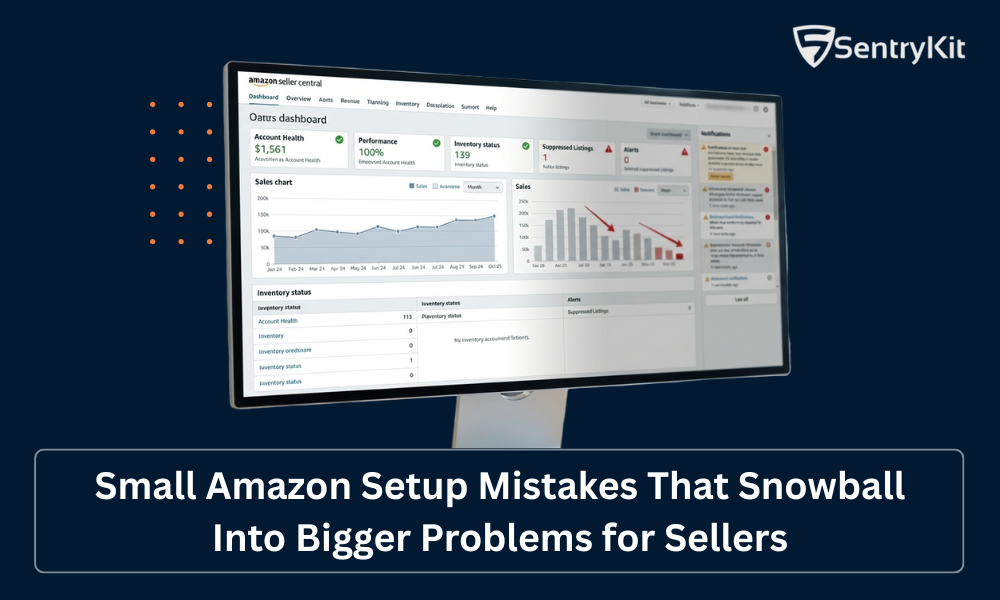
Setting up an Amazon seller account looks simple on the surface. Create an account, list products, ship inventory, and start selling.
But for many sellers, the biggest problems don’t come from advanced strategies or aggressive competition—they come from small Amazon setup mistakes made in the early days. These mistakes often go unnoticed until they snowball into:
Listing suppressions
Buy Box instability
Account health warnings
Sudden sales drops
Risk of suspension
Many Amazon sellers underestimate how small setup decisions can quietly snowball into serious problems over time. From incomplete listing settings to ignored performance notifications, these early missteps often go unnoticed—especially without an Amazon monitoring platform to track listing changes, policy alerts, and account-level risks before they escalate.
Amazon’s systems are automated and cumulative.
That means:
Minor issues stack over time
Performance metrics compound
Policy flags don’t always reset on their own
A seller can operate for months thinking everything is fine—until Amazon enforces all those small issues at once.
Understanding setup errors early is one of the most effective ways to protect long-term account health.
One of the earliest Amazon setup mistakes happens before the first product is even listed.
Common issues include:
Mismatched business names across documents
Incorrect tax classification
Outdated address or banking information
Why this snowballs:
Triggers verification delays
Can cause payout holds
Raises red flags during compliance reviews
Fix: Review your Seller Central account info quarterly and update changes immediately.
Many sellers list products without fully understanding category restrictions.
This often leads to:
Listing removals
Policy warnings
Restricted ASINs
Certain categories require:
Approval documentation
Safety certifications
Brand authorization
What starts as a simple listing mistake can later affect account health and selling privileges.
Messy inventory setup creates long-term operational problems.
Examples:
Inconsistent SKU naming
Duplicate SKUs across marketplaces
No internal SKU logic
Why it matters:
Makes troubleshooting harder
Increases fulfillment errors
Complicates performance analysis
Clean inventory structure is foundational for scaling safely.
Shipping templates are often left untouched during setup.
This leads to:
Unrealistic handling times
Late shipment rate increases
Negative buyer experience
Even FBA sellers aren’t immune—merchant-fulfilled backup offers still rely on accurate shipping settings.
Rushing listings live is a common Amazon setup mistake.
Problems include:
Missing attributes
Generic bullet points
Poor image compliance
Early listing quality impacts:
Indexing
Conversion rate
Long-term listing authority
Fixing a weak listing later is harder than launching it correctly.
Many sellers assume listings stay static.
In reality, listings change due to:
Amazon AI edits
Catalog merges
Competing sellers updating shared listings
Without monitoring, sellers often discover issues only after sales drop.
This is where an Amazon listing monitoring tool helps detect unexpected changes early.
New sellers often focus only on sales—not metrics.
Key metrics ignored:
Order Defect Rate (ODR)
Late Shipment Rate
Valid Tracking Rate
Small early failures here can permanently weaken account trust.
Many Seller Central warnings are easy to miss.
Without alerts, sellers may:
Miss policy warnings
Ignore suppressed listings
Fail to act within appeal deadlines
Using proactive Amazon alerts helps prevent small issues from becoming suspensions.
Early pricing mistakes include:
No minimum price limits
Reactive price drops
Ignoring fees
These mistakes can:
Kill margins
Lose Buy Box eligibility
Trigger pricing flags
Smart pricing tools help sellers compete without destructive price wars.
The biggest setup mistake of all is assuming Amazon runs itself.
Amazon requires:
Ongoing monitoring
Policy awareness
Performance tracking
Sellers who succeed long-term treat setup as an evolving foundation—not a one-time task.
The good news: most Amazon setup mistakes are fixable—if caught early.
Best practices:
Audit account settings quarterly
Monitor listings and performance daily
Use alerts for critical changes
Document processes as you scale
Learn how seller monitoring tools help prevent costly surprises on our Amazon monitoring solutions page.
Advanced strategies won’t save a poorly set-up seller account.
By fixing small Amazon setup mistakes early, sellers protect:
Account health
Buy Box eligibility
Long-term growth potential
The strongest Amazon businesses aren’t built on hacks—they’re built on solid fundamentals, consistent monitoring, and proactive risk management.
If you’re serious about scaling in 2025 and beyond, make sure your foundation isn’t quietly working against you.
For official requirements and updates, always refer to Amazon Seller Central documentation.